

Why Choose Family Owned Plumbing: A Homeowner’s Guide

Table of Contents
- What Makes Family Owned Plumbing Different?
- Hiring Local vs National Plumbing Companies: What Homeowners Need to Know
- Questions to Ask a Plumbing Contractor Before You Hire
- Plumbing Maintenance Tips for Minnesota Winters
- The Long-Term Benefits of a Family Owned Plumbing Relationship
- Why Brass Tacks Plumbing Does It This Way
- Frequently Asked Questions
Last Updated: September 14, 2026
What Makes Family Owned Plumbing Different?
Why choose family owned plumbing? Because the person who answers your call often has their name on the truck. Family owned plumbing is a residential service business where the owners live in the communities they serve, carry personal liability for the work, and depend on repeat customers rather than one-time transactions. At Brass Tacks Plumbing, we work this way every day across Plymouth, Wayzata, and the rest of the West Metro.
The practical gap comes down to incentives. A family owner who botches a water heater install in Minnetonka will hear about it at the grocery store. A call center dispatching a rotating crew of subcontractors has no such pressure. According to the Better Business Bureau’s guidance on hiring contractors, checking a company’s complaint history and ownership structure is one of the most reliable ways to predict how they handle problems.
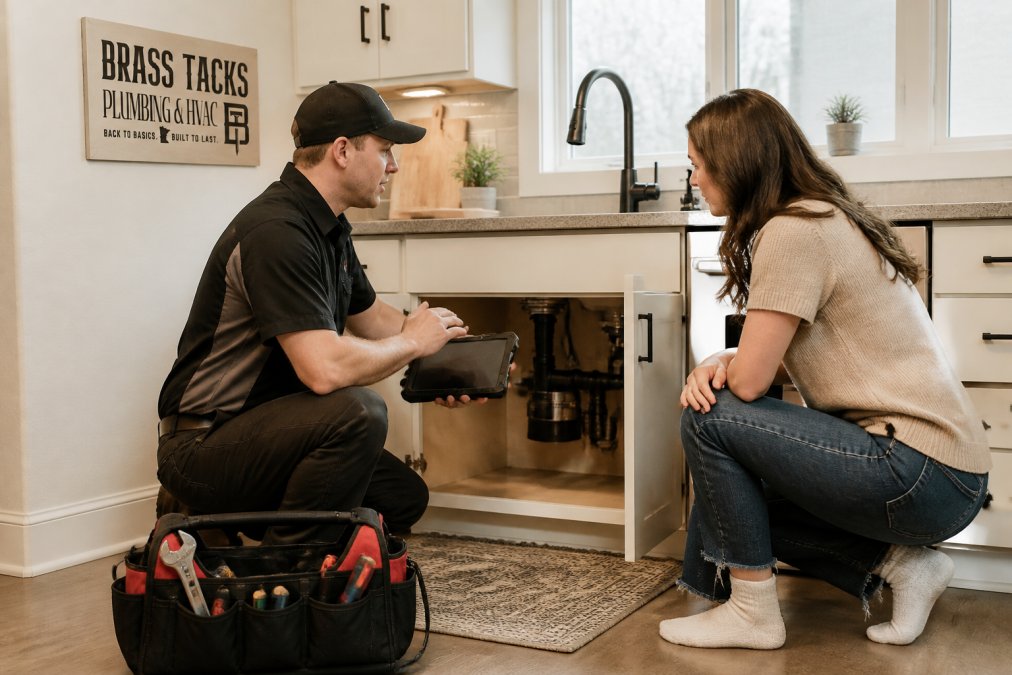
The Accountability Factor: Who Actually Answers When Something Goes Wrong
When a repair fails, a family owned company feels it directly. There is no corporate escalation queue, no regional manager to absorb the complaint. You call the same number, reach the same people, and the owner has a personal stake in making it right.
That structure creates accountability a franchise model struggles to copy. With a family operation, the owner usually knows which technician is coming to your house.
Hiring Local vs National Plumbing Companies: What Homeowners Need to Know
Local and national plumbing companies differ most in accountability, pricing transparency, and follow-through. National franchises bring standardized processes and broad availability. Local family businesses bring owner-level accountability, knowledge of area housing stock, and a reputation they cannot afford to damage.
Here is how the two compare on the factors homeowners ask about most:
| Factor | Family Owned Local | National Franchise |
|---|---|---|
| Who handles complaints | Owner, directly | Call center, regional chain |
| Pricing structure | Often upfront, quoted on site | Standardized tiers, varies by franchise |
| Knowledge of local housing | Deep, area-specific | General, script-based |
| Emergency response | Depends on crew size | Broader coverage network |
| Long-term relationship | Same faces, same standards | Technician rotation |
| Ownership | Owner lives in the service area | Often a franchisee, investor group, or holding company |
| Where the money goes | Stays with the owner, local payroll, and local suppliers | Franchise fees, royalties, and out-of-state corporate overhead |
One honest limitation: a small family shop may have fewer crews available during a January cold snap when every furnace in the neighborhood quits at once. A national network can sometimes pull in technicians from other regions. That trade-off is worth weighing against the accountability you get the rest of the year.
Where Your Money Actually Goes
When you pay a locally owned plumbing company, that money recirculates close to home. It pays the technician who was in your basement, the dispatcher who took your call, the local supplier who stocked the part, and the owner who lives a few miles away. That owner also pays property taxes and hires from the same labor pool your neighbors work in.
When you pay a private equity-backed or franchise operation, a meaningful share of that invoice leaves the community. Franchise models route a percentage of revenue back to the franchisor as royalty and marketing fees, and private equity-backed companies send profits to investors who may have never set foot in the state. Neither model is automatically bad, but the economic footprint is different.
How to Tell If a Company Is Actually Family Owned
Plenty of companies use the phrase “family owned” as branding while operating under an investment group. Run through this checklist before you book a service call.
- Check the ownership page, not just the homepage. A real family operation usually names the owners, often with a photo and a short bio. If the site says “our family of brands” or “part of the [company] network,” that is a different structure.
- Look up the business on your state’s Secretary of State business search. You can see who the registered agent and officers are, and whether the entity is owned by a holding company or an out-of-state LLC.
- Ask who signs the paychecks for the technician coming to your home. Family owned shops answer in one sentence. Corporate-backed operations often pivot to “our local team.”
- Read the reviews for ownership names. If customers mention the owner by name across multiple reviews over several years, that is a strong signal the owner is actually present in the business.
- Check how long the company has operated under the same name and ownership. A recent rebrand with a folksy new logo is worth a second look.
- Ask about the warranty and who honors it. A family owner who plans to be around for the next decade will stand behind the work. A company optimizing for a near-term sale may not.
If a company cannot name its owner, says it is “part of a larger family of brands,” or routes every question through a national call center, you are likely talking to a private equity-backed or franchise operation. Expect higher-pressure sales tactics and technician commissions tied to upsells.
Why This Matters More Than It Used To
Over the past decade, many independent plumbing, HVAC, and electrical companies have been acquired by private equity firms and rolled into regional platforms. The trucks often keep the original name and logo for a year or two after the sale, which is why homeowners are surprised to learn their “local” plumber is now owned by an out-of-state fund. Knowing how to check ownership is the most useful skill a homeowner can develop when hiring in this category.
If you want to see how a locally owned shop operates day to day, you can read more about our plumbing services and how we handle emergency plumbing calls across the West Metro.
Questions to Ask a Plumbing Contractor Before You Hire
Before hiring any plumbing contractor, ask five questions: who owns the business, who will actually do the work, how pricing is determined, what happens if the repair fails, and whether the technician is licensed and insured. The answers separate straightforward operators from ones that will surprise you later.
- Who owns this company, and do they live in the area? A family owner will answer immediately.
- Will the person quoting my job be the person doing it? This matters for accuracy and accountability.
- Is the price quoted upfront, or does it change once work starts? Upfront pricing protects you from surprises.
- What is your process if the repair does not hold? A real warranty or callback policy should come with a clear answer.
- Are your technicians licensed and insured? Ask to see it. Legitimate companies expect the question.
What a Straight Answer Sounds Like
A trustworthy contractor answers these questions in plain language without deflecting. If you ask about pricing and get “it depends” with no follow-up, that is a red flag. So is a story about a parent company when you ask who owns the business.
The Federal Trade Commission’s consumer advice on home improvement recommends getting everything in writing, including the scope of work and total cost, before any work begins. Family owned shops tend to welcome that request because their reputation depends on the paperwork matching the work.
Ask for the license number and verify it with your state or local licensing authority before work starts. It takes two minutes and eliminates a whole category of risk.
Plumbing Maintenance Tips for Minnesota Winters
Minnesota winters put residential plumbing under real stress. Water lines in exterior walls, unheated crawl spaces, and garages are the first to freeze, and a burst pipe in January is one of the most expensive emergencies a homeowner can face. A few preventive steps in fall go a long way.
- Disconnect garden hoses and shut off exterior spigots before the first hard freeze.
- Insulate pipes in unheated spaces like crawl spaces, attics, and garages.
- Keep cabinet doors open under sinks on exterior walls during deep cold snaps.
- Know where your main water shutoff is located and test that it turns freely.
- Schedule a fall inspection of your water heater before heating season begins.
Older homes around Plymouth and Wayzata often have original plumbing from the 1970s or earlier. Galvanized steel lines corrode from the inside out, and the first hard freeze can expose a weak spot. If your home is in that category, a seasonal walkthrough with a plumber who knows the area’s housing stock is worth the time.
The Long-Term Benefits of a Family Owned Plumbing Relationship
A long-term relationship with a family owned plumbing company compounds in value, but not for the reason most articles suggest. The real benefit is not that someone remembers your name. It is that the incentives line up around keeping your whole system healthy instead of selling you the biggest job on every visit.
Why the Incentives Are Different
A technician working on commission for a large platform has a reason to recommend the highest-margin option on every call. A family owner who plans to be in business in your neighborhood for the next twenty years has the opposite incentive. They want your water heater to last its full service life, your drains to stay clear, and your furnace to make it through another Minnesota winter without a middle-of-the-night failure, because the callback and the reputation hit land on them.
In practice, this shows up in a few specific ways:
- Repair versus replace guidance that actually favors repair when repair is the right call. A family shop will tell you a fifteen-year-old water heater with a failed element is worth replacing, and will also tell you a six-year-old unit with a bad thermocouple is worth fixing.
- Maintenance recommendations tied to your home, not a script. A house in Wayzata with original galvanized lines and a house in Maple Grove built in the 2000s need different attention. A long-term provider tracks that.
- Fewer surprise upsells during routine calls. When the same owner reviews the work, pressure tactics get noticed and corrected.
- Honest timing on big-ticket replacements. If your furnace has another two seasons in it, a family owner is more likely to say so than to push a replacement today.
What Long-Term Maintenance Actually Looks Like
A relationship with a family owned plumbing and HVAC company is not just about emergency calls. It is about a maintenance rhythm that matches how homes in this climate fail.
- Fall: exterior spigot shutoff, pipe insulation check in crawl spaces and garages, water heater flush and anode rod inspection, furnace tune-up before the first hard freeze.
- Winter: watch for reduced flow at fixtures on exterior walls, keep cabinet doors open during deep cold snaps, know where the main shutoff is.
- Spring: check for freeze damage that did not show up until thaw, inspect the sump pump before heavy rain season, look at water pressure and any new discoloration.
- Summer: water heater efficiency check, water quality review if you notice hardness or taste changes, AC tune-up before the first heat wave.
A provider who has been in your home across multiple seasons can spot the difference between a normal aging pattern and something that needs attention now. That is hard to replicate when every visit starts with a new technician reading a fresh work order.
The Compounding Effect Over Years
Customer retention in this model is driven by trust, not contracts. You keep calling because the work held up and the price matched the quote. Over several years, that relationship gives you a provider who can advise on water heater replacement timing, whether a repipe is worth considering, and whether a repair or replacement makes more sense. They also know which upgrades are genuinely useful in a Minnesota home and which are not.
If you want to see how this plays out in specific services, you can read about our approach to water heater replacement, furnace repair, and water quality work in the West Metro.
The real value of a family owned plumbing relationship is not a single discounted repair. It is having someone who knows your home, tracks how it ages, and tells you the truth about what it needs next.
Why Brass Tacks Plumbing Does It This Way
Brass Tacks Plumbing, Heating & Cooling is family owned and operated, and that shapes how we run every call. We give upfront pricing before work starts, we do not use sales pressure to push unnecessary replacements, and our licensed technicians treat your home the way they would treat their own.
We serve homeowners across the West Metro, from water heater replacement to furnace repair and emergency plumbing. When you call, you get clear communication about what is wrong, what it takes to fix it, and what it costs.
If you want a second opinion on a repair another company quoted, we will give you one honestly. Sometimes that means telling you the work is not needed yet.
Frequently Asked Questions
What are the primary benefits of hiring a family owned plumbing company?
Family owned plumbing companies tie their livelihood to their local reputation, so accountability is personal. You typically get direct access to the owner when something goes wrong, consistent technicians who remember your home, and pricing that reflects long-term relationships rather than quarterly sales targets. In the West Metro, that often means a plumber who knows the older housing stock in Plymouth and Minnetonka and can recommend repairs instead of replacements when that is the honest answer.
How does local ownership impact the quality of plumbing repairs?
Local owners live and work in the same communities they serve, so a failed repair follows them around town. That pressure produces careful workmanship and honest recommendations. Local companies also build familiarity with area-specific problems, from frozen pipes during Minnesota cold snaps to aging galvanized lines in mid-century homes. National franchises rotate technicians and follow standardized scripts, which can mean less flexibility when your home does not fit the template.
Are family owned plumbing businesses more accountable to homeowners?
They usually are, because the owner’s name and reputation are on every job. If a water heater replacement fails or a repair does not hold, you can reach the person who owns the business rather than a call center. That direct line creates a stronger incentive to make things right. Ask any company you consider who owns it, who handles complaints, and whether the same technicians will return for follow-up work.
What should I look for when vetting a local plumbing and HVAC contractor?
Confirm licensing and insurance, ask for the owner’s name, and request a written scope of work before anything starts. Ask whether pricing is upfront or hourly, and who to call if the repair fails. A trustworthy contractor explains what is wrong in plain language and gives you options rather than one pressure-filled recommendation. For older West Metro homes, ask specifically about experience with original plumbing and heating systems.
Plumbing problems rarely wait for a convenient moment, and finding a contractor you trust in the middle of one is stressful. Brass Tacks Plumbing offers upfront pricing, honest recommendations without sales pressure, and licensed technicians who respect your home. Whether you need a water heater repaired, a furnace checked before winter, or a second opinion on a big quote, we are here to help. Get started with Brass Tacks Plumbing and get straight answers about what your home actually needs.
