

How to Get an Upfront Plumbing Price Quote

Table of Contents
- Why Upfront Plumbing Price Quotes Matter
- How to Request an Accurate Plumbing Quote
- What a Detailed Plumbing Estimate Should Include
- Flat Rate vs Hourly Plumbing Pricing: Which Is Better?
- How to Avoid Hidden Fees and Surprise Costs
- Key Questions to Ask a Plumber Before Hiring
- Your Checklist for Comparing Plumbing Quotes
- Get Your Upfront Plumbing Price Quote Today
- Frequently Asked Questions
Last Updated: September 6, 2026
Why Upfront Plumbing Price Quotes Matter
Few things feel worse than approving a repair, only to have the final bill come in hundreds of dollars higher than the estimate. An upfront plumbing price quote is a fixed price agreed upon before work begins, protecting you from surprise charges and making it easy to compare contractors. Without this clarity, you are essentially signing a blank check for whatever the technician discovers.
A truly upfront quote covers the labor, the parts, and the specific work described, all before anyone starts. This is the standard many reputable companies, including Brass Tacks Plumbing, a family-owned company serving the West Metro Twin Cities, hold themselves to. Below, we show you how to get a firm number, what a fair estimate includes, and the questions to ask.
How to Request an Accurate Plumbing Quote
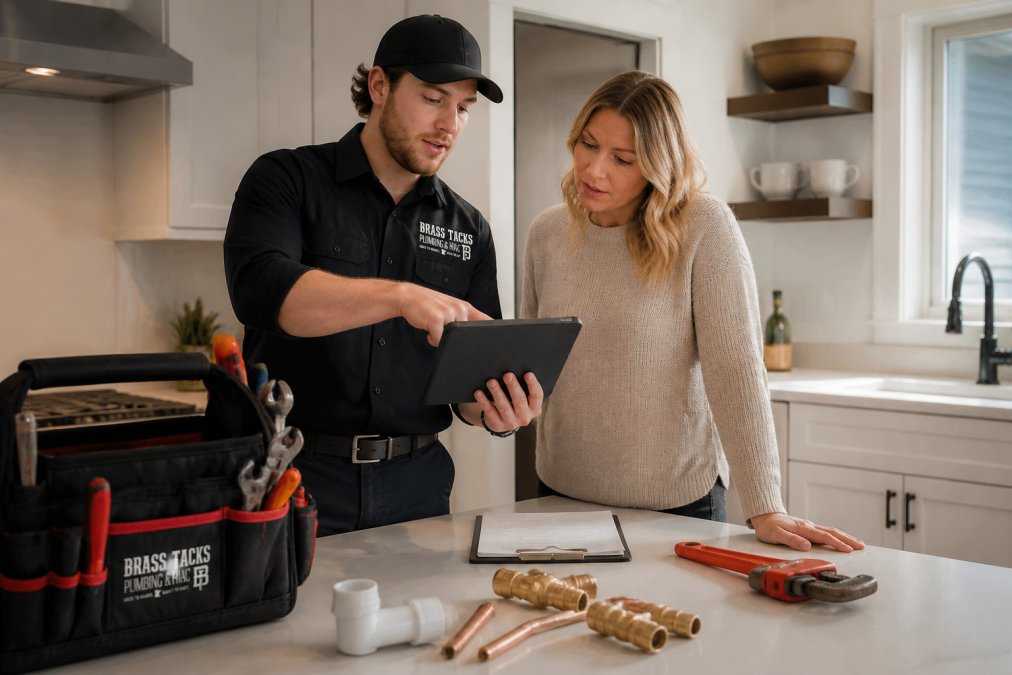
The method you use to request a quote directly affects how accurate that number will be. Understand the trade-offs between a phone estimate, a video call, and an in-person visit so you know what kind of number you are getting.
Phone Estimates: A Starting Point, Not a Final Price
A phone call is best for a ballpark range, not a firm commitment. A dispatcher can quote a standard rate for a common job, like clearing a clogged drain or replacing a water heater, but they cannot see the condition of your pipes or the layout of your utility closet. Use this call to confirm the company offers flat-rate pricing and to ask what the service call fee covers. If a company gives a rock-solid price without asking a single question about your home, treat that number with suspicion.
Video Calls: Better Than a Call, Still Limited
Many companies now offer video estimates where you show the technician the problem area on your smartphone. This is useful for visible issues like a leaking faucet or a corroded pipe under a sink, since the technician can see the brand, model, and condition of the fixture. However, a video cannot reveal what is inside the wall, under the slab, or within the venting of a furnace. Ask if the video quote is a fixed price or subject to change once the technician arrives.
In-Person Assessment: The Only Way to Get a True Upfront Price
For any job involving hidden infrastructure, such as a water heater replacement, a sewer line repair, or a furnace install, an in-person assessment is the only way to get a true upfront price. A technician needs to check the age and condition of the unit, measure the space, and look for complications like old galvanized pipes or a venting setup that requires extra parts. This is why we recommend scheduling a service visit for a firm quote.
Information to Have Ready Before You Call
Whether you call or request a visit online, gathering a few details beforehand speeds up the process and helps the dispatcher route the right technician with the right parts on the truck.
- The make and model of the unit (check the label on your water heater or furnace)
- The age of the system, if you know it
- A clear description of the problem, including any sounds, smells, or error codes
- Whether you have had previous repairs on the same issue
- Your home’s approximate square footage and number of bathrooms, if the issue is related to water pressure or drainage
For urgent situations like a water heater failure in the middle of a Minnesota winter, our emergency plumbing team can often provide guidance over the phone, but a firm quote still requires a service visit. A frozen or failing unit is high-stakes, and the last thing you want is a quote that misses a critical part because the technician never saw the installation.
Be cautious of any contractor who insists on giving you a final price without seeing the job. This is a common tactic to get a low number in front of you, only to reveal ‘additional necessary work’ once the job is underway.
What a Detailed Plumbing Estimate Should Include
A professional estimate is more than a single number scrawled on a notepad. A reliable written quote spells out the project scope, the specific parts and materials required, the labor costs, and the total fixed price, along with the timeline and any warranty information.
If an estimate lacks this detail, ask for clarification before scheduling. A vague quote is a red flag that the final bill could shift. The Federal Trade Commission guidance on home repair advises consumers to get written agreements that detail the work to be performed, which protects both you and the contractor if a dispute arises. A detailed estimate also makes it much easier to compare bids fairly, ensuring you are comparing identical scopes of work rather than apples to oranges.
Flat Rate vs Hourly Plumbing Pricing: Which Is Better?
When you get an upfront plumbing price quote, you are typically choosing between two pricing models: flat rate or hourly. Flat-rate pricing charges a single fixed price for a specific job, meaning the quote you receive is the price you pay regardless of how long the repair takes. Hourly pricing charges for time plus materials, making the final cost harder to predict.
For homeowners, flat-rate pricing is almost always the better choice. It removes the incentive for a technician to work slowly and protects you from cost overruns. The trade-off is that flat-rate quotes can sometimes run higher than an hourly rate for a simple, quick fix, since the price includes the contractor’s experience and the risk they assume.
| Pricing Model | How It Works | Best For | Main Risk |
|---|---|---|---|
| Flat Rate | One fixed price for the whole job | Predictable budgeting | May cost more for very simple fixes |
| Hourly | Pay for time spent plus parts | Small, straightforward tasks | Final cost is uncertain |
Most reputable contractors, including our team, use flat-rate pricing to provide guaranteed pricing before work begins. This approach aims to offer a clear estimate without hidden fees.
How to Avoid Hidden Fees and Surprise Costs
The most common source of surprise costs is the diagnostic charge. Some companies advertise a low service call fee, only to add a separate diagnostic charge once the technician arrives. Ask whether the service call fee includes the diagnostic assessment and confirm it will be credited toward the repair if you approve the work.
Another hidden cost to watch for is the “upcharge” on parts. Contractors often charge more for parts than the wholesale price, which is normal, but failing to disclose this markup in the written quote is not. Ask that the estimate itemize parts and materials separately from labor.
Before approving any work, confirm there are no additional charges for permits, disposal of old equipment, or after-hours scheduling. A reputable contractor will be upfront about these fees when they provide the written quote. If a company hesitates to put the price in writing, treat that as a warning sign. The Better Business Bureau tips for hiring contractors recommends getting at least three written estimates and being wary of any contractor who pressures you to decide on the spot.
Key Questions to Ask a Plumber Before Hiring
Asking the right questions before hiring a plumber separates a professional from a guesser. A licensed plumber expects these questions and will answer them directly. Remember that a quote is not a contract until you sign it, and you are never obligated to approve work on the spot.
The Core Questions
- Are you licensed and insured? This protects you if something goes wrong during the repair. In Minnesota, plumbers are licensed through the Minnesota Department of Labor and Industry, and you can verify a license online.
- Is this the final price, or could it change? Confirm that the quote is a fixed price for the work described. If it is an estimate, ask what conditions would change the price.
- What exactly does this price include? Ask for a breakdown of labor, parts, and any fees. A vague number is a red flag.
- Do you guarantee your work? Understand the warranty on both parts and labor. A contractor who stands behind the work will put the warranty in writing.
- Can you explain what is wrong before you start? A good technician will walk you through the issue so you understand the repair and why it is necessary.
Your Right to Refuse: Handling High-Pressure Tactics
A ‘no-obligation’ quote means you are free to decline the work. Some companies, however, use the onsite visit as a sales opportunity. Common pressure tactics include claiming a part is a ‘safety hazard’ that must be fixed immediately, offering a ‘discount’ that expires if you do not sign today, or starting work before you have approved the scope.
Here is how to handle those moments:
- Ask for a written quote before any work begins. If the technician cannot or will not provide one, that is your cue to stop the conversation.
- Take a photo of the written quote. This gives you a record even if the paper gets lost.
- Say, ‘I need time to review this.’ A reputable contractor will respect that. If the technician becomes pushy or dismissive, that is a strong signal about how the rest of the job will go.
- Get a second opinion. If a quote feels high or the diagnosis seems questionable, it is reasonable to pay a diagnostic fee at another company for a second assessment. That fee is often credited toward the repair if you approve the work.
The ‘Good, Better, Best’ Upsell
Be aware of the common sales structure where a technician presents three options: a basic fix, a premium fix, and a top-tier fix. This can pressure you into choosing a middle or high option when the basic fix is all you need. Ask the technician to explain the functional difference between the options and which one they would choose for their own home. An honest answer, even if it means a smaller sale, is a sign you can trust them for future work.
At Brass Tacks Plumbing, our licensed technicians explain the problem in plain language and give honest recommendations without pushing unnecessary work. We respect that your home is your largest investment, from wearing shoe covers to leaving the workspace clean. You are always free to get a second opinion, and we will never make you feel rushed.
Your Checklist for Comparing Plumbing Quotes
Once you have gathered a few quotes, comparing them requires more than looking at the bottom line. A lower price might mean a narrower scope of work or lower-quality parts. Use this checklist to evaluate each estimate.
- Written quote with a fixed total price
- Itemized list of labor and parts and materials
- Clear description of the work to be performed
- Statement on whether the diagnostic fee is waived if you approve the repair
- Warranty information for parts and labor
- Confirmation that the technician is a licensed plumber
- A realistic timeline for when the work will be completed
Price variance between quotes is normal, but the scope of work should not be. If one quote is significantly lower, ask what is excluded. The cheapest option is rarely the best value if it means a shorter warranty or a rushed job.
Get Your Upfront Plumbing Price Quote Today
Getting an upfront plumbing price quote does not have to be a guessing game. By requesting a detailed, written estimate, understanding flat-rate versus hourly pricing, and asking the right questions, you can protect yourself from surprise costs and hire with confidence.
At Brass Tacks Plumbing, we provide upfront pricing on every job, from water heater repair to furnace replacement, with no gimmicks and no sales pressure. Our licensed technicians serve Plymouth, Waynetonka, Maple Grove, and the surrounding West Metro communities with honest recommendations and respect for your home. Schedule your plumbing service now and get a clear, fixed price before any work begins.
Frequently Asked Questions
Is it normal for plumbers to charge for a quote?
Some companies charge a service call or diagnostic fee to cover the technician’s time and travel. Others, like Brass Tacks Plumbing, offer upfront pricing and apply any diagnostic fee to the repair cost if you move forward. Always ask about the service call fee and diagnostic charge before scheduling a visit so you know what to expect.
What is the difference between a plumbing estimate and a firm quote?
An estimate is a preliminary guess at the project scope and may change once work begins. A firm, upfront quote is a fixed price for the specific work described, and it should not change unless you approve additional work. Always ask for a written quote that lists parts and materials, labor costs, and the exact project scope before approving any work.
Why do some plumbing companies refuse to give quotes over the phone?
Accurate pricing requires seeing the problem in person. A leak under a sink may look simple, but the cause could be corroded pipes that need replacement or a failing fixture. An on-site assessment lets the plumber identify the true scope of work and give you a fixed price. Be cautious of any company that quotes a price over the phone without asking about your system.
What should I do if a plumbing quote is higher than I expected?
Ask for a detailed cost breakdown and compare it against other written quotes for the same project scope. A higher price often reflects better materials, licensed labor, and guaranteed workmanship. Check whether the quote includes parts and materials, cleanup, and warranty coverage. If you have questions, ask the plumber to explain the price variance before you decide.
