

Transparent Pricing for HVAC Repair: 2026 Guide

Table of Contents
- What Does Transparent Pricing for HVAC Repair Actually Mean?
- Why Some HVAC Companies Avoid Upfront Pricing
- What Factors Influence the Cost of Furnace or AC Repair?
- How to Read an HVAC Repair Estimate Template
- Questions to Ask HVAC Technicians Before You Approve Work
- Warranty Impact, Financing, and DIY vs. Professional Repairs
- Conclusion
- Frequently Asked Questions
Last Updated: September 24, 2026
What Does Transparent Pricing for HVAC Repair Actually Mean?
Transparent pricing for HVAC repair means you know the full cost before any work begins: the diagnostic fee, the labor, the parts, and any additional charges, all disclosed in writing and agreed to by you. This guide from Brass Tacks Plumbing, Heating & Cooling explains how to read estimates, what to ask technicians, and how warranties and financing change your final bill.
The Difference Between Flat-Rate and Time-and-Materials Billing
Flat-rate pricing means the company publishes a set price for a defined repair, and that number does not change based on how long the job takes. Time-and-materials billing means you pay for labor by the hour plus parts, so the total depends on how the work goes. Both models can be honest. The difference is who carries the risk: with flat-rate, the company absorbs the risk of a job running long, and you approve a number that is your number.
Ask any company to state, in writing, whether their quoted price is flat-rate or time-and-materials before the technician starts. A company that cannot answer that question clearly over the phone is telling you something about how the invoice will read.
Why Some HVAC Companies Avoid Upfront Pricing
Companies avoid upfront pricing because it removes their ability to adjust the number upward after the work is underway. Hourly billing and vague “it depends” answers protect the company’s margin, not your budget.
What Factors Influence the Cost of Furnace or AC Repair?
The cost of furnace or AC repair depends on four things: the failed part, how hard it is to reach, how long the labor takes, and whether the repair is covered by warranty. Diagnostic charges are usually separate from the repair itself. Two homes with the same symptom can produce very different repair scopes, and a company that explains why is being straight with you.
Parts and Materials
Parts drive a large share of any repair. A thermostat replacement and a compressor replacement sit at opposite ends of the spectrum in both part cost and labor.
Common repair categories include:
-
Thermostat replacement and control board faults
-
Igniters, flame sensors, and inductions motors on furnaces
-
Refrigerant recharge and leak diagnosis on central air conditioning
-
Compressor replacement on older condensing units
-
Ductwork repair and sealing
-
Heat pump components, including reversing valves
-
OEM versus aftermarket. Original equipment manufacturer parts are built to the unit’s spec and usually carry the manufacturer’s part warranty. Aftermarket parts can cost less up front but may not be covered the same way. Ask which one is going in.
-
Refrigerant type. Older air conditioners use R-22, which is no longer produced and is only available from recovered stock, so a recharge on an older system can cost far more than the same job on a newer unit. This is one of the biggest hidden variables in AC pricing.
-
Part availability. A part common for a furnace model popular in this region may be on the truck. An older or less common unit may need an ordered part, which adds days, not dollars, to the timeline.
-
System age and condition. A repair on a system near the end of its service life often reveals a second worn component once the technician is inside. That is not upselling, it is what happens when parts wear together.
Labor and Diagnostic Charges
Labor covers technician time, and diagnostic charges cover the visit that identifies the problem. Some companies waive the diagnostic fee if you approve the repair; others bill it separately no matter what. Ask which applies before you book.
- Getting to the equipment, which matters if the furnace is in a tight closet, a crawlspace, or an attic
- Disassembly and reassembly around the failed component
- Testing the system after the repair to confirm it holds
- Handling refrigerant, which requires recovery and recharge equipment and adds time on any sealed-system job
Why Two Identical Symptoms Can Produce Different Bills
Never approve a repair based on a verbal description alone. Ask to see the failed component or the test reading that identified it. Approving work you cannot see is how homeowners end up paying for parts their system did not need.
If you are weighing a repair against a replacement, our furnace repair team can walk you through both options with a written estimate before you decide.
How to Read an HVAC Repair Estimate Template
A good HVAC repair estimate template lists the diagnostic finding, the specific repair, the parts, the labor, the warranty terms, and the total, with a clear statement of what is not included. If any of those six items is missing, ask for it before you sign.
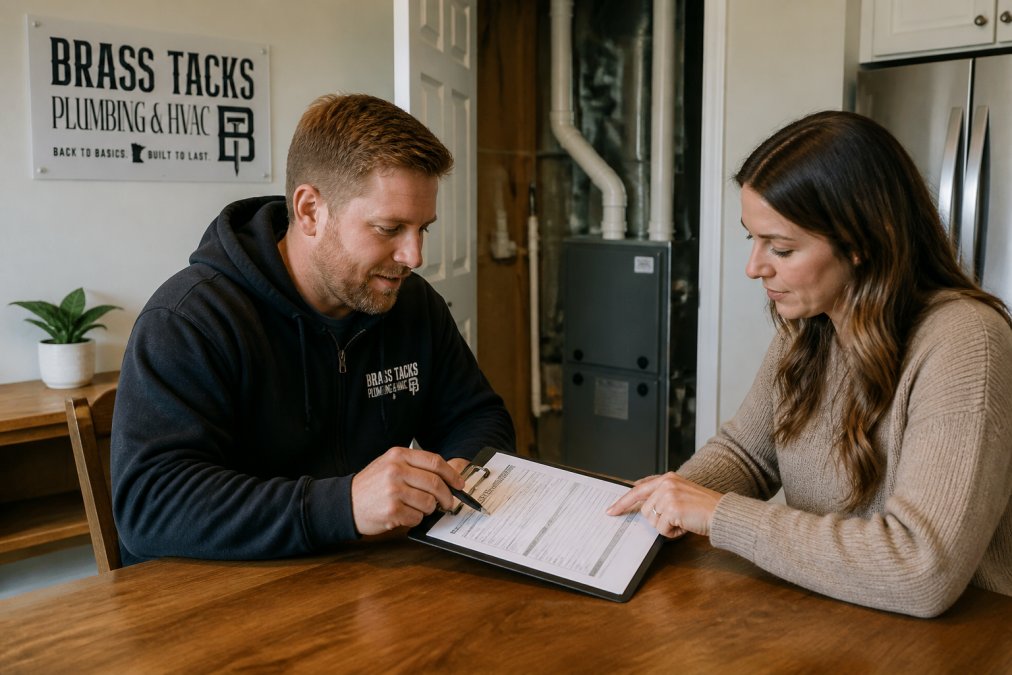
Here is what to look for, line by line:
| Estimate Line Item | What It Should Tell You | Red Flag If Missing |
|---|---|---|
| Diagnostic finding | The specific failed component | Only a symptom is listed |
| Repair description | What will be replaced or repaired | Vague “system service” wording |
| Parts | Part name and whether OEM or aftermarket | No part listed at all |
| Labor | Flat rate or hourly, stated clearly | Labor left blank |
| Warranty | Parts and labor coverage terms | No warranty stated |
| Total | One final number you approve | “Starting at” pricing |
Questions to Ask HVAC Technicians Before You Approve Work
Ask these questions before you authorize any repair, and expect direct answers. A technician who welcomes them is confident in the diagnosis. The most useful questions cover diagnosis, pricing, and scope:
- What exactly failed, and how did you confirm it?
- Is this a repair or a symptom of something larger?
- What is the total cost, including the diagnostic charge?
- Is this price flat-rate or hourly?
- What happens if you find a second problem once you start?
- Is any of this covered by warranty?
- How long should this repair last on a system this age?
Warranty Impact, Financing, and DIY vs. Professional Repairs
Warranties, financing, and the repair-or-replace decision are where the biggest cost swings happen, and they are the three things most pricing guides skip. Here is how each one changes what you actually pay.
How Warranties Affect What You Pay Out of Pocket
A manufacturer warranty typically covers the part, not the labor to install it. That distinction surprises homeowners who expect a covered repair to cost nothing. A covered compressor still comes with a labor bill, and labor is often the larger half of the total on a major repair.
- Manufacturer warranty covers the part itself for a set period from the installation date. It is tied to the equipment, not to you, so it transfers with the home in most cases.
- Labor warranty covers the workmanship. It comes from the installing contractor, not the manufacturer, and it is usually much shorter than the parts warranty. This is the one homeowners forget to ask about.
Payment Plans and Financing Options
Financing options let you spread the cost of a larger repair or a system replacement instead of paying it all at once. Ask what terms are available and what the total cost is after any interest, not just the monthly payment.
A few things to check before you sign anything:
- The total cost, not the monthly payment. A low monthly number stretched over a long term can cost far more than the sticker price. Ask for the total you will pay across the life of the plan.
- Whether there is a promotional period. Some plans offer no interest if paid in full within a set window. Miss that window and interest can apply retroactively to the original balance.
- Whether the financing is through the contractor or a third party. Third-party lenders run credit checks and set their own terms. Contractor-offered plans may be simpler but less flexible.
- Whether there is a prepayment penalty. If you expect to pay it off early, confirm there is no penalty for doing so.
DIY vs. Professional: An Honest Cost-Benefit Check
Some HVAC tasks are reasonable for a homeowner. Others are not, and the line is not about confidence. It is about safety, licensing, and equipment.
Reasonable DIY:
- Replacing a furnace filter, which should happen monthly during heavy heating season
- Clearing debris, leaves, and snow away from an outdoor condensing unit
- Replacing batteries in a thermostat
- Vacuuming return grilles and keeping supply vents unobstructed
- Gently rinsing an outdoor coil with a garden hose when the unit is off
Not DIY:
- Refrigerant handling, which requires certification and recovery equipment
- Gas line work of any kind
- Electrical control board replacement
- Compressor work
- Anything requiring a combustion analysis
- Heat exchanger inspection, which needs a trained eye and specific tools
The cheapest repair is the one done correctly the first time. A clear diagnosis, a written estimate, and a technician who explains the finding will save you more than shopping for the lowest quote.
Conclusion
The hardest part of an HVAC repair is not the repair itself. It is knowing whether the number on the invoice matches the work that was actually needed, and that uncertainty hits hardest when your heat is out and the temperature is dropping.
Frequently Asked Questions
What is the HVAC $5,000 rule?
The $5,000 rule is a common guideline some homeowners use when deciding between repairing and replacing an HVAC system. The idea is that if the repair cost multiplied by the age of the unit exceeds a certain threshold, replacement may make more financial sense. However, this rule is not a universal standard. Factors like system efficiency, warranty coverage, and how long you plan to stay in your home matter just as much. A licensed technician can walk you through the actual numbers for your situation.
How can I tell if an HVAC repair quote is fair?
A fair quote breaks down parts, labor, and any diagnostic or service call fees separately. It should also state whether the price is flat-rate or time-and-materials. Ask whether the diagnostic charge is credited toward the repair if you approve the work. Get the scope in writing, including what the technician will inspect and what happens if additional problems are found. Comparing two or three written estimates with the same scope gives you the clearest picture.
What should be included in a professional HVAC repair estimate template?
A thorough HVAC repair estimate template should list the date, technician name and license number, a description of the problem found during inspection, the specific parts and materials needed, labor hours or flat-rate pricing, any diagnostic or service call fee, warranty terms on parts and labor, and the total cost. It should also note whether the estimate is binding or subject to change if additional issues are discovered. Ask for this in writing before any work begins.
Why do some HVAC companies avoid upfront pricing?
Some companies avoid upfront pricing because they want flexibility to adjust the bill after the work is done, or they use the service call as a sales opportunity to recommend larger replacements. Others simply have not invested in flat-rate pricing tools. When a company cannot give you a written estimate before starting, you lose the ability to compare quotes or set a budget. Reputable companies provide a clear estimate after the diagnostic inspection and before any repair work begins.
