
Repair vs Replace AC: How to Decide for Your Home
Last Updated: November 11, 2026
Quick Summary
The repair vs replace ac decision usually comes down to three things: the system’s age, how often it has needed repairs, and whether the latest repair is a small fix or a major component failure. A young system with a minor problem is usually worth repairing, while an aging one facing a big repair often makes more sense to replace.
- Repair is often worth considering if the unit is under 10 years old with a solid repair history.
- Replacement is often worth considering if the system is past 12 to 15 years old.
- A failed capacitor is not a sign of end of life and is almost always worth replacing.
- A system needing three or more service calls in two seasons points toward replacement.
- Compare repair and replacement over five to ten years, not on the immediate bill alone.
Table of Contents
- When to Repair vs Replace an AC: The Short Answer
- Air Conditioner Replacement Signs You Should Not Ignore
- AC Repair vs Replacement Cost: What Each Path Really Adds Up To
- HVAC Repair vs Replace Chart: Matching System Age to the Decision
- How Minnesota Climate and Your Household Shift the Math
- HVAC Replacement Estimate Checklist: What a Fair Quote Includes
- Refrigerant Rules and Equipment Compatibility Before You Commit
- Schedule an AC Assessment and Get a Straight Answer
- Frequently Asked Questions
When to Repair vs Replace an AC: The Short Answer
The repair vs replace AC decision usually comes down to three things: the system’s age, how often it has needed repairs, and whether the latest repair is a small fix or a major component failure. A young system with a minor problem is usually worth repairing, while an aging one facing a big repair often makes more sense to replace.
Here is the short version. Repair is often worth considering if the unit is under 10 years old, has a solid repair history, and the problem is a relatively small part. Replacement is often worth considering if it is past 12 to 15 years, has needed repeated service calls, or needs a compressor or coil.
The three questions that settle most decisions
- How old is the system? Age sets the ceiling on what a repair is worth.
- What is failing? A capacitor is cheap to fix. A compressor is not.
- How has it behaved so far? Frequent breakdowns signal a system that is telling you something.
Answer those honestly and most homeowners already know which way they are leaning.
Air Conditioner Replacement Signs You Should Not Ignore
A failing air conditioner rarely quits without warning. The signs that matter most are rising energy bills, weak airflow, warm air from the vents, strange noises, frequent short cycling, and repeated refrigerant leaks.
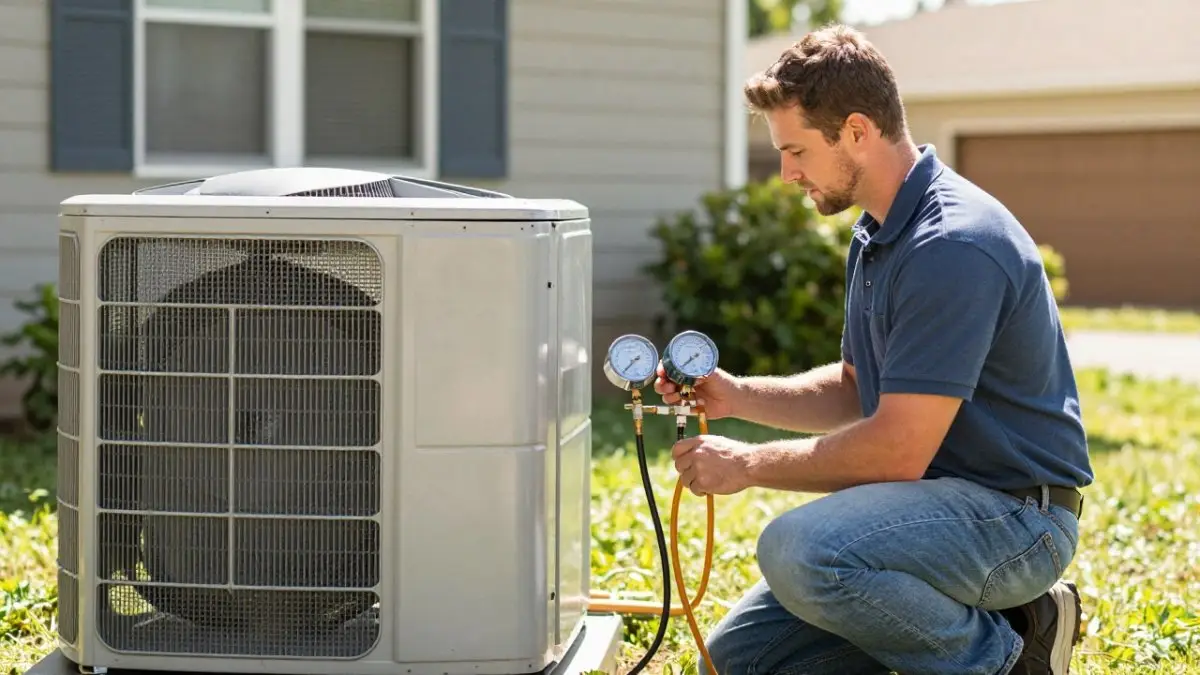
Watch out: homeowners often mistake a failing capacitor or a dirty condenser coil for a dying system. A proper diagnosis separates a small repair from a real end-of-life problem.
Failure-specific guidance: how the recommendation changes by component
The component that fails changes the math considerably. Here is how the repair-versus-replace call shifts for the parts that come up most often.
- Capacitor or contactor: small, inexpensive parts that start the compressor and fan. On a system with a clean history, these are almost always worth replacing. A failed capacitor is not a sign of end of life.
- Blower motor or fan motor: a moderate repair. On a younger unit, replace it and keep going. On a unit past its expected lifespan, weigh the repair against the remaining life you are buying.
- Compressor: the most expensive single part on the system, and the one that most often tips the decision toward replacement on an older unit. On a young system still under warranty, a compressor replacement can make sense. On an aging system, the repair cost plus the risk of a second major failure usually favors replacement.
The pattern to remember: cheap parts on a young system are repairs. Expensive parts on an old system are replacement signals. The middle cases are where an onsite diagnosis earns its keep.
Signs that point to replacement regardless of age
A few conditions override the age rule entirely. A system that has needed three or more service calls in the past two seasons is telling you something. So is a unit that cannot keep up on the hottest days even after a tune-up, or one where the repair quote approaches a meaningful share of a replacement. When those show up, the age of the unit matters less than the pattern.
AC Repair vs Replacement Cost: What Each Path Really Adds Up To
Repair keeps today’s bill lower but leaves you exposed to the next breakdown. Replacement costs more upfront but resets the clock on efficiency, reliability, and warranty coverage. The honest comparison is total cost over the next several years, not the line item in front of you.
We do not publish invented price ranges, because every home and system is different.
How to build a total-cost comparison for your own system
Add up four numbers for each path, then compare the totals over the same time horizon, say the next five to ten years.
- The immediate bill. The repair quote versus the replacement quote. This is the only number most homeowners compare, and it is the least useful on its own.
- Likely future repairs. Ask the technician what else on the system is aging. A unit that just lost a blower motor may be a year from a coil leak. Estimate one or two more service calls per year on an aging system and add them in.
- Operating cost. An older system runs less efficiently than a new one. Your electricity rate and cooling hours determine the gap. A new system will not erase the purchase price overnight, but the difference is real and compounds over years.
- The reset value. A new system comes with a fresh warranty and a known lifespan. An aging system you keep patching has neither. That has value even if it does not show up on an invoice.
When the gap narrows fast
The distance between repair and replacement shrinks quickly when the repair is a major component. If a technician is quoting a large repair on a system near the end of its expected lifespan, ask for the replacement number alongside it.
Watch out: a low repair quote can hide a second problem. If the technician finds one failed part, ask whether the rest of the system was checked.
For context on what repair work should cost, see our guide to honest HVAC repair pricing.
Efficiency payback and realistic savings
A new system will generally run more efficiently than an aging one, but savings may not cover the purchase price quickly. Payback depends on your current system’s efficiency, your cooling habits, and how long you plan to stay in the home. Treat efficiency savings as a bonus that can strengthen the case for replacement, not as the main reason to buy.
What actually drives the price of either path
Two homes on the same street can get very different quotes for the same nominal job. The variables that typically move the number most include system size, accessibility of the indoor coil and line set, whether ductwork or electrical work is needed, the efficiency tier of the equipment chosen, and whether the old unit needs special handling. Ask each contractor to itemize so you can see which of these is driving your quote, and compare line by line rather than on the bottom line alone.
HVAC Repair vs Replace Chart: Matching System Age to the Decision
An HVAC repair vs replace chart is a starting point, not a verdict. Use system age as the first filter, then weigh repair history and the severity of the current problem.
| System Age | Minor Repair | Major Repair | Repair History |
|---|---|---|---|
| Under 10 years | Repair | Repair, get a second opinion | Isolated issues: repair |
| 10 to 15 years | Repair if cost is modest | Weigh both carefully | Frequent calls: lean replace |
| Over 15 years | Consider replacement | Lean replacement | Repeated repairs: replace |
The 10-year-old system and the 15-year-old system sit in very different places. If you are weighing system age against the decision in more detail, our team walks through when to replace your HVAC system with the signs and red flags that matter.
How Minnesota Climate and Your Household Shift the Math
A cooling system in Minnesota works hard in July and August, then sits idle through a long heating season. That short, intense cooling load means the compressor and condenser carry a heavy burden during the months they run.
Household factors matter just as much. A larger family, a finished basement, or a home office that runs all day raises the cooling demand.
HVAC Replacement Estimate Checklist: What a Fair Quote Includes
An HVAC replacement estimate checklist helps you compare quotes on equal footing. A fair quote should spell out the equipment model and efficiency rating, the size and load calculation, the scope of work, permit handling, warranty terms, and whether any ductwork or thermostat work is included.
- Equipment brand, model, and efficiency rating
- Load calculation or sizing method used
- Scope of work and removal of the old unit
If the replacement quote feels steep, ask about HVAC and plumbing financing for Minnesota homeowners before you rule the project out.
Refrigerant Rules and Equipment Compatibility Before You Commit
Refrigerant rules have changed in recent years, and that affects what equipment is available and how older systems get serviced. If your current system uses an older refrigerant, a repair that involves refrigerant can be more complicated than it used to be.
Compatibility matters at replacement too. If a technician suggests a tune-up first to rule out a preventable problem, our late-summer AC tune-up covers the checks that catch small issues early.
Schedule an AC Assessment and Get a Straight Answer
The repair vs replace AC decision is easier when someone inspects the system and explains the options in plain terms. Guessing from age alone can lead you to replace a unit with years left, or to sink money into one that is finished.
At Brass Tacks Plumbing, Heating & Cooling, we give honest recommendations without sales pressure, upfront pricing, and clear communication about what is actually wrong. If you want the direct answer on a specific system, our repair or replace AC decision page lays out the framework.
Contact Brass Tacks Plumbing, Heating & Cooling to talk through whether to repair or replace your air conditioner.
Frequently Asked Questions
What is the $5,000 rule for AC units, and should homeowners rely on it?
The $5,000 rule multiplies your system’s age by the repair estimate. If the result tops $5,000, the thinking goes, replacement deserves a look. A 12-year-old unit facing a $500 repair lands at $6,000, which points toward replacement. It is a quick conversation starter, not a verdict. The rule ignores refrigerant type, warranty coverage, and how well the rest of the system is holding up. Use it to frame the discussion with a technician, then let an onsite diagnosis make the call.
How do I compare AC repair vs replacement cost fairly?
Add up more than the repair invoice. A fair comparison includes the repair itself, any follow-up visits, higher energy bills from a declining system, and the replacement you may face in a few years anyway. On the replacement side, factor in the new equipment, installation, and the efficiency gain on summer cooling bills. Ask for both numbers in writing from the same visit so you are comparing real figures rather than guesses.
What are the clearest air conditioner replacement signs?
Repeated breakdowns, rising energy bills without a rate change, weak cooling in some rooms, strange noises, and a system past the 10 to 15 year mark all point toward replacement. A refrigerant leak that keeps returning matters too, especially on older equipment. One repair on a young system is normal. Three service calls in two summers on a 14-year-old unit is a pattern, and patterns are what should drive the decision.
What should an HVAC replacement estimate checklist include?
A solid estimate names the equipment model and efficiency rating, states the labor and any ductwork or line-set work, and spells out warranty terms for parts and labor. It should include permit handling where required, disposal of the old unit, and a clear start and completion window. Ask whether a load calculation was done to size the system for your home. If a quote is a single number on a business card, ask for the breakdown before signing.
Should you replace your furnace when you replace your air conditioner?
Not automatically, but the two are worth evaluating together. If the furnace is close in age to the AC and has a repair history of its own, replacing both at once can save on labor and keep the systems matched. If the furnace is newer and running well, keep it. In Minnesota, where heating season is long, a mismatched pair can cost you comfort and efficiency. Ask the technician to assess both before you commit.

