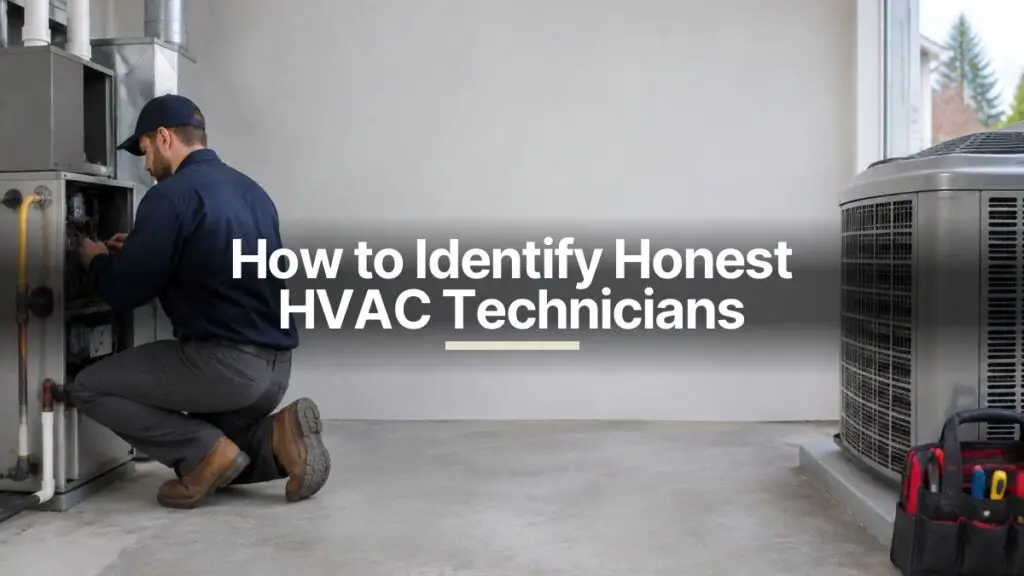
How to Identify Honest HVAC Technicians
Last Updated: November 18, 2026
Quick Summary
To identify honest HVAC technicians, watch what happens before anyone quotes a price: an honest technician diagnoses first, explains what they found, and only then talks about cost. Ask what they tested, what the reading was, and whether they will put the diagnosis in writing before work begins.
- Ask what the technician tested and what the reading was before approving any repair.
- Request the license number and verify it through the state’s official licensing resources.
- A quote that recommends full replacement without a diagnosis has skipped the repair call entirely.
- Get a second opinion whenever replacement is recommended on a system under 10 years old.
- A written estimate should list parts by model number and labor as a separate line item.
Table of Contents
- What Separates Honest HVAC Technicians From Good Salespeople
- Questions to Ask an HVAC Technician Before Work Begins
- How to Verify Licenses, Insurance and Credentials
- HVAC Repair Red Flags That Signal Upselling
- Your HVAC Repair Estimate Checklist
- When to Get an HVAC Second Opinion
- Schedule Service With a Team That Explains the Problem First
- Frequently Asked Questions
What Separates Honest HVAC Technicians From Good Salespeople
The best way to identify honest HVAC technicians is to watch what happens before anyone quotes a price.
That difference matters most in the middle of a Minnesota winter. When your furnace quits at 10 p.m. and the house is dropping fast, you are not in a position to comparison shop.
Here is the throughline: a diagnosis is evidence, and evidence can be checked. Below are the questions, documents, and red flags that separate a real repair from a sales pitch.
The Diagnosis Comes Before the Price
Honest HVAC technicians explain the problem before they mention a number. Ask any technician to walk you through what failed, how they tested it, and what the reading was.
A fair diagnosis usually includes three things:
- What failed. The specific part, not “the whole system.”
- How they know. A reading, a visual finding, a test result.
- What happens if you wait. Honest answers include “it can wait a few weeks.”
Watch out: a technician who says “I can’t tell you what’s wrong until you approve the full replacement” has skipped the diagnosis entirely. That is a sales move, not a repair call.
Questions to Ask an HVAC Technician Before Work Begins
Ask these before anyone opens a toolbox. The answers tell you more than any review score.
- “What did you test, and what was the reading?” A real tech can point to a gauge, a meter, or a part.
- “Is this a repair or a replacement, and why?” You want a reason, not a default.
- “Can you show me the failed part?” Most will happily point it out.
- “What happens if I do nothing for 30 days?” Honest answers vary. Some say “nothing urgent.”
- “Will you put this in writing before you start?” The answer should be yes.
- “Who is licensed, and who is the apprentice?” Know who is doing the work.
- “Is there a diagnostic fee, and does it apply to the repair?” Get this clear up front.
That last one catches people. A service call fee is normal. What matters is whether it was disclosed before the visit, not after.
If you are building a list of questions for a plumbing visit too, our guide on what questions to ask a plumber covers the plumbing side in the same spirit.
Ask these questions before anyone opens a toolbox, because the answers tell you more than any review score.
| Question to ask | What a good answer looks like |
|---|---|
| What did you test, and what was the reading? | Points to a gauge, meter, or part |
| Is this a repair or a replacement, and why? | Gives a reason, not a default |
| Can you show me the failed part? | Happily points it out |
| What happens if I do nothing for 30 days? | Honest answers vary, some say nothing urgent |
| Will you put this in writing before you start? | The answer should be yes |
| Who is licensed, and who is the apprentice? | You know who is doing the work |
| Is there a diagnostic fee, and does it apply to the repair? | Disclosed before the visit, not after |
How to Verify Licenses, Insurance and Credentials
Verification is the fastest filter you have. Ask any contractor for their license number, then verify it through the state’s official licensing resources rather than relying on a business card.
Insurance matters too. Ask any contractor for proof of current liability and workers’ compensation coverage before work begins.

Checking Minnesota Licensing and Insurance
Three checks cover most of it:
- License lookup. Confirm the company name matches the license, not just the individual tech.
- Insurance certificate. Ask the office to email it. A legitimate company sends it without drama.
- Certification. Manufacturer certifications and technician credentials are a bonus, not a substitute for a state license.
For a deeper walkthrough, our guide to licensed HVAC technicians in the West Metro breaks down the specifics. And for the bigger picture on why this matters, read why hiring licensed plumbing and HVAC technicians pays off over time.
HVAC Repair Red Flags That Signal Upselling
The clearest HVAC repair red flags show up in how a technician talks and what they can show you. Pressure is one tell. A missing diagnosis is the other.
Pressure Tactics and What They Are Designed to Do
High-pressure tactics work by shrinking your decision window. Here is what to watch for.
- Same-day urgency on a non-emergency. “This price expires today” is a sales tactic, not a safety finding. A genuine safety issue gets a clear explanation and a recommendation to act, not a countdown clock.
- A jump from repair to full replacement with no middle options. Honest technicians usually lay out a repair path and a replacement path and let you weigh them. A single-option pitch removes your ability to compare.
- Commission language. Ask directly: “Are you paid commission on this?” You are allowed to ask, and the answer is informative either way.
The Evidence Test: What a Real Diagnosis Looks Like
A diagnosis is evidence, and evidence can be checked. Before you approve any repair, ask the technician to show you four things. This step separates a real repair from a sales pitch.
- The measurement. Ask what they tested and what the reading was. A technician checking refrigerant should show gauge readings; one checking a furnace should show a temperature rise or combustion reading. If the answer is “it’s just bad,” ask for the number.
- The visual finding. Ask to see the failed part. A cracked heat exchanger, a burned-out control board, or a seized motor can usually be pointed out.
- The photo or documentation. Many technicians photograph the failed component. Ask whether those photos will be attached to the estimate.
- The plain-language explanation. You should hear what failed, how they know, and what happens if you wait. If you cannot repeat it back in your own words, ask them to walk through it again.
Watch out: a technician who says “I can’t tell you what’s wrong until you approve the full replacement” has skipped the diagnosis entirely. That is a sales move, not a repair call.
What to Do After a Suspected Dishonest Repair
If you think you were pushed into a repair you did not need, you have options, and the order matters.
- Document everything. Keep the estimate, invoice, photos, and notes on what was said and when, including the date and technician’s name.
- Get an independent second opinion. Call another company, describe the first diagnosis, and ask them to confirm or challenge it. Do not tell them the price you were quoted. You want an independent read, not a match.
- Contact the licensing authority. Minnesota licenses HVAC contractors, and the state board takes complaints about contractor conduct. A complaint does not guarantee a refund, but it creates a record.
Replacement is sometimes the right call, especially on a furnace patched three winters running. The problem is replacement recommendations that arrive before any diagnosis.
Our page on how to avoid unnecessary HVAC repairs goes deeper on spotting this pattern before you sign anything, and our guide to licensed HVAC technicians in the West Metro explains how to check credentials before the truck arrives.
Your HVAC Repair Estimate Checklist
A written estimate should let you compare apples to apples. This section covers what belongs on the document and how to read it once two estimates are in front of you.
What Every Written Estimate Should Contain
Use this checklist on every quote you receive.
- Company name, license number, and date on the document
- The diagnosed problem stated in plain language
- Parts listed by name and model number, not “misc. parts”
If any line is missing, ask for it in writing before you approve anything. A company that cannot produce an itemized estimate is asking you to trust a verbal number, and verbal numbers drift.
How to Compare Two Estimates Line by Line
Put the estimates side by side and match them by category, not by total. The total is the least useful number until you know what is inside it.
- Match the diagnosis. Do both companies name the same failed part? If one says “bad blower motor” and the other says “airflow restriction,” you are not comparing the same job. Ask each to explain the test behind their conclusion.
- Match the parts. Compare model numbers, not descriptions. A cheaper quote may use a lower-tier or rebuilt part. Ask whether it is new, remanufactured, or aftermarket, and whether it carries the manufacturer’s warranty.
- Match the labor. Labor should be a line item with hours or a flat rate. If it is bundled into a lump sum, ask for it to be broken out.
- Match the warranty. A long parts warranty with a short labor warranty can cost more over time than the reverse. Write both numbers down.
- Match the diagnostic fee treatment. One company may credit the fee toward the repair; another may not. That changes the real cost even when the repair line looks identical.
- Match the scope. Does the estimate include cleanup, disposal of the old part, and a post-repair test? Those are sometimes added later as extras.
Watch out: a quote that is dramatically lower than the others usually means something was left out of the scope, not that you found a bargain. Find the missing line before you celebrate.
Judging Whether a Recommendation Is Proportionate
The estimate tells you what the technician wants to do. It does not tell you whether that is the right call. Use the system’s age and condition as your frame.
- Routine maintenance is cleaning, adjusting, and testing. It should not come with a repair recommendation unless the technician found a specific problem.
- Repair makes sense when a single identifiable component failed and the rest of the system tested within normal ranges. Ask for those readings.
- Replacement is worth discussing when the system is near the end of its expected service life, when repair cost approaches a meaningful share of replacement, or when multiple major components are failing at once. Ask which condition applies.
A furnace patched three winters running in a Minnesota cold snap may genuinely be a replacement candidate. The point is not to resist replacement, but to make sure the recommendation rests on test results and age, not a sales target.
For context on what fair repair pricing looks like in this area, see our breakdown of honest HVAC repair pricing.
When to Get an HVAC Second Opinion
Get a second opinion whenever a quote recommends full replacement, costs more than you expected, or arrived with pressure attached. There is no rule against it, and honest companies expect it.
A few situations where a second opinion is worth the service call:
- Replacement recommended on a system under 10 years old
- Repair quote that jumped mid-visit
- A technician who would not explain the diagnosis
A second opinion is not an insult to the first company. It is basic diligence, the same as getting two quotes on a roof.
Schedule Service With a Team That Explains the Problem First
The simplest test of any HVAC company is whether they will explain the problem before they charge you for work.
Brass Tacks Plumbing, Heating & Cooling is a family-owned and operated business that offers upfront pricing with no sales pressure.
If your furnace is acting up, your AC is short-cycling, or you just want a straight answer about a repair, we will diagnose it and explain what we found before we talk about cost. The same standard applies across our HVAC services, from furnace repair to furnace replacement, so you always know what you are approving and why.
Get started with Brass Tacks Plumbing, Heating & Cooling and schedule service with a team that shows you the problem before quoting the fix.
Frequently Asked Questions
How can you tell if an HVAC technician is honest?
An honest HVAC technician explains the problem before quoting a repair, shows you the failed part or reads the diagnostic readings with you, and gives you a written estimate that separates parts and labor. They answer questions without pressure and never rush you into a same-day decision on a full system replacement. If a technician cannot describe what failed and why, ask them to walk you through it before you approve any work.
What should an HVAC repair estimate include?
A solid HVAC repair estimate checklist starts with the diagnosis in plain language, then lists the specific parts, the labor, and whether the diagnostic fee is credited toward the repair. It should state the warranty on both parts and labor and note anything the technician could not verify during the visit. Ask for the estimate in writing before work starts, and compare line items rather than just the bottom-line number.
Is it normal for an HVAC technician to recommend replacing a system?
Sometimes, yes. A replacement recommendation is reasonable when a system is near the end of its service life, has a failed compressor or heat exchanger, or when repair costs approach a large share of replacement. What matters is whether the technician shows you the evidence and lays out repair versus replacement side by side. A recommendation delivered without a diagnosis, or with pressure to sign today, is a reason to get an HVAC second opinion.
How do I know if an HVAC repair recommendation is necessary?
Ask the technician to show you the failed component, the diagnostic readings, or the error codes behind the recommendation. Honest HVAC technicians welcome this because the evidence supports the repair. Then check the estimate for a clear parts-and-labor breakdown and a stated warranty. If the explanation is vague or the recommendation jumps straight to replacement, a second opinion from another licensed company is a reasonable next step before you spend anything.

