

Fix Low Water Pressure Issues: A Homeowner’s Guide

Table of Contents
- Is It a Whole-House Problem or Just One Fixture?
- How to Clean Faucet Aerators and Fix Single-Fixture Pressure
- Water Pressure Test Gauge Usage: Measuring Your Home’s PSI
- Adjusting a Water Pressure Regulator Valve (PRV)
- When the Problem Is Hidden: Clogs, Corroded Pipes, and Leaks
- Well Water vs. Municipal Supply: Different Troubleshooting Paths
- When to Call a Professional for Low Water Pressure Issues
- Frequently Asked Questions
Last Updated: September 16, 2026
Is It a Whole-House Problem or Just One Fixture?
Low water pressure is a drop in the flow rate or force of water from your fixtures. First, figure out whether it affects one tap or every tap, because that answer decides everything that follows.
How to Clean Faucet Aerators and Fix Single-Fixture Pressure
Cleaning a faucet aerator is the fastest fix for low water pressure at a single tap. The aerator is the small screened cap at the tip of the spout, and it traps mineral deposits and sediment over time.
- Close the drain or place a towel in the sink so small parts do not disappear.
- Unscrew the aerator by hand, or use pliers wrapped in tape if it is stuck.
- Take apart the pieces and note their order.
- Soak the screen and housing in white vinegar for a few hours to break down scale.
- Scrub away remaining grit with an old toothbrush.
- Rinse, reassemble, and run the tap to check the flow.
Aerators on kitchen taps clog faster than bathroom aerators because they catch more food debris and grease. If yours clogs repeatedly, the sediment is coming from deeper in the plumbing system, not the aerator itself.
Water Pressure Test Gauge Usage: Measuring Your Home’s PSI
Water pressure test gauge usage tells you exactly how much pressure your home has, measured in psi. A gauge screws onto an outdoor hose bib or laundry sink thread and gives you a reading in seconds.
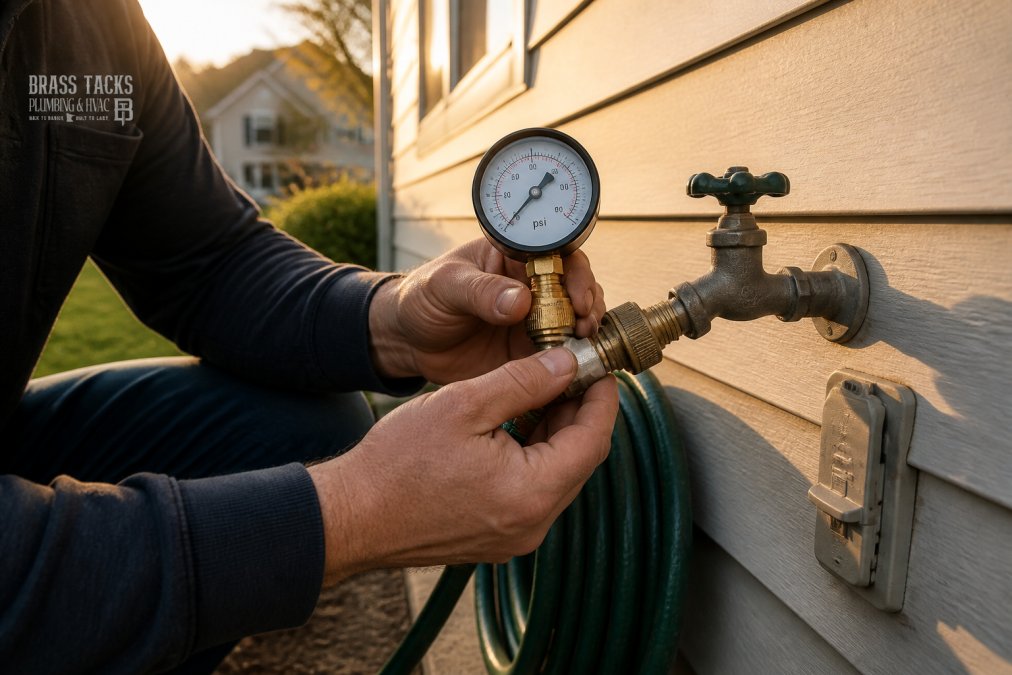
Do not crank your pressure regulator up to chase a stronger shower. Pushing pressure too high stresses supply lines, shut-off valves, and appliance connections, and it is a common cause of burst pipes in cold weather.
Adjusting a Water Pressure Regulator Valve (PRV)
Adjusting a water pressure regulator valve is the right move when your gauge shows pressure that is too high or too low at every fixture. The PRV, also called a pressure reducing valve, sits on the main line where water enters the home and holds incoming pressure steady. City mains can deliver well over 100 psi, and the PRV knocks that down to something your pipes, fixtures, and appliances can handle.
How to tell a misadjusted PRV from a failed one
Run this quick test before you adjust anything:
- Attach your gauge to an outdoor hose bib with all fixtures off. Write down the static reading.
- Run a shower and a sink at the same time. A healthy PRV holds pressure within a few psi of the static reading.
- Shut everything off and watch the gauge for 10 to 15 minutes. If pressure creeps upward on its own, the diaphragm is passing water and the valve is failing.
A PRV that will not respond to adjustment, hums, leaks from the bell, or lets pressure creep up overnight has failed internally. That is a replacement, not a tune-up, and a job for a licensed plumber.
Making the adjustment safely
If the valve passes the tests above and just needs a tweak:
- Find the bell-shaped valve on the main line, usually near the main shut-off.
- On top sits a locking nut and an adjustment screw. Loosen the nut, but do not remove it.
- Turn the screw clockwise to raise pressure or counterclockwise to lower it. Work in quarter-turn increments.
- Recheck with your gauge after each adjustment. Small turns add up fast.
- Tighten the locking nut when you land on a reading in the normal range for a home.
Why PRVs fail faster here
In older West Metro homes, the PRV is often original to the house and well past its service life. Two local factors speed up failure. Hard water leaves mineral scale on the diaphragm and plunger, so a valve that worked fine for years can start sticking. Minnesota’s freeze-thaw cycles also stress the main line where the PRV sits, and a valve that takes repeated thermal movement tends to lose its seal sooner than one in a milder climate.
When the Problem Is Hidden: Clogs, Corroded Pipes, and Leaks
Hidden restrictions are the cause most homeowners miss because nothing looks wrong on the outside. Three different problems hide behind the same weak-flow symptom, and each one needs a different response. Sorting them out is the difference between a simple repair and a slow leak that damages your floors.
Corroded pipes: the inside-out problem
Galvanized steel pipes, common in older Minnesota homes, corrode from the inside out. The pipe keeps its shape while the interior narrows, so flow drops gradually over years. You will not see rust on the outside until the pipe is close to failing. What you notice instead is a slow decline you eventually stop noticing.
Watch for these signals:
- Weak flow at every fixture that worsens over time
- Discolored water, especially brown or rusty on the first draw in the morning
- A metallic taste or smell
- Visible moisture, staining, or soft drywall near supply lines
Clogs: sediment, scale, and the hot-side pattern
Clogs from sediment buildup behave differently from corrosion. They often hit the hot side first because heat accelerates mineral deposits, so a water heater full of scale sheds particles that settle in hot-water lines. If your hot water pressure is worse than your cold, that points to sediment, not a failing main.
Leaks: the meter test that settles it
A hidden leak and a hidden clog can feel identical at the tap. The meter test separates them. Turn off every fixture and appliance that uses water, including the ice maker and any humidifier, then watch your water meter. If the dial or leak indicator moves with everything off, you have a leak somewhere in the plumbing system, and it needs attention before it damages floors or framing.
Common hiding spots include:
- Under slab in older rambler-style homes
- Behind finished basement walls
- At hose bibs that were not drained before a freeze
- In the line between the meter and the house
If your pressure drops only in winter, suspect a partially frozen or restricted line before you suspect the PRV. Frost can push against buried service lines and pinch flow without causing a visible break.
What to do with what you find
Match the symptom to the cause before you call anyone:
| What You Notice | Likely Cause | Next Step |
|---|---|---|
| Hot side weak, cold side fine | Sediment from water heater | Flush water heater, check softener |
| Rusty first draw, gradual decline | Galvanized corrosion | Scope lines, plan repipe |
| Meter moves with fixtures off | Hidden leak | Call a plumber |
| Pressure drops only in winter | Frost or restricted buried line | Call a plumber |
Well Water vs. Municipal Supply: Different Troubleshooting Paths
Well water and municipal water fail for completely different reasons, and troubleshooting the wrong system wastes time. On municipal water, the utility delivers consistent pressure to your meter, so a whole-house drop almost always traces back to your PRV, main valve, or interior piping.
- A well pump that is aging or failing
- A waterlogged or undersized pressure tank
- A clogged pressure switch or sediment filter
- A dropping water table, which is worth watching during dry stretches
When to Call a Professional for Low Water Pressure Issues
Call a licensed plumber when you have ruled out the simple fixes and the problem persists. Aerators, a partly closed valve, and a minor PRV adjustment are fair game for any homeowner. Corroded pipe, a failed regulator, hidden leaks, and well system faults are not.
Reach out if you see any of these:
- No change after cleaning aerators and checking the main valve
- A pressure gauge reading that stays low at every fixture
- Rusty or discolored water alongside weak flow
- A water meter that moves with everything shut off
- A PRV that will not adjust or is visibly leaking
- Any sign of water damage near supply lines
| What You Notice | Likely Cause | DIY or Pro |
|---|---|---|
| One tap runs weak | Clogged aerator | DIY |
| Every tap weak, gauge reads low | Failed PRV | Pro |
| Rusty water, gradual decline | Corroded pipes | Pro |
| Meter spins with fixtures off | Hidden leak | Pro |
| Pump short-cycles, tank gauge low | Well pump or tank | Pro |
Measure your pressure with a gauge before you change anything. The reading tells you whether you are dealing with a fixture, a regulator, or a supply problem, and it saves you from fixing the wrong thing.
Frequently Asked Questions
Why did my water pressure suddenly drop?
A sudden drop usually points to a specific event: a city water main break, a failed pressure regulator valve, or a new blockage in a pipe or aerator. If only one faucet is affected, clean the aerator first. If the whole house lost pressure at once, check for a shut-off valve that was bumped, a PRV failure, or a supply issue by calling your municipal water department. In Minnesota, a sudden drop during a deep freeze may also mean a frozen or cracked pipe.
Does a clogged aerator cause low water pressure throughout the house?
No. A clogged aerator only affects the fixture it is attached to. If one faucet has weak flow but others are fine, the aerator is the likely culprit. Learning how to clean faucet aerators is a quick DIY fix: unscrew the tip, soak the screen in vinegar to dissolve mineral deposits, rinse, and reattach. If multiple fixtures are weak, the problem is in your plumbing system, not the aerator.
Can cold weather in Minnesota affect my home’s water pressure?
Yes. Extended freezing temperatures can cause pipes in unheated spaces, like crawl spaces, garages, or exterior walls, to freeze and restrict flow. Frozen pipes may thaw without damage, but they can also crack and leak when they thaw. If your pressure drops during a cold snap, check for frozen sections and consider adding insulation or heat tape. Contact a licensed plumber if you suspect a burst pipe.
When should I call a professional plumber for low water pressure?
Call a professional if you have checked the aerators, confirmed the main shut-off valve is fully open, and tested your water pressure with a gauge, yet the problem persists. Signs it is time for expert help include pressure below 40 psi throughout the house, visible corrosion on pipes, a leaking water heater, or a pressure regulator valve that will not adjust. A licensed plumber can diagnose hidden clogs, failing PRVs, and corroded galvanized steel pipes safely.
