

How to Reset Furnace After Power Outage

Table of Contents
- What Happens to Your Furnace During a Power Outage
- Finding the Furnace Reset Button Location
- Safety Precautions Before You Start
- Step-by-Step Power Cycle and Reset Procedure
- Furnace Blowing Cold Air After Power Restoration
- When to Call an HVAC Technician
- Post-Reset Maintenance and Verification
- Frequently Asked Questions
Last Updated: September 28, 2026
What Happens to Your Furnace During a Power Outage
When the power goes out, your furnace stops running immediately. The blower motor shuts down, the ignition system cuts off, and your heating system goes silent.
Most modern furnaces enter a lockout mode as a safety feature to prevent dangerous ignition attempts. The control board detects the interruption and waits for a manual reset rather than risk malfunction. Understanding this is the first step to getting your heat back safely.
In Minnesota’s cold winters, this lockout can feel urgent. But rushing through a reset without understanding what happened can lead to problems. The good news is that how to reset furnace after power outage is straightforward once you know the steps.
Finding the Furnace Reset Button Location
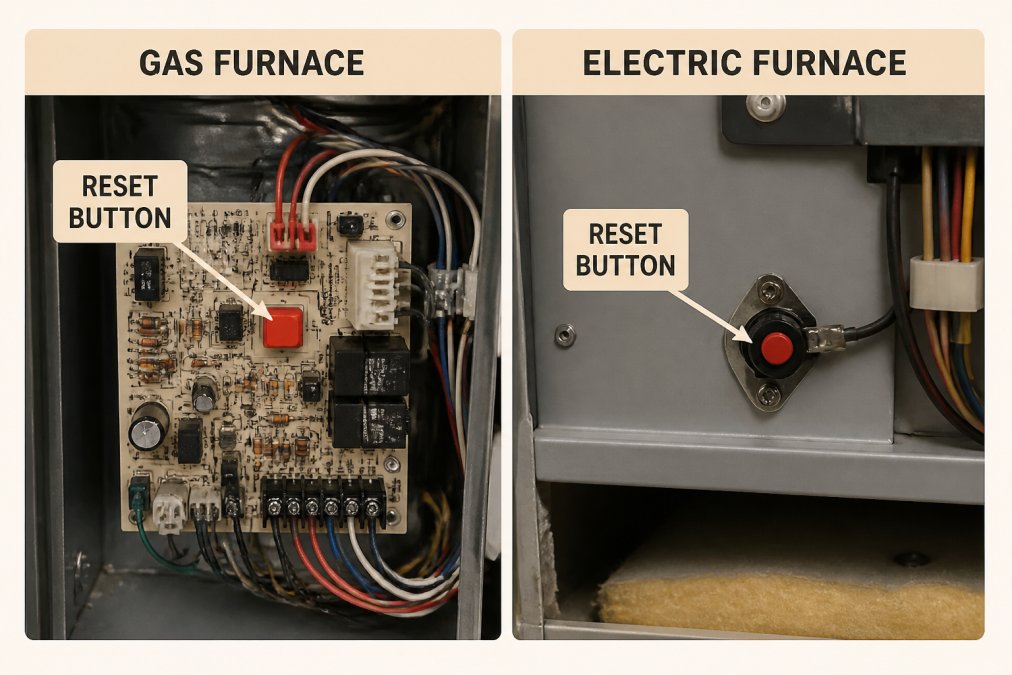
The reset button’s location and appearance vary significantly depending on whether you have a gas or electric furnace. Understanding the difference prevents confusion and saves time.
Gas Furnace Reset Button
On gas furnaces, the reset button is mounted on the ignition control module (also called the flame safeguard or ignition board). Look for a red, yellow, or black button about the size of a pencil eraser, usually on the right or left side of the control board near the burner assembly. It’s often labeled “Reset” or “Ignition Reset.”
Electric Furnace Reset Button
Electric furnaces use a limit switch or thermal cutoff instead of an ignition control module. Look for a red button (often larger than gas furnace buttons) labeled “Reset” or “Thermal Cutoff,” usually mounted on or near the heating element assembly on the furnace cabinet or inside an access panel.
How to Locate Your Furnace’s Reset Button
-
Identify your furnace type: Look at the burner area. If you see a gas burner assembly and a pilot light or electronic igniter, you have a gas furnace. If you see metal heating coils, you have an electric furnace.
-
Check the model number: Find the nameplate on your furnace and search online for “[Your Model Number] reset button location” or consult the owner’s manual.
-
Look in the right zone: For gas furnaces, focus on the control board near the burner. For electric furnaces, look near the heating elements or on the blower compartment door.
-
Don’t force anything: The button should be accessible without removing major components. If you need to disassemble the furnace, stop and call a professional.
If You Can’t Find It
Some furnaces don’t have a manual reset button and reset automatically after 30 minutes to an hour. If you can’t find a button after checking your manual, the power cycle procedure (turning off the breaker and waiting) is sufficient. If you’re uncertain about your furnace type, call a professional.
Safety Precautions Before You Start
Turn off the power first. Locate your furnace’s circuit breaker and switch it to the off position to prevent electrical shock and unintended ignition.
Wait 30 seconds. This allows residual electrical charge to dissipate from the control board.
Check for gas smell. If you detect a strong gas odor, do not touch the furnace. Leave the house immediately and call your gas company’s emergency line.
Ensure proper ventilation. Make sure the furnace room has adequate airflow and don’t block vents or exhaust pipes.
Step-by-Step Power Cycle and Reset Procedure
This process works for most residential furnaces. Follow each step in order.
Step 1: Turn off power at the breaker
Locate your furnace’s circuit breaker (usually labeled “Furnace” or “HVAC”) and switch it to the off position.
Step 2: Wait 5 minutes
Let the furnace sit without power to allow the control board to fully reset and residual charge to clear.
Step 3: Restore power
Switch the circuit breaker back to the on position.
Step 4: Set your thermostat to heat mode
Raise the temperature setting above the current room temperature. The furnace should attempt to start within 30 seconds to a few minutes.
Step 5: Listen for the blower and feel for warm air
You should hear the blower motor start and feel warm air within a few minutes. If the furnace starts, you’re done.
Step 6: Press the reset button if needed
If the furnace doesn’t start, turn off the power again, locate the red or black reset button on the control board, press it firmly for 1-2 seconds, and turn power back on.
Step 7: Wait 10 minutes
Modern furnaces run a safety diagnostic when they start. Don’t assume something is wrong if the furnace doesn’t start immediately.
Furnace Blowing Cold Air After Power Restoration
Your furnace is running and pushing cold air through your vents. This is normal after a power outage in most cases. Understanding why it happens will keep you from making it worse.
Why Gas Furnaces Blow Cold Air at Startup
When a gas furnace restarts, it follows a safety sequence: the control board runs a diagnostic check, the blower motor starts immediately, the igniter lights the gas burner, and the heat exchanger gradually warms up. During this process, the blower is running but the burner hasn’t yet heated the heat exchanger, so you feel cold air. This is intentional, the blower starts first to prevent the furnace from overheating.
Why Electric Furnaces Blow Cold Air at Startup
Electric furnaces follow a similar pattern: the control board checks for faults, the blower starts, and the heating elements energize. Electric heating elements warm faster than gas heat exchangers, so the cold-air phase is usually shorter, 2-5 minutes instead of 5-15 minutes.
How Long the Cold-Air Phase Lasts
- Gas furnaces: 5-15 minutes is typical. Older furnaces or those with larger heat exchangers may take longer.
- Electric furnaces: 2-5 minutes is typical.
- High-efficiency gas furnaces: These have secondary heat exchangers that extract extra warmth from exhaust gases. The warm-up phase may be slightly longer because the system is more complex.
If cold air continues for more than 20 minutes, something is wrong and you should stop troubleshooting.
Smart Thermostat Behavior After Power Loss
Programmable and smart thermostats may lose their schedule and revert to a default setting or basic heating mode. After a power outage, always verify that your thermostat is in heat mode and set to a temperature above the current room temperature. This is the most common reason furnaces don’t start after a reset.
What to Do While the Furnace Warms Up
- Don’t turn off the furnace or adjust the thermostat repeatedly. Each adjustment resets the warm-up cycle and delays heating.
- Don’t assume something is broken. Cold air for 5-15 minutes is normal. Patience is part of the process.
- Feel the air over time. After 5 minutes, the air should be noticeably warmer than when the furnace first started. If there’s no change after 10 minutes, something may be wrong.
- Check your thermostat settings again. Make sure it’s in heat mode, not fan-only mode. In fan-only mode, the blower runs without the burner igniting, producing only cold air indefinitely.
- Listen for the burner. On a gas furnace, you should hear a soft whoosh or click as the igniter lights the burner. On an electric furnace, you may hear a relay click as the heating elements energize. These sounds confirm the heating system is working.
When Cold Air Means There’s a Real Problem
Stop waiting and call a professional if:
- Cold air continues for more than 20 minutes after the furnace starts.
- The furnace starts but you never hear the burner ignite (gas furnaces) or the heating elements energize (electric furnaces).
- The air warms up briefly, then goes cold again, and the furnace cycles on and off repeatedly (short cycling).
- The thermostat is set correctly in heat mode, but the furnace won’t start at all.
- You smell gas or burning odors.
These symptoms suggest a flame sensor failure, ignition control problem, gas supply issue, or thermostat malfunction, all of which require professional diagnosis and repair.
When to Call an HVAC Technician
Some situations require professional help. Knowing when to stop troubleshooting and call saves time and prevents damage.
Call a technician if:
- The furnace won’t start after completing the reset procedure
- You smell gas during or after the reset attempt
- The furnace starts but shuts down repeatedly (short cycling)
- The reset button is stuck or won’t press
- Cold air continues for more than 20 minutes after startup
- You see visible damage, corrosion, or burnt components on the control board
- The furnace makes unusual noises (grinding, squealing, or loud rattling)
- You’re uncomfortable accessing the furnace or locating the reset button
Why professional diagnosis matters: A furnace that won’t restart may have a failed ignition control, a blocked gas line, a faulty flame sensor, or an electrical issue.
Post-Reset Maintenance and Verification
After your furnace restarts, take a few minutes to verify everything is working properly.
Frequently Asked Questions
How do I manually reset my furnace after a power outage?
Locate the red reset button on your furnace’s control board (usually near the burner assembly), turn off the power at the circuit breaker, wait 30 seconds, press the reset button once, then restore power. If the furnace doesn’t ignite within a few minutes, wait 15 minutes before trying again. Do not press the button repeatedly, as this can trigger lockout mode and require a professional reset.
Why is my furnace blowing cold air after the power comes back on?
After a power outage, your furnace’s control board needs time to restart and signal the burner assembly to ignite. This delay can last several minutes. If cold air continues after 10-15 minutes, the ignition control or flame sensor may not be working properly. Check that the reset button has been pressed and power is fully restored at the circuit breaker. If the problem persists, contact an HVAC technician for diagnosis.
When should I call an HVAC technician instead of trying to reset it myself?
Call a professional if the furnace doesn’t ignite after two reset attempts, if you see error codes on your thermostat, if there’s a burning smell or visible damage, or if you’re uncomfortable working with electrical panels. Also contact a technician if the furnace enters lockout mode (won’t respond to reset attempts) or if you have an older furnace and aren’t sure how to locate the reset button safely.
How long should I wait before turning my furnace back on after a power outage?
Wait at least 5-10 minutes after power is restored to your home before attempting to reset the furnace. This allows the electrical system to stabilize and prevents potential damage from power surges. If your furnace has a manual service disconnect switch, turn it off for 30 seconds before restarting. In Minnesota’s cold winters, don’t delay too long, but a few minutes of patience prevents most reset problems.
