

Furnace Blower Motor Replacement Cost in 2026: What to Expect
Last Updated: October 25, 2026
Quick Summary
A blower motor replacement cost typically runs from $350 to $2,500 installed, depending on motor type and labor. PSC single-speed motors usually fall between $350 and $1,200, while ECM variable-speed motors range from $900 to $2,500.
- Motor type is the single biggest lever on blower motor price.
- A furnace blower motor commonly lasts 10 to 20 years before failing.
- Repair makes sense when the fault is a cheap component like a capacitor.
- A fair quote is itemized, not a single lump sum.
- Ask the technician to show the failed part and meter reading.
Table of Contents
- What Does Furnace Blower Motor Replacement Cost in 2026?
- What Drives Your Furnace Blower Motor Replacement Cost?
- How Long Does a Furnace Blower Motor Last?
- Furnace Blower Motor Repair vs. Replacement: Which Makes Sense?
- When a Furnace Blower Assembly Replacement Is the Better Call
- Furnace Repair Estimate Checklist: What a Fair Quote Includes
- Schedule Your Furnace Blower Motor Diagnosis
- Frequently Asked Questions
What Does Furnace Blower Motor Replacement Cost in 2026?
Most homeowners searching for furnace blower motor replacement cost analysis want one thing: a realistic number before they agree to work.
At Brass Tacks Plumbing, Heating & Cooling, we quote these jobs across Plymouth, Wayzata, Minnetonka, and Maple Grove, and the spread is real. Two furnaces that look identical from the outside can produce very different bills.
How Motor Type Changes the Price
Motor type is the single biggest lever on price. A basic PSC motor costs less to buy and less to install. An ECM or variable-speed motor costs more on both counts, and it usually needs a matched control module. That module is often the hidden line item homeowners do not expect.
PSC vs. ECM Motors: Pros, Cons, and Price Ranges
A PSC motor is a single-speed blower motor that runs at one fixed speed and uses a run capacitor to start and run.
| Motor Type | Typical Installed Range | Pros | Cons |
|---|---|---|---|
| PSC single-speed | $350 to $1,200 | Lower upfront cost, simple design, widely available parts | Less efficient, louder, one fixed speed |
| ECM variable-speed | $900 to $2,500 | Better efficiency, quieter, steadier airflow and humidity control | Higher part cost, control module adds expense |
PSC wins on budget. ECM wins on comfort and electricity use over the life of the system. For a Minnesota home that runs heat five months a year, the efficiency gap matters more than it does in a mild climate.
What Drives Your Furnace Blower Motor Replacement Cost?
Several factors move the number up or down, and knowing them helps you read a quote honestly.
- Motor type and horsepower. Higher horsepower and variable-speed designs cost more.
- Parts availability. An OEM motor matched to your furnace costs more than a universal motor, but it fits without modification.
- Labor time. Some furnaces require pulling the blower assembly; others allow a motor swap in place.
Regional pricing varies too. A dense metro market with high overhead runs higher than a rural one. Two identical furnaces in different ZIP codes can produce quotes that differ by hundreds of dollars.
How Long Does a Furnace Blower Motor Last?
A furnace blower motor commonly lasts 10 to 20 years, with many failing somewhere in the middle of that window. PSC motors tend to run longer on simple design; ECM motors can last just as long but cost more when they fail.
Watch for the warning signs before a full failure: a humming motor that will not spin, weak airflow from the vents, a burning smell, rattling or squealing, or a blower that runs constantly. If you notice any of these, signs your furnace needs repair in 2026 covers what each symptom usually points to.
Furnace Blower Motor Repair vs. Replacement: Which Makes Sense?
Repair makes sense when the motor itself is sound and the fault is a cheap component: a failed capacitor, a loose wire, a bad connection, or a control board that is not sending power. Replacement makes sense when the motor is seized, the windings are failing, the bearings are noisy, or the motor is already near the end of its service life.
A Decision Framework You Can Actually Use
Work through these questions in order. The first one that tips clearly toward replace usually settles it.
- How old is the motor? A motor under manufacturer warranty changes the math entirely. If the part is covered, your out-of-pocket cost drops to labor and any related components, which usually favors replacement. A motor well past its expected service life favors replacement even if a cheap repair would get you through this season.
- How old is the furnace? If the furnace is 15 years or older and the blower is failing, weigh the motor job against the remaining life of the whole system. Putting a major repair into an aging furnace can be throwing good money after bad.
- What is the repair history? One blower motor failure on an otherwise healthy furnace is a straightforward replacement. A second or third major repair in as many years is a pattern, and patterns favor system replacement.
- Is the rest of the system sound? Ask about the heat exchanger, inducer motor, control board, and draft system. If several of these are aging alongside the blower, a motor-only fix rarely pays off.
- What does the warranty cover? A parts-and-labor warranty on a new motor has real value. A furnace with an expired warranty and a failing blower is a different decision than one still under coverage.
- What is the cost gap? Compare the installed motor replacement against a full system replacement. When the motor job approaches a meaningful fraction of a new system, the decision usually tilts toward replacement, especially on an older furnace.
Repair the motor when the fault is a cheap component and the furnace has years left. Replace the motor when the motor itself has failed and the furnace is otherwise healthy. Replace the furnace when the blower is one of several aging parts and the system is near the end of its life.
The Capacitor Trap
A common mistake is approving a motor replacement when a capacitor was the whole problem. A failing capacitor can make a healthy motor hum without starting, which looks identical to a seized motor to an untrained eye. A technician should test the capacitor, check voltage at the motor, and confirm the control board is sending the signal before condemning the motor.
When the Blower Is the Only Problem
If the heat exchanger, inducer, and control board are all in good shape, a blower motor replacement is usually the right call regardless of furnace age. The blower is a serviceable component, and a new motor can add years of reliable airflow to an otherwise sound system.
If your furnace is 15 years old or older, the repair-versus-replace question gets bigger than the motor. Should you repair a 15-year-old furnace? walks through when fixing an aging system still makes financial sense, and when should I replace my HVAC system gives you a framework for weighing a blower assembly job against a full system replacement.
When a Furnace Blower Assembly Replacement Is the Better Call
Sometimes the motor is not the only worn part. The blower wheel, housing, and mounting can wear together, and replacing the full assembly is the cleaner fix.
The real decision point is whether the rest of the furnace is worth the investment. If the heat exchanger, control board, and inducer are all aging alongside the blower, putting major money into one component rarely pays off.
Furnace Repair Estimate Checklist: What a Fair Quote Includes
A fair quote is itemized, not a single lump sum. The fastest way to compare two contractors is to line up their quotes side by side and see whether each one accounts for the same work. Below is a sample structure that a transparent blower motor quote typically follows, with placeholder amounts so you can see how the line items stack up.
| Line Item | What It Covers | Why It Matters |
|---|---|---|
| Diagnostic fee | Time to test the motor, capacitor, control board, and airflow | Ask whether it is credited toward the repair if you approve the work |
| Motor (OEM or universal) | The replacement motor itself, matched to your furnace | OEM fits without modification; universal may need adapter parts |
| Control module | Required for many ECM and variable-speed motors | Often the hidden line item homeowners do not expect |
| Capacitor or relay | Small components that commonly fail alongside the motor | Should be listed separately, not buried in labor |
| Labor | Removal, installation, wiring, and testing | Varies with how much of the blower assembly must come out |
| Disposal and shop supplies | Old motor haul-away, fasteners, sealant | Small but legitimate; should be visible, not padded |
| Warranty terms | Part warranty and labor warranty, stated in writing | A strong labor warranty is worth more than a slightly lower price |
What to Ask Before You Approve the Work
- Motor make, model, and whether it is OEM or universal
- Separate line for parts and for labor
- Diagnostic fee stated upfront and whether it applies to the repair
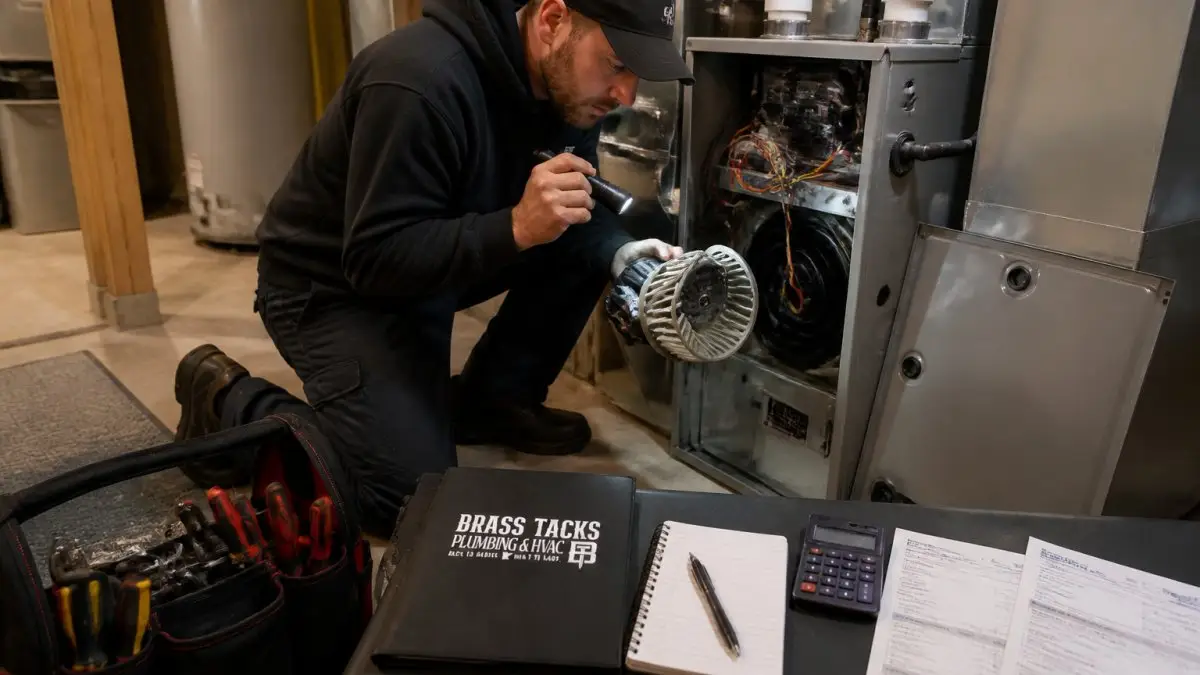
Ask the technician to show you the failed part and the meter reading that proved it. A capacitor that reads out of spec, a motor winding that fails a resistance test, or a control board with a burned terminal are all things you can see or have explained in plain language. If the explanation stays vague, get a second opinion before you sign.
Red Flags in a Blower Motor Quote
A quote that is one number with no breakdown is hard to compare and easy to pad.
If a quote is one number with no breakdown, ask for the detail. Our guide to licensed HVAC technicians in the West Metro explains what credentials to confirm before hiring, and our furnace repair page covers how a proper diagnostic visit should unfold.
Schedule Your Furnace Blower Motor Diagnosis
A failing blower motor rarely fixes itself, and in a Minnesota winter, waiting turns a repair into an emergency. If your furnace is blowing weak air, humming without starting, or making noise, get it looked at before the cold settles in.
Brass Tacks Plumbing, Heating & Cooling sends licensed technicians who explain the diagnosis before any work begins, quote upfront pricing with no sales pressure, and treat your home with respect. We are family-owned and local to the West Metro. Schedule furnace maintenance in the West Metro or call us for a blower motor diagnosis and get a straight answer on repair versus replacement.
Frequently Asked Questions
How much should it cost to replace a furnace blower motor?
Published homeowner guides put installed blower motor replacement cost at roughly $450 to $2,000, with one guide citing an average near $550. Single-speed PSC motors usually land at the lower end and variable-speed ECM motors at the higher end. A Minnesota-focused guide lists $500 to $1,200 installed for a PSC motor and $900 to $2,500 for an ECM motor. Your actual quote depends on the motor type, furnace model, and labor, so ask for an itemized estimate before approving work.
What is the average lifespan of a furnace blower motor?
Most furnace blower motors last somewhere in the range of 10 to 20 years, though runtime, dust, and Minnesota’s long heating season all shorten that window. A motor that has already been repaired once, or one in a furnace older than 15 years, is a stronger candidate for replacement than repair. If you hear grinding, notice weak airflow, or the motor overheats and shuts down repeatedly, have it inspected before the cold sets in.
Can a furnace blower motor be repaired instead of replaced?
Sometimes. A failed capacitor, loose wiring, or a dirty blower wheel can often be fixed for far less than a new motor. Bearings that grind, a seized shaft, or a burned-out winding usually mean replacement. The right call comes from a diagnostic visit, not a phone guess. Ask the technician to explain what failed and show you the part before you approve a furnace blower motor repair versus replacement decision.
What should a furnace blower motor replacement quote include?
A fair quote names the motor (OEM or universal), the labor to pull and reinstall the blower assembly, and any related parts like a capacitor or belt. It should state whether the diagnostic fee is credited toward the repair and whether a manufacturer warranty covers the part. Use a furnace repair estimate checklist: itemized parts, itemized labor, warranty terms, and a clear statement of what happens if the new motor does not solve the problem.
A blower motor problem in January is not something to sit on. If you want an honest diagnosis and a clear quote before you commit to anything, Brass Tacks Plumbing, Heating & Cooling is ready to help. Our licensed technicians provide upfront pricing, honest recommendations without sales pressure, and clear communication about what actually failed. Get started with Brass Tacks Plumbing, Heating & Cooling and get your heat back to where it should be.

