

7 Best Water Heater Brands for Hard Water in 2026

Table of Contents
- How Hard Water Affects Your Water Heater
- Quick Comparison: 7 Best Water Heater Brands for Hard Water
- 1. Bradford White: Best Overall for Hard Water
- 2. Rheem: Best for Parts Availability and Service Network
- 3. A.O. Smith: Best Value for Budget-Conscious Homeowners
- 4. Navien: Best Tankless for Energy Efficiency
- 5. Rinnai: Best Tankless for Scale Detection Technology
- 6. State Water Heaters: Best Mid-Range Tank Option
- 7. Brass Tacks Plumbing, Heating & Cooling: Best for Local Installation and Service
- What Are the Signs Your Water Heater Needs Replacing?
- Water Heater Maintenance for Hard Water
- Frequently Asked Questions
Last Updated: September 27, 2026
How Hard Water Affects Your Water Heater
Hard water is the quiet killer of water heaters in Minnesota homes. At Brass Tacks Plumbing, Heating & Cooling, we see the results every week: tanks that fail years early, heating elements caked in white rock, and homeowners surprised by a cold shower in January. Some water heater brands are built to survive that assault.
Hard water carries dissolved calcium and magnesium. When heated, those minerals settle as calcium carbonate, the same chalky stuff that crusts a kettle, landing on the tank floor and heating element.
Sediment Buildup and Scale Accumulation
Sediment buildup is the layer of mineral particles that settles at the bottom of a tank. Scale accumulation is the harder, bonded crust that forms on heating surfaces. Both insulate the water from the heat source, so the burner runs longer to hit the same temperature.
The damage compounds. A gas burner firing against sediment overheats the steel above it, which flexes, cracks, and eventually leaks. Electric elements cook inside their own scale jacket until they burn out. Corrosion resistance in the tank lining buys you time.
How to Test Your Home Water Hardness
You can test your water two ways. A home test strip gives a rough reading in under a minute. A laboratory test through your municipal utility or a certified lab gives you exact grains per gallon, the number that matters for sizing equipment.
Most West Metro communities pull from groundwater or the Mississippi River, and both run moderately hard to hard. If you are on well water in the outer suburbs, expect higher mineral content than a city water customer two miles away. Water chemistry varies block to block, so test your own tap.
Skipping an annual flush on a hard water tank is the single most expensive shortcut in home maintenance. Sediment that hardens for two or three years can turn a simple flush into a full replacement.
Quick Comparison: 7 Best Water Heater Brands for Hard Water
Here is the short version. Match your situation to the row, then read the full section.
| Brand | Type | Standout Hard Water Feature | Best For |
|---|---|---|---|
| Bradford White | Tank | Hydrojet sediment reduction, Vitraglas lining | Overall durability |
| Rheem | Tank + tankless | Self-diagnostic controls, wide parts network | Easy service and repairs |
| A.O. Smith | Tank | DynaClean diffuser, enhanced anode rod | Budget-conscious buyers |
| Navien | Tankless | Dual stainless heat exchangers | Energy efficiency |
| Rinnai | Tankless | Scale-detection alerts | Scale monitoring |
| State | Tank | Heavy-duty anode rods | Mid-range value |
| Brass Tacks install | Full service | Correct sizing, flush schedules, local support | West Metro homeowners |
One note before the rankings: brand matters less than installation. A premium tank installed with the wrong anode rod or set to the wrong temperature will scale up faster than a mid-grade unit maintained properly.
1. Bradford White: Best Overall for Hard Water
Bradford White is engineered for conditions that can affect water heaters. The company sells through plumbing professionals only, so you will not find it on a big-box shelf.
Hydrojet System and Vitraglas Tank Lining
The Hydrojet Total Performance System uses a dip tube that jets incoming cold water across the tank floor, keeping sediment suspended instead of letting it bake onto the bottom. Less sediment buildup means the burner stays efficient and the tank floor stays intact.
The Vitraglas tank lining adds a bonded glass coating that resists corrosion far better than bare steel. Pair that with a sacrificial anode and you have a tank designed to give its anode rod up before the steel gives up.
Where it falls short: you cannot buy one yourself, and not every plumber stocks the brand. In the West Metro, local service companies carry professional lines, so the tradeoff is worth it for homeowners who plan to keep the house long term.
2. Rheem: Best for Parts Availability and Service Network
Rheem units sell through retail and professional channels, and replacement parts are widely available.
The self-diagnostic control board flashes a fault code when it senses a problem, which shortens troubleshooting. Titanium elements on the electric models resist scale corrosion better than standard elements, and the stainless steel heat exchanger in the tankless line holds up to mineral-heavy water longer than copper.
The honest limitation: Rheem tankless models still need regular flushing in hard water areas. No tankless unit escapes that. Skip the flush and scale will choke the heat exchanger regardless of brand.
When you buy a Rheem, photograph the model and serial plate before installation. Parts counters can pull the exact element or anode rod in one call instead of three.
3. A.O. Smith: Best Value for Budget-Conscious Homeowners
A.O. Smith is a brand to consider when balancing budget and hard water concerns. The DynaClean diffuser dip tube reduces sediment accumulation at the tank floor, and the enhanced anode rod gives more corrosion protection than a bare-bones unit.
The value shows up in availability. A.O. Smith units sell at major retailers and through plumbing suppliers, so replacement parts and warranty service are rarely a headache. For a rental property or starter home in Plymouth or Maple Grove, that combination of low entry cost and easy service is hard to beat.
The catch is maintenance cadence. Standard A.O. Smith models in hard water need more frequent anode rod inspections than a premium tank. Check the rod every couple of years and you will get a normal service life.
4. Navien: Best Tankless for Energy Efficiency
Navien builds condensing tankless units with dual stainless steel heat exchangers, which makes them an option for hard water homes. Stainless resists scale corrosion better than copper, so the exchanger survives longer between cleanings.
5. Rinnai: Best Tankless for Scale Detection Technology
Rinnai units offer scale detection. The unit monitors its own operating conditions and alerts you when scale affects performance, turning maintenance from guesswork into a scheduled task.
6. State Water Heaters: Best Mid-Range Tank Option
State sits in the middle of the market and earns its place with heavy-duty anode rods and solid build quality. Tank longevity in hard water comes down to how well the anode sacrifices itself, and State ships with a rod sized for the job.
7. Brass Tacks Plumbing, Heating & Cooling: Best for Local Installation and Service
The brand on the tank matters, but proper installation is key to longevity. Brass Tacks Plumbing, Heating & Cooling is a locally owned plumbing and HVAC company serving Plymouth, Wayzata, Minnetonka, Maple Grove, and the surrounding West Metro. We install and service water heaters, softeners, and full plumbing and HVAC systems.
An effective hard water strategy includes a quality tank, correct sizing, and a maintenance schedule built around your water chemistry. Hardware alone will not outlast neglect.
What Are the Signs Your Water Heater Needs Replacing?
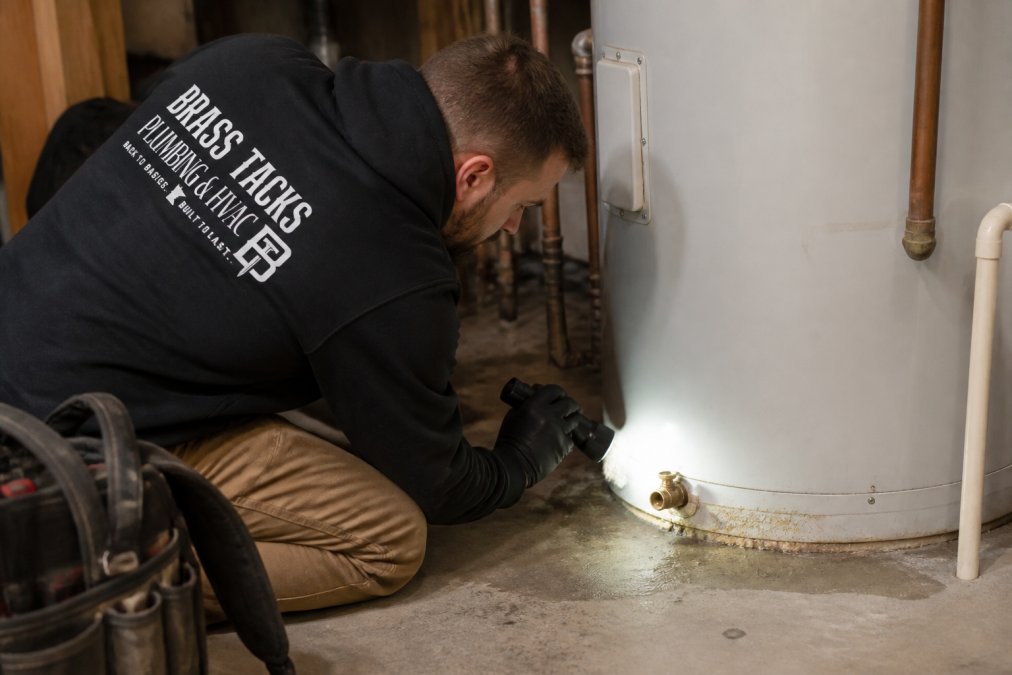
The clearest signs are rumbling or popping during heating, rusty or metallic-tasting hot water, moisture or corrosion around the tank base, and hot water that runs out faster than it used to. Any one of these points to sediment, corrosion, or a failing component that needs an inspection.
Water Heater Maintenance for Hard Water
Water heater maintenance for hard water comes down to three tasks: flush the tank annually, check the anode rod every one to two years, and test your water so you know what you are fighting. These habits extend tank life more than any brand upgrade.
Mark your flush on the calendar next to your furnace filter change. Pairing maintenance tasks makes both more likely to actually happen.
Frequently Asked Questions
What features should I look for in a water heater if I have hard water?
Focus on three things: tank lining material, sediment reduction technology, and anode rod type. Bradford White’s Vitraglas lining and Hydrojet system are designed to minimize sediment accumulation. A.O. Smith uses a DynaClean diffuser dip tube for the same purpose. For tankless units, stainless steel heat exchangers resist scale better than copper. Also check whether the unit accepts a powered anode rod, which lasts longer than a standard sacrificial rod in mineral-heavy water.
Do tankless water heaters handle hard water better than tank models?
Tankless units avoid the standing-water sediment problem that plagues tank heaters, but they are not immune to hard water. Scale accumulates inside the heat exchanger, and in hard water areas, manufacturers typically recommend descaling once a year. Rinnai’s scale-detection technology alerts you when maintenance is needed. Tankless units last longer in hard water only if you keep up with descaling. Skip that maintenance and the heat exchanger can fail prematurely.
How often should I flush my water heater to prevent sediment buildup?
In hard water areas, plan on flushing your tank water heater every six to twelve months. If your water hardness exceeds 10 grains per gallon, lean toward the six-month schedule. Tankless units need descaling about once a year, or more often if your water is especially mineral-heavy. You can flush a tank yourself with a garden hose and drain valve, but tankless descaling requires a pump kit and some comfort with the process. A plumber can handle either.
Are there specific water heater brands that are more resistant to scale?
Yes. Bradford White and A.O. Smith both build tank models with sediment-reduction features. Rinnai and Navien use stainless steel heat exchangers in their tankless models, which hold up better against mineral deposits than copper. No brand is scale-proof, but these designs slow the damage and extend the time between cleanings.
Is a water softener necessary if I have a high-quality water heater?
A quality water heater buys you time, but it does not cancel out hard water damage. If your water tests above 7 grains per gallon, a water softener protects the entire plumbing system, not just the water heater. It reduces scale in pipes, fixtures, and appliances. Many West Metro homes sit in that range. Pairing a softener with a sediment-resistant water heater is the most effective way to protect your investment long term.
