

Whole Home Air Purifier vs Portable Units: What Works
Table of Contents
- Whole Home Air Purifier vs Portable Units: The Short Answer
- Whole-Home vs Portable: Side-by-Side Comparison
- How Whole-Home Systems Work With Your HVAC
- How Portable Units Clean a Single Room
- Whole-Home Air Purifier Pros and Cons
- Portable Air Purifier Room Size: Matching the Unit to the Space
- Air Purifier CADR and Room Size: The Math That Matters
- Air Purifier Electricity Use and Long-Term Costs
- Frequently Asked Questions
Last Updated: October 19, 2026
Whole Home Air Purifier vs Portable Units: The Short Answer
A whole home air purifier treats the air across your entire house by working with your central heating and cooling system, while a portable unit cleans the air in one room. For most homeowners in the West Metro, the honest answer is that neither wins outright. The right pick depends on how many rooms you want to treat, how much you want to spend up front, and how your home is built. At Brass Tacks Plumbing, Heating & Cooling, we see this question come up most often in winter, when windows stay shut for months and stale air builds up.
Whole-Home vs Portable: Side-by-Side Comparison
The table below sums up the trade-offs. Whole-house systems win on coverage and hands-off operation. Portable air cleaners win on price and flexibility. But the numbers behind those trade-offs matter more than the labels, so the table includes measurable criteria where they apply.
| Factor | Whole-Home System | Portable Unit |
|---|---|---|
| Coverage | Entire home through ductwork | One room, typically a bedroom or office |
| Installation | Ties into HVAC system, requires a filter cabinet and a technician | None, plug and play |
| Upfront cost | Higher, includes equipment and labor | Lower, one-time purchase |
| Filter changes | One filter, one location | One per unit |
| Noise | Mostly at the furnace or air handler | In the room with you |
| Measurable performance | Depends on blower runtime, duct leakage, and filter MERV rating | Rated by CADR and air changes per hour (ACH) for a given room size |
| Pollutant coverage | Particles plus some gases if a carbon or VOC filter is added | Particles with HEPA; gases and odors only if the unit includes a carbon stage |
| Best for | Treating the whole house, especially in closed-up winter months | Targeting a bedroom, office, or a single priority room |
What the measurable criteria actually mean
CADR, or clean air delivery rate, tells you how much filtered air a portable unit moves per minute. A higher CADR covers a larger room. Air changes per hour (ACH) tells you how many times the unit turns over the air in that room.
Whole-home systems are not rated the same way. Their real-world performance depends on how often the blower runs, how leaky the ductwork is, and what filter the system is designed to accept.
Pollutant-specific performance
Neither option removes every pollutant. HEPA filters capture particles like dust, pollen, pet dander, and smoke particles. They do not remove gases, odors, or volatile organic compounds (VOCs) unless the unit includes a carbon or specialty filter stage. Whole-home systems can add a carbon or VOC filter, but the same airflow trade-offs apply. Portable units with a carbon stage handle odors in one room well, but they cannot treat the whole house. If your concern is cooking odors, new furniture off-gassing, or seasonal smoke, ask specifically what the filter media targets, not just how many particles it captures.
HVAC runtime, duct leakage, and room-to-room airflow
A whole-home system only cleans air while the blower is running. In a Minnesota winter your furnace cycles often, so coverage stays steady. In mild spring and fall, runtime drops and so does filtration. Duct leakage matters too: gaps in the ductwork let unfiltered air slip in after the filter. Room-to-room airflow also varies. A bedroom at the end of a long duct run may get less filtered air than a room near the furnace.
Ask your technician to check static pressure and duct condition before quoting a whole-home filter. A filter that chokes airflow can make your furnace work harder than it should.
How Whole-Home Systems Work With Your HVAC
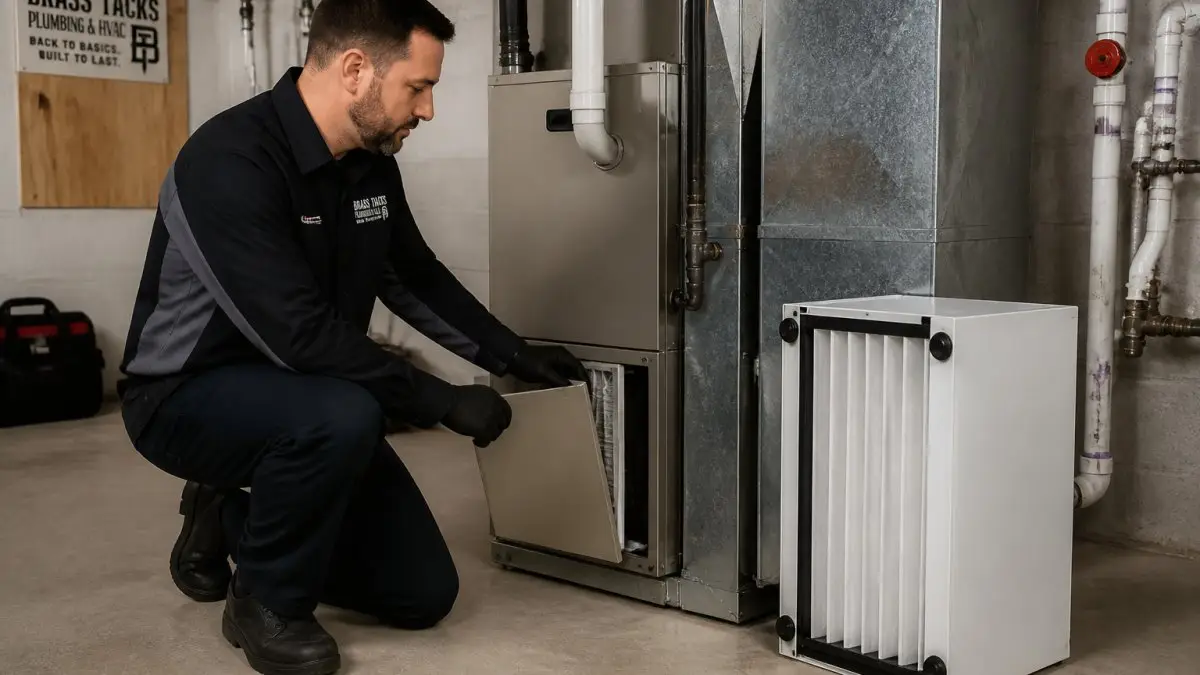
A whole-home air purifier installs in line with your furnace and ductwork, so every time your heating or cooling system runs, air passes through the filter before it reaches your rooms. That means one filter handles the whole house instead of one unit per room. The catch is that the system only cleans air while the blower is running.
How Portable Units Clean a Single Room
A portable air purifier pulls air through a HEPA filter and circulates clean air back into the same room. It works best in a closed space, like a bedroom or home office, where the door stays shut. Move it to a large open living area and the effect thins out fast. Most units include an onboard sensor and smart features, and reviews often note quiet operation. What they cannot do is clean air in a room they are not sitting in.
Whole-Home Air Purifier Pros and Cons
The pros of a whole-home air purifier are real: one filter, whole-house coverage, and no machines cluttering your rooms. You set it and forget it. The cons are just as real. Upfront cost is higher because you pay for equipment and installation. If your ductwork is leaky or undersized, performance suffers. And you need a compatible HVAC system to begin with. For a family in Plymouth heating an older house all winter, the hands-off coverage often justifies the cost. For a single room, it rarely does.
Portable Air Purifier Room Size: Matching the Unit to the Space
Portable air purifier room size is the number most shoppers skip, and it is the one that matters most. A unit rated for a small bedroom will underperform in an open-concept kitchen and living area. Match the unit to the square footage of the room where it will sit, and buy for the size of the space, not the size of the box. If a room has high ceilings or connects openly to other spaces, treat it as larger than the floor plan suggests. Two smaller units in two rooms usually beat one large unit trying to cover both.
Air Purifier CADR and Room Size: The Math That Matters
Air purifier CADR and room size go together. CADR, or clean air delivery rate, tells you how much filtered air a unit moves per minute. A higher CADR covers a larger room. Air changes per hour (ACH) tells you how many times the unit turns over the air in that room. A common rule of thumb is to aim for about four to five air changes per hour in the room you are treating. Divide the unit’s CADR by the room’s volume to estimate ACH.
Air Purifier Electricity Use and Long-Term Costs
Air purifier electricity use is modest for a portable unit running on a low fan speed, but it adds up across several units running all winter. A whole-home system draws power through your HVAC blower, so the added cost shows up as longer runtime rather than a separate plug. The bigger long-term cost is filters. Portable units need a replacement filter per machine, per schedule. A whole-home system needs one filter in one place. Over several years, the filter math often closes the gap between the two options.
A framework for total cost of ownership
Instead of comparing sticker prices, compare total cost of ownership over a consistent time horizon, such as five years. Add up these categories for each option:
- Equipment and installation: the unit itself plus any labor, filter cabinet, or ductwork changes.
- Replacement filters: the filter cost multiplied by how often you replace it, times the number of units or the single whole-home filter.
- Energy: the portable unit’s wattage at the fan speed you actually use, or the added blower runtime for a whole-home system.
- Maintenance: cleaning, sensor checks, and any service visits.
A single portable unit in one bedroom may cost less up front and less to run than a whole-home system. But if you want cleaner air in three bedrooms, three portable units means three filters, three plugs, and three machines running. At that point the whole-home filter math often looks better, especially if your HVAC system already runs frequently in winter. The reverse is also true: if you only care about one room, a portable unit usually wins on total cost.
Minnesota-specific operating considerations
In a Minnesota winter, windows stay shut for months and stale air builds up. That means both options run more hours, so energy and filter costs rise. A whole-home system benefits from the furnace running often, but it also means the filter loads up faster. Portable units in bedrooms run overnight, so noise and filter schedules matter more. In mild spring and fall, furnace runtime drops, and a whole-home system cleans less air unless the fan is set to run continuously, which adds its own energy cost. Plan filter replacements around the heating season, not just the calendar.
When a mixed strategy makes sense
Sometimes the practical answer is both. A whole-home filter handles the bulk of the house, and a portable unit in a bedroom or home office gives you targeted cleaning where you spend the most time. That combination often costs less than trying to cover every room with portable units, and it gives you a backup if the HVAC system is off. For a whole-house approach, our HVAC services team can walk you through what fits your system. If you are also thinking about humidity and air quality together, our indoor air quality page covers the options.
Compare total cost of ownership over five years, not sticker price. Add equipment, filters, energy, and maintenance for each option, and factor in how many rooms you actually want to treat.
Frequently Asked Questions
Is a whole house air purifier worth it?
It depends on how much of your home you want to treat. A whole home air purifier works with your central heating and cooling system to filter air across every room that shares the ductwork, which suits households dealing with pet dander, dust, or outdoor pollen in several rooms at once. If only one bedroom or office is a problem, a portable unit usually costs less upfront. Minnesota homes also run the furnace for long stretches in winter, so a system tied to that airflow gets plenty of runtime.
What is the 2/3 rule for air purifiers?
The 2/3 rule is a sizing shortcut: choose a purifier whose clean air delivery rate, or CADR, is at least two-thirds of the room’s square footage. A 300-square-foot room would call for a CADR around 200. The rule assumes an 8-foot ceiling and average conditions, so vaulted ceilings or open floor plans need more capacity. Use it as a starting point for portable air purifier room size, then check the manufacturer’s stated coverage area before buying.
Can one air purifier clean an entire house?
A single portable air purifier cannot clean a whole house. It moves and filters air in the room where it sits, and air in other rooms stays largely untouched. A whole home air purifier installed in the HVAC system can treat the whole house because it filters the air that the furnace or air conditioner circulates through the ducts. The catch is that it only works while the system fan runs, so many homeowners set the fan to circulate continuously for steady filtration.
Do air purifiers run up your electric bill?
Portable units draw little power, often in the range of a few cents per day at average electricity rates, though larger units on high speed use more. A whole home air purifier adds resistance to the duct system, and the blower motor uses somewhat more energy, especially if the fan runs continuously. The bigger ongoing cost for either type is filter replacement. Running the fan in circulate mode does add to air purifier electricity use, so weigh that against the filtration benefit.
Are whole-home air purifiers more effective than portable units?
Each works differently. Whole home systems filter all the air passing through your ductwork, which gives broad coverage but depends on HVAC runtime, duct leakage, and room-to-room airflow. Portable units can deliver a high CADR in one room and run independently of the furnace, which helps in a closed bedroom. Many homes do best with a mixed approach: a whole home air purifier for general filtration plus a portable unit in the room where someone sleeps or works.
If your home stays shut up all winter and the air feels stale, a whole-home approach may be the better fit. Brass Tacks Plumbing, Heating & Cooling offers honest recommendations without sales pressure, upfront pricing, and licensed technicians who respect your home. We can check your ductwork and confirm what your system can handle before you spend a dime. Get started with Brass Tacks Plumbing, Heating & Cooling and breathe easier in every room.
