

Is Whole Home Air Purification Worth It? 2026 Guide
Table of Contents
- Is Whole Home Air Purification Worth It? The Short Answer
- What a Whole-House Air Purifier Does That a Standard Filter Cannot
- Whole-House Air Purifier Pros and Cons for Minnesota Homes
- Whole-Home Air Purifier vs Portable Air Purifier: Which Fits Your Space?
- HVAC Air Purifier Installation: Compatibility, Airflow, and What to Expect
- Whole-Home Air Purifier Maintenance and Total Cost of Ownership
- Conclusion: Making the Call for Your Home
- Frequently Asked Questions
Last Updated: October 12, 2026
Is Whole Home Air Purification Worth It? The Short Answer
For many Minnesota households, whole home air purification is worth it if you want cleaner indoor air without managing a portable unit in every room.
Here is the honest version. A whole-house air purifier adds filtration or purification to the air that already moves through your furnace and air conditioner.
The sections below walk through what these systems catch, what they cost to own, and how to decide if one fits your home.
Whole home air purification makes the most sense when you have a specific airborne problem, such as allergies, pets, or smoke, and a ducted HVAC system that can handle the added resistance.
What a Whole-House Air Purifier Does That a Standard Filter Cannot
A whole-house air purifier is a filtration or purification device installed in your central HVAC system that treats the air as it circulates through your home. A standard filter catches some particles and protects your equipment. A purifier is built to capture or neutralize a much finer range of contaminants.
The difference comes down to filter media and technology, not marketing.
MERV Ratings, HEPA Filtration, and What Your HVAC Filter Actually Catches
Your HVAC air filter is rated on the MERV scale, which describes how well it captures particles of different sizes. A basic filter catches larger dust and lint.
True HEPA filtration captures a very fine range of particles, but a HEPA filter is thick and restrictive. Most residential furnaces and air conditioners were not designed to push air through one without a pressure drop that strains the blower.
EPA guidance on indoor air quality and air cleaners
UV-C, Ionization, and Ozone: Technology Trade-Offs and Safety
Ultraviolet light, usually described as UV-C, is aimed at living contaminants like mold spores, bacteria, and viruses as air passes the lamp. It works best as a supplement to filtration, not a replacement.
Ionization and similar technologies charge particles so they clump together and settle or get caught. The catch is ozone. Some of these devices produce ozone as a byproduct, and ozone is a lung irritant.
Avoid any device that produces ozone as a feature. Ozone is a respiratory irritant, and no amount of “fresh air smell” is worth the health risk.
Whole-House Air Purifier Pros and Cons for Minnesota Homes
Minnesota homes spend most of the year closed up, first against the cold and then against the heat and humidity. That means your indoor air quality depends heavily on what your HVAC system is doing, which is exactly why whole-home purification gets attention here. But the pros and cons only matter if you match them to your actual problem.
The Real Advantages
- Whole-house coverage. Every room connected to your ductwork gets treated air, not just the one room with a portable unit.
- No units to move or plug in. Nothing sits in the middle of a bedroom or competes for an outlet.
- Year-round operation. The system runs whenever your blower runs, which in a Minnesota winter is most of the time.
- Particle reduction over time. With the right filtration, dust, pollen, pet dander, and smoke particles drop across the whole home, not just near the unit.
The Real Trade-Offs
- Upfront cost is higher than a portable unit. You are paying for equipment, installation labor, and often ductwork or airflow corrections.
- Ongoing maintenance is non-negotiable. Filters and, depending on the technology, lamps need replacing on a schedule.
- Airflow resistance is the hidden risk. A filter that is too restrictive for your blower raises pressure drop, which can reduce comfort in far rooms and shorten equipment life.
- Duct condition matters. Leaky or undersized ducts mean treated air never reaches the rooms you care about. A purifier cannot fix a distribution problem.
A Decision Framework by Household and Problem
Instead of asking whether whole-home purification is worth it in general, ask which category you fall into:
- Seasonal allergies, whole house. If pollen and mold spores bother you in every room, a whole-home system with appropriate filtration is usually the better fit than moving a portable unit from room to room.
- Pets, whole house. Pet dander circulates everywhere your pet goes. Whole-home filtration addresses that better than a single-room unit.
- Smoke or wildfire haze. Whole-home filtration helps, but source control and sealing gaps matter too. No filter fixes a house that leaks air freely.
- One problem room. If a single bedroom or office is the issue, a portable purifier is the simpler and cheaper answer.
When a Portable Purifier or Source Control Is the Better Call
If your ducts leak, your blower is undersized, or your complaint is limited to one space, a whole-home system may underperform or cost more than the problem justifies.
That is why we check compatibility before recommending anything. If your ducts leak or your blower is already undersized, a purifier can underperform or even shorten equipment life. An honest inspection tells you which category you are in.
Homeowners with a ducted furnace or air handler, a whole-house airborne problem like allergies, pets, or smoke, and a system that can handle the added filtration without straining the blower.
Whole-Home Air Purifier vs Portable Air Purifier: Which Fits Your Space?
A whole-home air purifier treats air across your entire ducted system, while a portable air purifier cleans the air in a single room. The right choice depends on how many rooms you actually need to cover and how long you plan to stay in the home.
| Factor | Whole-Home Air Purifier | Portable Air Purifier |
|---|---|---|
| Coverage | Every room on the ductwork | One room |
| Upfront cost | Higher | Lower |
| Maintenance | Filter changes, occasional service | Filter changes, more frequent |
| Best for | Whole-house allergies, pets, smoke | A single bedroom or office |
| Noise | Quiet, tied to HVAC runtime | Varies by unit and speed |
If one bedroom is the problem, a portable unit is the simpler answer. If every room feels stuffy and you have pets or allergies throughout the house, a whole-home system usually makes more sense.
If you are testing the waters, start with a portable purifier in the room you use most. If it helps and you wish it covered the whole house, that is your signal to look at a whole-home option.
HVAC Air Purifier Installation: Compatibility, Airflow, and What to Expect
HVAC air purifier installation starts with an inspection of your furnace, ductwork, and blower capacity.
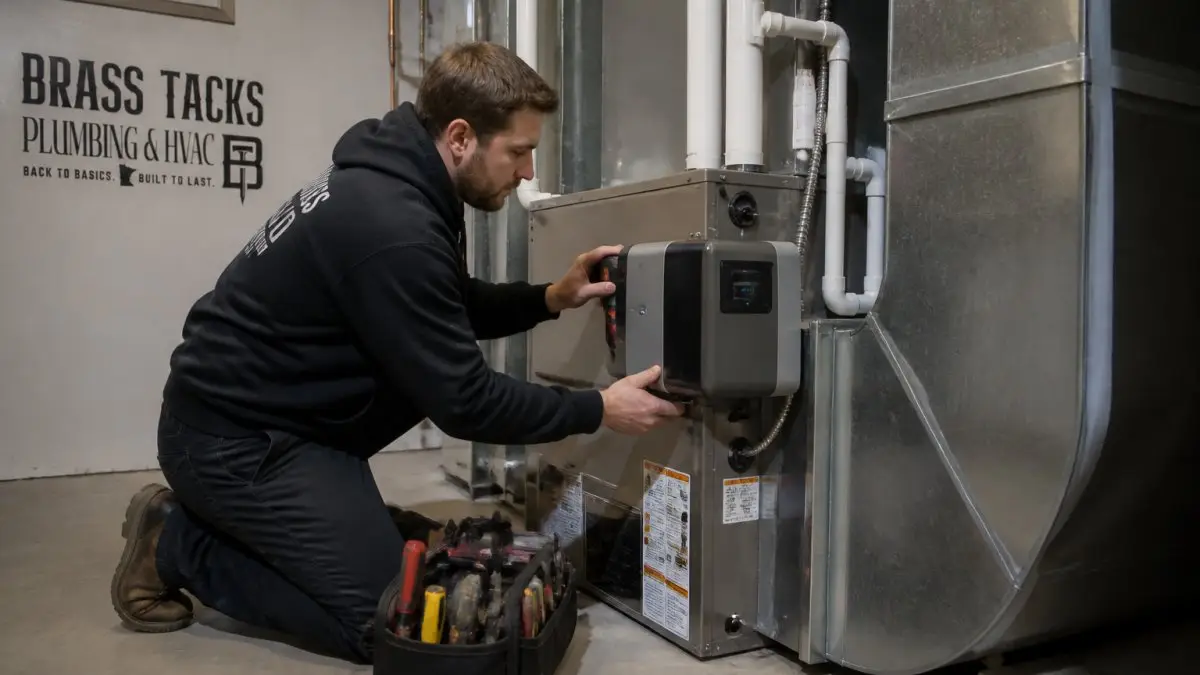
Most installations take a few hours. The unit mounts on or near the furnace or air handler, and the technician wires it into the system so it runs with your blower.
Airflow matters more than most homeowners realize. A filter that is too restrictive raises the pressure drop across your system, which makes the blower work harder and can reduce comfort in rooms farthest from the furnace.
Homeowners with a ducted furnace or air handler who want cleaner air across the whole house and are willing to keep up with filter changes.
Whole-Home Air Purifier Maintenance and Total Cost of Ownership
Whole-home air purifier maintenance comes down to filters, lamps, and occasional service, and those recurring costs usually matter more than the sticker price over the life of the system. Most homeowners focus on the install quote and forget that a purifier is a long-term commitment with its own operating budget.
What Actually Drives the Cost Over Time
Instead of a single number, think in terms of four buckets:
- Installation. Varies widely with the type of system, the condition of your ductwork, and whether your blower and return air path can handle the added resistance. A bypass media cabinet, an in-duct media filter, and a UV or ionization add-on all price differently.
- Replacement filters. High-efficiency media filters cost more than a basic fiberglass or pleated filter and need changing on a schedule. During a Minnesota heating season, your system can run nearly continuously, so filters load up faster than they would in a milder climate.
- Consumables like UV lamps. UV-C lamps lose intensity over time and are typically replaced on a manufacturer-set interval, not just when they burn out.
- Electricity and blower load. A restrictive filter raises the pressure drop across your system. That makes the blower work harder, which shows up as higher energy use and, over years, more wear on the motor.
The indirect cost is the one most homeowners miss. A filter that is too aggressive for your equipment can shorten blower life and reduce comfort in rooms farthest from the furnace. That is a real cost, even if it never appears on a receipt.
Maintenance Habits That Keep Costs Predictable
- Replace filters on the manufacturer’s schedule, not just when they look dirty. A filter can look fine and still be loaded.
- Check the filter after dusty projects like remodeling, drywall work, or moving.
- Have the purifier inspected during your regular furnace service so airflow and pressure drop get checked at the same time.
- Watch for reduced airflow, longer run times, or higher energy bills. Those can signal a clogged filter or a system that is working against too much resistance.
If you have not had your furnace serviced in a while, that is the first thing to fix. A well-maintained system gets more out of any purifier you add, and it protects the equipment you already own. Our heating and cooling service page covers what a seasonal tune-up includes, and if something sounds off between visits, furnace repair can catch a small issue before it turns into a mid-winter breakdown.
A Simple Way to Think About Payback
There is no universal break-even point, because it depends on your equipment, your filter schedule, and what you are trying to solve. A practical approach is to compare the whole-home option against the alternative you would actually use: multiple portable purifiers, each with its own filters and its own electricity draw, spread across the rooms you care about. When you add up the units, the filters, and the outlets they occupy, the gap often narrows more than people expect.
ENERGY STAR guidance on heating and cooling maintenance
Ask for the filter part number and the recommended replacement interval before you buy. If a quote does not include that information, you cannot compare total cost of ownership between two options.
Conclusion: Making the Call for Your Home
Whole home air purification is worth it when you have a real airborne problem and a ducted system that can handle the added filtration.
The deciding factor is usually your HVAC system itself. Compatibility, airflow, and duct condition determine whether a purifier actually performs or just adds resistance.
If you are weighing your options in Plymouth, Wayzata, Minnetonka, or anywhere in the West Metro, our team can look at your furnace and ductwork and tell you plainly whether a whole-home system fits.
Frequently Asked Questions
Is it a good idea to have a whole-home air purifier in your house?
It depends on what is bothering you. If dust, pollen, pet dander, or smoke particles are a constant problem and you already run your central HVAC system daily, a whole-home air purifier can clean the air across every room instead of just one. If your concerns are limited to a single bedroom or a specific odor, a portable unit may be enough. A technician can inspect your ductwork and system compatibility before you commit.
Do whole-home air purifiers help with allergies and asthma triggers?
They can reduce airborne allergens such as pollen, dust, and pet dander that circulate through your ductwork, which may ease symptoms for some people. However, no system eliminates every trigger. Pet dander on furniture, dust mites in bedding, and mold spores in damp areas need separate attention. Pairing purification with regular filter changes and humidity control gives you the best chance at cleaner indoor air.
What are the disadvantages of a whole-home air purifier?
The main drawbacks are upfront cost, ongoing filter replacement, and potential airflow restriction if the unit is not matched to your system. High-efficiency filters can create pressure drop that makes your blower work harder, raising energy consumption. Some technologies, like ionization, may produce trace ozone. Proper sizing and a qualified HVAC air purifier installation matter more than the brand on the box.
Is a whole-home air purifier better than a portable air purifier?
A whole-home system treats air in every room connected to your ductwork and runs automatically whenever your HVAC system runs. A portable purifier is simpler to place and move but only cleans the room it sits in. For households with widespread allergy concerns or open floor plans, whole-home purification usually makes more sense. For renters or single-room issues, portable units are a practical starting point.
