

How Often Should Sewer Lines Be Cleaned? A Homeowner’s Guide

Table of Contents
- How Often Should Sewer Lines Be Cleaned? The Short Answer
- What Actually Determines Your Sewer Line Cleaning Schedule
- Signs of a Clogged Sewer Line You Should Never Ignore
- How to Prevent Sewer Line Clogs Before They Start
- Professional Sewer Cleaning: What Happens and What It Costs
- Sewer Line Inspection: Why Cleaning Alone Isn’t Enough
- Minnesota Homeowner Considerations: Cold Weather and Older Pipes
- Conclusion: Building a Sewer Maintenance Plan That Works for Your Home
- Frequently Asked Questions
Last Updated: October 7, 2026
How Often Should Sewer Lines Be Cleaned? The Short Answer
For most homes, how often should sewer lines be cleaned comes down to one number: every 18 to 24 months.
Sewer line cleaning removes buildup, roots, and debris from the pipe that carries wastewater from your home to the city main. At Brass Tacks Plumbing, Heating & Cooling, we have cleared enough backed-up lines in the West Metro to know a fixed schedule rarely fits every home.
Three things set your number: pipe age and material, household water use, and what is growing in your yard.
Below, we break down how to build a schedule that fits your home, plus the warning signs that mean you should not wait.
What Actually Determines Your Sewer Line Cleaning Schedule
No two homes need the same cleaning interval. A 1950s rambler in Maple Grove with mature maples out front is a different situation than a newer build with PVC pipe and no trees nearby.
Here is what moves your timeline.
Pipe Age and Material
Older pipes clog faster. Cast iron and clay tile, common in homes built before the 1980s, develop rough interior walls that catch debris and build up over time.
- PVC plastic: Smooth walls, fewer clogs, longer intervals
- Cast iron: Rusts and scales inside, needs closer watching
- Clay tile: Joints shift and crack, inviting roots and soil
If your home still has original 1970s plumbing, a camera inspection tells you more than any calendar can.
Household Size and Water Use
More people means more water, grease, and waste moving through the same pipe. A family of five sends far more down the drain than a couple.
- More showers and laundry mean more flow
- Heavy cooking sends more grease and food waste
- Guests and holidays spike usage fast
Trees and Landscaping
Tree roots are the most common cause of repeat sewer backups. Roots find tiny cracks and seams, then grow into the pipe looking for water.
Mature trees within about 10 feet of your sewer line deserve attention. Maples, willows, and elms are the usual suspects in this part of Minnesota.
Signs of a Clogged Sewer Line You Should Never Ignore
A slow drain here and there is normal. Several slow drains at once is not. When multiple fixtures back up together, the problem is usually in the main sewer line, not the individual drain.
Watch for these warning signs:
- Multiple slow drains in sinks, tubs, and showers
- Gurgling sounds from toilets after you run water
- Sewage odors inside the house or near floor drains
One backup is a warning. Two is a pattern. If the same line has been cleared twice in a year, cleaning alone is not solving the problem.
How to Prevent Sewer Line Clogs Before They Start
Prevention comes down to what you put down the drain, how you maintain the line, and what you avoid. Most online advice skips the part that matters: which habits protect the pipe and which quietly make things worse.
What to keep out of the drain
Start with the kitchen:
- Never pour grease, oil, or fat down the sink. It cools and hardens on the pipe wall, and each layer narrows the opening.
- Scrape plates into the trash and use a drain strainer to catch food waste.
- Run cold water while and after using the disposal, so waste keeps moving instead of settling.
Then the bathroom and laundry:
- Use a hair catcher in tubs and showers.
- Never flush wipes, paper towels, or feminine products. Even wipes labeled flushable snag on rough pipe walls and root hairs.
- Clean the dryer vent and washer filter on schedule.
Safe DIY habits that actually help
A few low-cost habits make a real difference on a main line:
- Run water long enough. After using the disposal or finishing a shower, let the water run a bit longer so waste clears the branch line and reaches the main.
- Flush with hot water monthly. A pot of hot (not boiling) water down the kitchen sink helps move grease residue before it sets.
- Watch the lowest drain in the house. In many West Metro homes that is a basement floor drain. If it smells or drains slowly, the main line is telling you something before a backup does.
Methods to avoid
These are the ones that cause the most trouble:
- Chemical drain cleaners. Caustic and acidic versions can damage older cast iron, clay tile, and Orangeburg pipe, and they rarely clear a main-line blockage because they only contact the small pool of water in the trap. On roots, they do nothing.
- Store-bought hand snakes on a main line. A 25-foot drum auger cannot reach a blockage 40 or 60 feet out at the city connection, and it can scratch the pipe wall, giving debris and roots a better grip.
- Flushing wipes or “flushable” products. The label does not match how they behave in a real pipe.
Never pour chemical drain cleaners into a main line with a suspected root blockage. The chemicals can damage older pipes and rarely clear the actual cause, leaving you with a bigger repair bill.
Add one preventive step
An annual camera inspection is worth it if your line has a history of problems, if your home has mature trees within about 10 feet of the sewer, or if the pipe is original cast iron, clay tile, or Orangeburg. Catching root intrusion early costs far less than an emergency backup and turns a reactive cleaning into a schedule you can plan around.
If your home has mature trees near the sewer line, ask for a camera inspection during your next routine plumbing visit. Spotting roots early means a quick cleaning instead of a flooded basement.
Professional Sewer Cleaning: What Happens and What It Costs
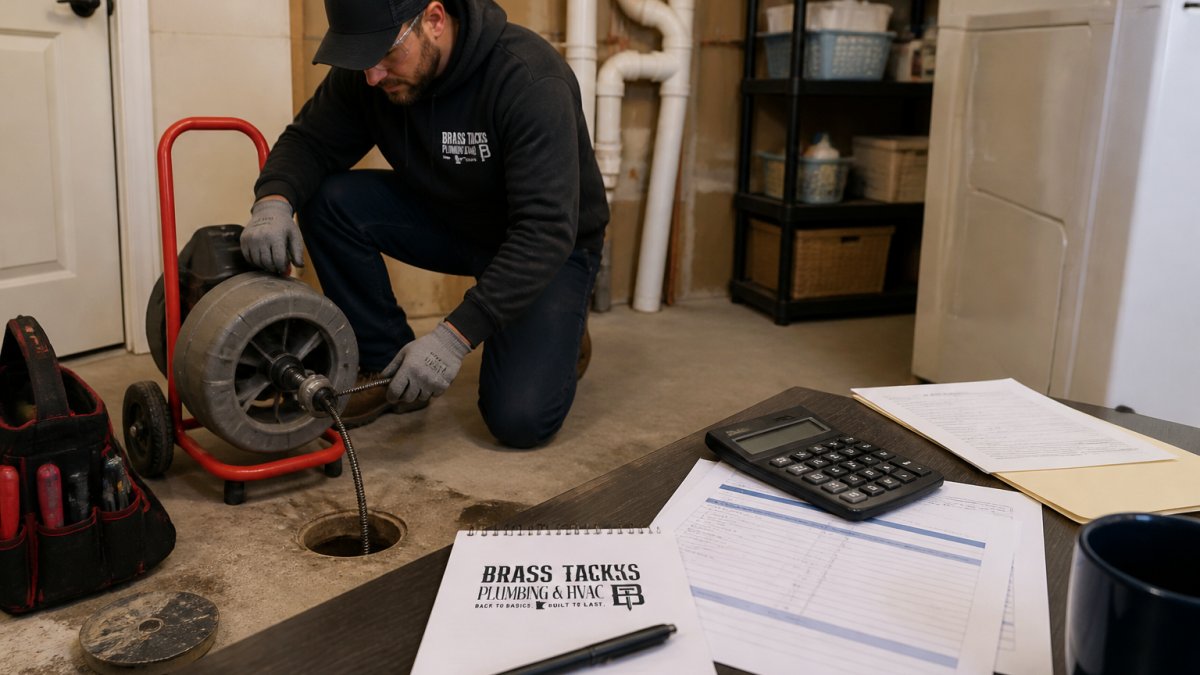
Professional sewer cleaning is not the same as snaking a single drain. A technician works the full length of the main line from the house to the city connection, using equipment sized for the pipe.
Step 1: Locate the cleanout and assess the line
The technician finds the cleanout, usually a capped pipe near the foundation or in the basement floor. If the home has no accessible cleanout, that is a conversation before work starts, because pulling a toilet to access the line changes the job.
Step 2: Run a camera before cleaning
A camera inspection comes first on any line with a history of backups. The camera shows whether the blockage is grease, roots, scale, or a broken pipe, and the right tool depends on what is actually in the line. Jetting a collapsed or cracked pipe can turn a repair into a replacement.
Step 3: Clear the blockage with the right method
Soft clogs, grease, and small roots usually come out with a mechanical auger. Heavy grease, scale, and dense root masses respond better to hydro jetting, which scours the pipe wall rather than just punching a hole through the clog.
Step 4: Flush and verify flow
The technician runs water through the line and confirms it drains at full speed. A line that drains slowly after cleaning usually means the tool did not reach the full blockage or the pipe has a belly or offset the camera will show.
Step 5: Show you the footage and explain what comes next
You should see the before and after camera footage. If roots are the cause, the technician can tell you whether they were cut back or whether the pipe has damage that will bring them back. That is the difference between a cleaning and a plan.
Hydro Jetting vs. Mechanical Augering
These are the two main methods, and each fits a different job.
Mechanical augering uses a rotating steel cable to break up clogs. It works well for grease, soft blockages, and small roots.
Hydro jetting uses high-pressure water to scour the pipe walls clean.
| Method | Best For | Limitation |
|---|---|---|
| Mechanical augering | Grease, soft clogs, small roots | May leave residue behind |
| Hydro jetting | Heavy grease, scale, root masses | Not for fragile or damaged pipes |
A camera inspection should come first. Jetting a cracked or collapsed pipe can make the damage worse.
What affects the cost
Sewer cleaning is not a flat-rate job, and any quote that ignores these factors is a guess. The main drivers are:
- Line length and access. A long run to the city main takes more time and cable than a short one. A missing or buried cleanout adds work.
- Blockage type. Grease and soft waste clear quickly. Dense roots and scale take longer and may need jetting instead of augering.
- Pipe condition. A fragile clay tile or Orangeburg line limits which tools are safe to use.
We list our current rates on our pricing page, so you know the cost before we start. If a quote does not mention line length, blockage type, or whether a camera is included, ask. Those three answers tell you whether the number is real.
Ask whether the camera inspection is included in the cleaning quote or billed separately. On a line with a backup history, the camera is the part that keeps you from paying for the same cleaning twice.
Sewer Line Inspection: Why Cleaning Alone Isn’t Enough
Cleaning clears the pipe. Inspection tells you why it clogged. Without a camera, you are guessing.
A sewer line inspection is a camera survey of the inside of your pipe to find cracks, root intrusion, bellies, and offset joints.
Inspection matters because it changes the plan:
- It shows whether roots will return
- It spots cracks before they collapse
- It tells you if the pipe is the wrong material or slope
Cleaning without inspection is like treating a symptom and ignoring the cause. If your line backs up twice, ask for the camera.
Minnesota Homeowner Considerations: Cold Weather and Older Pipes
Freezing temperatures change the rules here. Cold alone rarely freezes a main sewer line, but it affects everything around it.
- Frozen ground shifts soil, which can crack older clay or cast iron pipes
- Thaw cycles let water into cracks, then refreeze and widen them
- Snowmelt in spring flushes debris and roots into lines
Older housing stock across the West Metro adds to the risk. Many homes still have original cast iron or clay tile lines that have been in the ground for decades.
Spring, after the thaw, is a smart time to inspect a problem line. Fall, before the freeze, is the time to clear one.
Conclusion: Building a Sewer Maintenance Plan That Works for Your Home
The right schedule is not a number on a calendar. It is a plan built around your pipe material, your household, and your yard.
For most homes, that means cleaning every 18 to 24 months, with an inspection whenever you see warning signs. For older homes with mature trees, it may mean annual checks.
At Brass Tacks Plumbing, Heating & Cooling, we handle sewer cleaning, camera inspections, and honest recommendations with no sales pressure. Because we are a full-service team, we can also help when a related system needs attention, whether that is plumbing services for the rest of your home or emergency plumbing when a backup will not wait.
If your drains are slow, gurgling, or backing up, do not wait for the next flood. Schedule your plumbing service with Brass Tacks Plumbing, Heating & Cooling and get a clear answer about what your line actually needs.
Frequently Asked Questions
How often should a residential sewer line be cleaned?
Most homes benefit from professional sewer line cleaning every 18 to 24 months. If your home has mature trees near the sewer line, older clay or cast iron pipes, or a large household, you may need cleaning more often, sometimes annually. Homes with newer PVC pipes and no tree root issues can often stretch the interval to two or three years. A camera inspection gives you the clearest picture of what your specific line needs.
What are the signs that a sewer line needs cleaning?
Watch for slow drains in multiple fixtures at once, gurgling sounds from toilets after flushing, sewage odors inside or outside the home, and water backing up in tubs or showers when you run the washing machine. Recurring backups are the clearest sign of buildup or root intrusion. If you notice any of these, schedule a sewer line inspection before the problem becomes an emergency.
Can I clean out a sewer line myself?
You can handle minor clogs in a single drain with a plunger or hand auger, but the main sewer line requires professional equipment. Store-bought chemical drain cleaners can damage older pipes and rarely clear the full line. A professional sewer cleaning uses mechanical augering or hydro jetting to remove grease, roots, and debris throughout the pipe. DIY attempts on the main line often push the clog deeper or miss it entirely.
Does homeowners insurance cover underground sewer pipes?
Standard homeowners insurance typically does not cover sewer line repair or replacement, since it is considered maintenance. Some policies offer an endorsement or service line coverage add-on that handles sudden damage. Check your policy documents or call your agent to confirm what is covered. Routine sewer line maintenance, including professional cleaning and inspection, is generally the homeowner’s responsibility.
