

Most Common Water Heater Problem: What Breaks First

Table of Contents
- What Is Usually the Most Common Water Heater Problem?
- Why Is My Water Heater Not Producing Enough Hot Water?
- Water Heater Leaking From the Bottom: What It Means
- Strange Noises, Rusty Water, and Other Warning Signs
- Signs Your Water Heater Needs Replacing (Not Just Repairing)
- How Long Does a Water Heater Last? Understanding Water Heater Lifespan
- Repair or Replace? A Decision Framework for Homeowners
- Conclusion: Get an Onsite Diagnosis Before You Decide
- Frequently Asked Questions
Last Updated: October 8, 2026
What Is Usually the Most Common Water Heater Problem?
Ask most plumbers what they get called about the most and the answer is simple: no hot water or not enough of it.
A water heater problem rarely appears out of nowhere. Most units give warning signs first, and knowing what to look for can save you a cold shower and an emergency call.
Below, we break down the most common issues by symptom and show you when a repair makes sense versus when it is time to replace.
The most common water heater problem is a lack of hot water, not a leaking tank. Heating elements, thermostats, and pilot assemblies fail far more often than tanks do.
Why Is My Water Heater Not Producing Enough Hot Water?
Insufficient hot water usually means one of three things: a burned-out heating element, a thermostat that reads the wrong temperature, or sediment built up on the tank bottom. The fix depends on whether you have a gas or electric unit.
If your showers start warm and fade fast, that points to a heating element that is partially failing or a dip tube that has broken off.
Electric vs. Gas: Different Causes, Same Symptom
Electric and gas heaters fail in different ways, so the diagnosis matters before anyone touches the unit.
- Electric water heaters: The upper or lower heating element burns out, or a thermostat fails. A tripped breaker can mimic a dead heater.
- Gas water heaters: The pilot light goes out, the thermocouple fails, or the ignition system stops firing. A dirty burner can also reduce output.
- Both types: Sediment buildup insulates the water from the heat source, so the unit runs longer and delivers less.
One thing most guides miss: on a gas unit, a pilot that keeps going out is rarely the pilot’s fault. It is usually the thermocouple telling the gas valve to shut off.
If you are not comfortable working around gas lines or 240-volt circuits, stop there. Both are worth handing to a licensed technician.
Water Heater Leaking From the Bottom: What It Means
A water heater leaking from the bottom is the one symptom you should never ignore. It usually means the tank itself has corroded through, and a corroded tank cannot be repaired, only replaced.
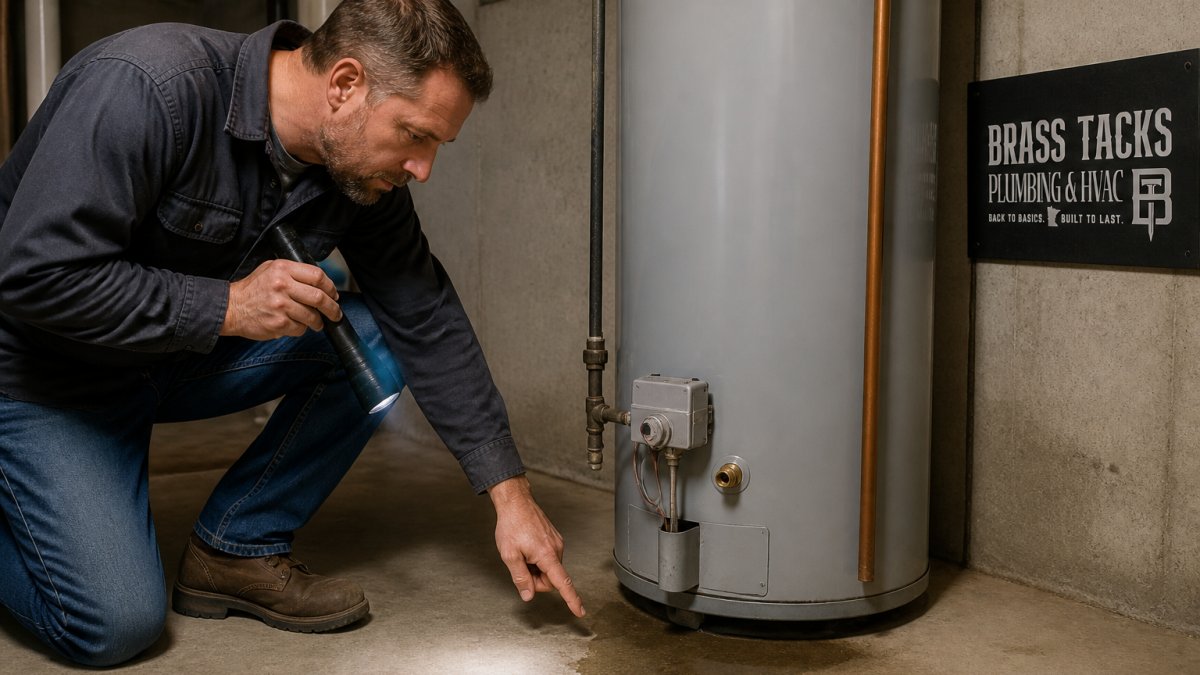
Not every bottom leak is a dead tank, though. Sometimes the water comes from a loose drain valve, a failing pressure-relief valve, or a fitting above the tank that drips down the side.
When a Bottom Leak Is an Emergency
Treat any active leak as urgent if you see standing water, rust-colored water, or water pooling near electrical outlets. Shut off the water supply and the power or gas to the unit, then call for help.
- Water spreading toward electrical panels or outlets
- A leak that will not stop after shutting off the supply
- Rust streaks or a bulging tank seam
A slow drip from a fitting can wait for a scheduled visit. A steady stream from the tank cannot.
Strange Noises, Rusty Water, and Other Warning Signs
Not every symptom deserves the same reaction. Some are cosmetic, some point to a part you can replace, and some mean the tank is finished. Here is how the common complaints rank by how often they show up.
- No hot water or not enough hot water: the most frequent call by a wide margin. On electric units it is usually a burned-out element or a failed thermostat. On gas units it is usually the thermocouple, the pilot, or the ignition system.
- Popping, rumbling, or banging: sediment on the tank bottom. Very common in hard-water homes, and the noise gets worse the longer it goes unflushed.
- Rusty or discolored hot water: a worn anode rod if only the hot side is affected. If both hot and cold run rusty, the pipes are the source, not the heater.
Which Problems Hit Which Heater Type
Frequency shifts depending on what you own, which changes what you should watch for.
| Heater type | Most common failure | What it looks like |
|---|---|---|
| Electric tank | Heating element or thermostat | Lukewarm water, tripped breaker, no hot water at all |
| Gas tank | Thermocouple, pilot, or ignition | Pilot will not stay lit, unit clicks but does not fire |
| Tankless | Scale buildup, flow sensor, error codes | Temperature fluctuates, unit shuts off mid-shower |
| Any tank | Sediment and anode rod wear | Popping noises, rusty hot water, shorter tank life |
Tankless units fail differently than tanks. With no standing water to heat, the wear items are the heat exchanger, the flow sensor, and the descaling schedule. In hard-water areas, skipping annual descaling is the fastest way to shorten a tankless unit’s life.
A Safe Order for Checking Things Yourself
To narrow down the problem before calling, work in this order. Stop at any point that involves gas, 240-volt wiring, or standing water near electricity.
- Confirm the symptom. Is it no hot water, not enough hot water, or water that never gets hot? Each points somewhere different.
- Check the breaker (electric) or the pilot (gas). A tripped breaker can look exactly like a dead heater. A pilot that will not stay lit usually means the thermocouple.
- Listen at the tank. Popping means sediment. Silence on a gas unit means it is not firing.
- Look at the base and the fittings. A drip from a valve or fitting is a repair. Water weeping from the tank seam is not.
- Check the anode rod if you can reach it. A rod that is mostly consumed means the tank interior is next.
Do not open the burner compartment, disconnect gas lines, or remove access panels on an electric heater. Gas and 240-volt circuits are not homeowner jobs, and a pressure-relief valve should never be capped or plugged to stop a drip.
If any step points to gas, high voltage, or active leaking, stop and call a licensed technician. Our team handles water heater repair across the West Metro and can tell you on site whether you are looking at a part or a tank.
Signs Your Water Heater Needs Replacing (Not Just Repairing)
Age plus a major symptom is the clearest signal to replace. If your tank is past its expected lifespan and you are seeing leaks, rust, or repeated failures, repairs become a temporary patch on a unit that is already on its way out.
Here is how to tell the difference:
| Symptom | Likely Cause | Repair or Replace? |
|---|---|---|
| No hot water, unit under 10 years | Heating element or thermostat | Repair |
| No hot water, unit over 12 years | Multiple failing parts | Replace |
| Rusty hot water only | Worn anode rod | Repair if caught early |
| Rusty water plus tank corrosion | Tank interior failing | Replace |
| Popping or rumbling | Sediment buildup | Flush, or replace if severe |
| Leaking from the tank itself | Corroded tank | Replace |
| Leaking from a valve or fitting | Loose or worn part | Repair |
When you are weighing a repair against a replacement, our team walks you through what is actually failing, with no pressure either way. You can see how we handle water heater repair and water heater replacement before you decide.
How Long Does a Water Heater Last? Understanding Water Heater Lifespan
Lifespan is not just a number. It is the clearest predictor of which problem you are likely to face next. A 6-year-old tank that is popping has a very different outlook than one that is 14 and leaking.
Typical ranges homeowners see:
- Standard tank, gas or electric: roughly 8 to 12 years with annual flushing. Closer to 8 without it.
- Tankless: 20 years or more, but only with annual descaling in hard water.
- Power-vent and high-efficiency tanks: similar to standard tanks, though electronics and blowers add parts that can fail earlier.
How Water Quality and Climate Change the Timeline
Hard water is common across the West Metro and is the biggest single factor in how long a tank lasts. A water softener reduces that scale load and can push a tank toward the top of its range.
Cold groundwater matters too. Incoming water in Minnesota can be dramatically colder in winter than in summer, so the heater has to raise it further to reach the setpoint.
What Usually Fails First, by Heater Type
Knowing the typical failure order helps you decide whether a repair is worth it.
- Electric tank: the lower heating element usually goes first, then the upper element or thermostat. Anode rod wear follows.
- Gas tank: the thermocouple or ignition system is the first repeat offender, then the anode rod, then the tank itself.
- Tankless: scale in the heat exchanger, then the flow sensor, then error codes from either.
A tank that has had two or more part failures in the last two years is telling you the rest of the unit is not far behind. That is when repair stops being the economical choice.
Flush a tank water heater once a year and check the anode rod every two to three years. Those two habits do more for lifespan than anything else, and they directly reduce the sediment and corrosion problems that cause most mid-life failures.
If you are not sure when your unit was last serviced, or you are weighing a repair against a replacement, our team can inspect it and give you a straight answer. You can see how we handle water heater replacement and water heater maintenance before you decide.
Repair or Replace? A Decision Framework for Homeowners
Use age and symptom together, not age alone. A 6-year-old heater with a dead element is an easy repair. A 14-year-old heater with a leaking tank is not worth fixing.
Run through this before you call:
- How old is the unit? Under 10 years leans repair. Over 12 leans replace.
- Is the tank itself leaking or corroded? If yes, replace.
- Is the problem a single part like an element or thermocouple? Repair.
- Have you had repeat failures in the last two years? Replace.
If you are in an older Plymouth home with original plumbing, a new heater may need updated connections or a different venting setup. That is normal, and a good technician will explain it before any work starts.
Conclusion: Get an Onsite Diagnosis Before You Decide
No hot water, a bottom leak, or rusty water all point to different fixes, and guessing wrong wastes money. Some problems are a quick repair.
Brass Tacks Plumbing, Heating & Cooling is a family-owned team serving the West Metro with upfront pricing and no sales pressure. We diagnose the actual failure, explain your options in plain language, and let you decide.
Frequently Asked Questions
What are the first signs of a water heater going bad?
The earliest signs usually include inconsistent hot water, a drop in water temperature, or hot water running out faster than it used to. You might also notice popping or rumbling sounds from sediment buildup, rusty or discolored hot water, or small moisture spots around the base of the tank. Catching these early gives you time to schedule a repair or plan for replacement before the unit fails completely.
What is the average lifespan of a hot water heater?
Most tank-style water heaters last between 8 and 12 years, though this varies by brand, usage, and maintenance. Tankless units can last up to 20 years with regular descaling. In Minnesota, hard water and heavy winter demand can shorten lifespan, so annual flushing and anode rod checks help you get closer to the upper end of that range.
When should a water heater be repaired or replaced?
If your heater is under 10 years old and the problem is a single failed component like a heating element, thermostat, or pressure-relief valve, repair usually makes sense. If the tank itself is leaking, the unit is over 10 to 12 years old, or you are facing multiple failures at once, replacement is typically the better long-term decision. An onsite inspection gives you the clearest answer.
Why is my water heater making popping or rumbling noises?
Popping and rumbling come from sediment buildup on the bottom of the tank. As the burner or element heats the water, trapped water under the sediment layer boils and pops. Flushing the tank removes the sediment and often quiets the noise. If flushing does not help and the tank is older, the sediment may have already caused damage that shortens the unit’s remaining life.
A quick note: This article is educational. It is not a substitute for an onsite diagnosis when a plumbing or HVAC problem needs an in-person look. If you are unsure, call a licensed professional.
