
AC Not Keeping Up in 100 Degree Weather? What to Do
Table of Contents
- Why Your AC Is Not Keeping Up in 100 Degree Weather
- Is Your AC Not Cooling in Extreme Heat? A Safe Troubleshooting Checklist
- Step 1: Confirm what the system is actually doing
- Step 2: Check the air filter before anything else
- Step 3: Verify the outdoor unit is running and breathing
- Step 4: Reduce the load inside the house
- Step 5: Walk the supply vents room by room
- Step 6: Feel the air at a supply register
- Step 7: Look for ice on the indoor coil or refrigerant lines
- Step 8: Know when to stop and call
- How to Keep House Cool in 100-Degree Weather
- Dirty Air Filter AC Symptoms You Should Not Ignore
- AC Frozen Coil in Hot Weather: Why It Happens and What to Do
- Outdoor Unit, Ductwork, and Room-by-Room Airflow Checks
- When to Call a Professional for AC Repair
- Frequently Asked Questions
Last Updated: October 9, 2026
Why Your AC Is Not Keeping Up in 100 Degree Weather
When the outdoor temperature hits 100 degrees, a central air conditioner is not designed to hold your home at 70 degrees. An AC not keeping up in 100 degree weather usually means the system is working near its limit, not that it has failed.
The U.S. Department of Energy guidance on air conditioning makes the same point: cooling systems are sized for a design temperature, and once outdoor conditions blow past it, indoor comfort drops. So before you panic, let’s set realistic expectations.
What Counts as Normal Cooling in a Heat Wave
A properly working AC should hold your indoor temperature about 15 to 20 degrees below the outdoor temperature. So when it is 100 outside, an indoor reading of 80 to 85 is normal.
That gap is the number to watch. A 15 to 20 degree split is healthy. A 5 to 10 degree split on a hot day points to a real problem.
Continuous Operation During Extreme Heat
Long run times are expected when it is this hot. A system that runs nonstop from afternoon into evening is doing its job. The trouble starts when it runs constantly and the house still climbs.
- Normal: runs most of the day, holds a 15 to 20 degree split
- Normal: catches up after sunset when the load drops
- Warning: runs nonstop and the house gets warmer
If your system never shuts off and never catches up, move to the checklist below.
Is Your AC Not Cooling in Extreme Heat? A Safe Troubleshooting Checklist
Work through this checklist from top to bottom, and stop immediately if you smell burning, see smoke, notice ice on the equipment, or hear a loud grinding or banging sound.
Step 1: Confirm what the system is actually doing
Start at the thermostat. Is it set to COOL, not FAN or AUTO? If the display is blank or flickering, replace the batteries or check the breaker at the panel. A thermostat that lost its schedule during a power blip will run the fan without calling for cooling.
Step 2: Check the air filter before anything else
Pull the filter and hold it up to a light. If you cannot see through it, airflow is restricted. A clogged filter is the most common reason an AC cannot keep up, and it is the easiest fix. During a heat wave, check it weekly rather than monthly.
Step 3: Verify the outdoor unit is running and breathing
The condenser should be humming with the fan spinning on top. If it is silent while the indoor blower runs, you likely have a tripped breaker, a failed capacitor, or a contactor issue, none of which are homeowner fixes. If it is running, clear at least two feet of space around the sides and keep the top clear of debris.
Step 4: Reduce the load inside the house
Close windows and exterior doors. Pull blinds on south and west facing windows, which take the hardest afternoon sun. Turn off unnecessary lights and electronics, and hold off on the oven, dryer, and dishwasher until evening.
Step 5: Walk the supply vents room by room
Open every supply register and confirm furniture, rugs, or curtains are not blocking them. Check that return grilles are unobstructed too. A closed register in one room raises pressure in the duct system and reduces airflow everywhere else.
Step 6: Feel the air at a supply register
Hold your hand at a register for a full minute. Strong airflow that feels only slightly cooler than room temperature points to a refrigerant or compressor problem. Weak airflow points to a filter, blower, or duct issue. No airflow points to a damper or duct problem.
Step 7: Look for ice on the indoor coil or refrigerant lines
Ice on the copper lines near the indoor unit or on the coil itself means the system is running cold enough to freeze moisture out of the air. That happens when airflow is restricted or refrigerant is low. Turn the system off at the thermostat, switch the fan to ON to speed melting, and let it thaw completely before restarting.
Step 8: Know when to stop and call
If you have worked through these steps and the house is still climbing, stop troubleshooting. Repeated restarts on a struggling system can turn a small repair into a compressor replacement. A technician with gauges and a multimeter can tell you in minutes what no amount of homeowner inspection will reveal.
Never open the outdoor unit’s electrical panel, never add refrigerant yourself, and never bypass a breaker that keeps tripping. Refrigerant work requires a licensed technician and specialized equipment. Handling it wrong can cause serious injury and turn a minor repair into a full system replacement.
If your system is 12 to 15 years old and this is the second or third summer it has struggled, it is worth having a technician look at it before the next heat wave rather than during one. Our AC repair and diagnostics team works across Plymouth, Wayzata, Minnetonka, and Maple Grove, and we will tell you plainly whether you are looking at a repair or a replacement.
How to Keep House Cool in 100-Degree Weather
You can lower the load on your system without touching a single tool.
- Close blinds and curtains on south and west windows during the day.
- Run ceiling fans counterclockwise to move air across your skin.
- Cook outdoors or use the microwave instead of the oven.
A common mistake is cranking the thermostat down to 65. That does not cool the house faster.
ENERGY STAR guidance on cooling efficiently notes that a well-sealed home holds cool air far better, so small air-sealing fixes pay off all summer.
Dirty Air Filter AC Symptoms You Should Not Ignore
A clogged filter is the most common cause of an AC not keeping up, and it is the easiest to fix.
Watch for these dirty air filter AC symptoms:
- Weak airflow from the vents
- The house cools unevenly, room to room
- The system runs longer than usual
Check your filter every month during cooling season. Replace a standard 1-inch filter every 1 to 3 months, and more often if you have pets or live near a busy road.
Write the install date on the filter’s edge with a marker. It takes five seconds and ends the guessing game about when it was last changed.
AC Frozen Coil in Hot Weather: Why It Happens and What to Do
An AC frozen coil in hot weather sounds backwards, but it happens often. Ice forms when airflow drops or refrigerant runs low.
Here is what to do:
- Turn the system off at the thermostat.
- Switch the fan to “on” to move air and speed melting.
- Check and replace the filter.
- Wait several hours for the ice to melt fully.
- Turn the AC back on and watch the airflow.
- If ice returns, call a technician.
Running a frozen system strains the compressor, and compressor repairs are among the most expensive HVAC fixes. If the coil ices up twice, stop restarting it and get it looked at.
Outdoor Unit, Ductwork, and Room-by-Room Airflow Checks
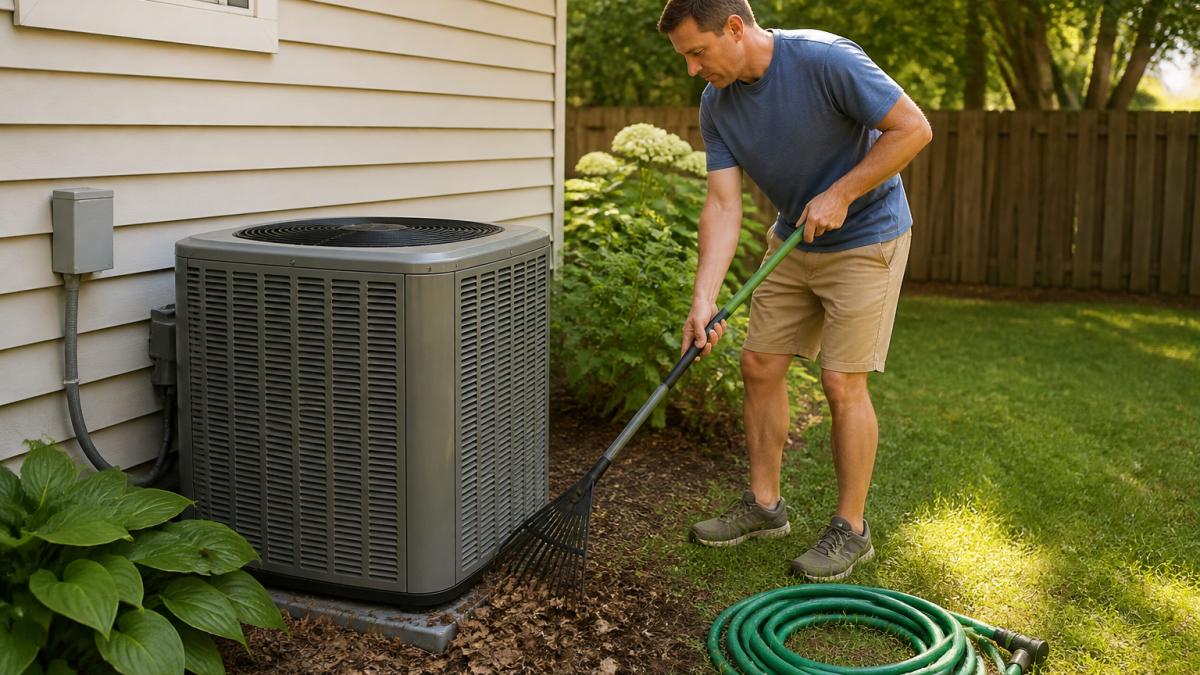
The outdoor condenser needs room to breathe. Clear at least two feet of space around the unit and keep the top clear. Trim back shrubs, rake away leaves, and rinse the coil with a garden hose on low pressure.
Inside, walk room to room and check the airflow:
| Problem | Likely Cause | What to Do |
|---|---|---|
| One room warm, rest cool | Closed or blocked register | Open vents, move furniture |
| Whole floor weak | Duct leak or damper issue | Schedule a duct check |
| Weak flow everywhere | Clogged filter | Replace the filter |
| Warm air at all vents | Frozen coil or low refrigerant | Turn off, call a pro |
Closed doors and blocked returns choke the system. Keep interior doors open when the AC runs, and never stack boxes in front of a return grille.
Airflow is a chain. One clogged filter, closed register, or blocked return affects the whole house, not just one room.
When to Call a Professional for AC Repair
Some problems are homeowner fixes. Others are not, and pushing a struggling system through a heat wave is how a repair turns into a replacement.
Signs that mean call today, not next week
- The house will not cool below 80 degrees even after sunset, when the outdoor load drops
- Ice forms on the indoor coil or refrigerant lines, and returns after you thaw it out
- You hear grinding, squealing, or banging from the outdoor unit
Any of these can point to a compressor, capacitor, contactor, or refrigerant problem. None improve with time, and several get more expensive the longer they run.
Signs that mean schedule service soon
- The system cools, but unevenly from room to room
- Run times have stretched noticeably compared to last summer
- The house feels clammy even when the thermostat is satisfied
Repair or replace? The questions that actually decide it
Age is the first filter. Most central air conditioners have a service life of 12 to 15 years.
Repair frequency is the second. One repair in five years is normal.
Refrigerant type matters too. Older systems using R-22 have not been produced with that refrigerant for years, and recharge costs have climbed as supply has tightened.
Sizing: the problem repairs cannot fix
An undersized system will never catch up on a 100 degree day, no matter how many parts you throw at it. An oversized system is not the answer either.
Proper sizing is based on a load calculation that accounts for square footage, window area and orientation, insulation levels, duct condition, and airtightness.
What to have ready before the technician arrives
- The model and serial number of the outdoor unit and the indoor coil or furnace
- The approximate age of the system, if you know it
- The filter size you use and when you last changed it
That information saves diagnostic time and helps the technician give you a straight answer instead of a guess.
A Minnesota note
Homes here run heating equipment hard for six or seven months, then ask the same blower, coil, and duct system to handle cooling in July and August. A system that was marginal last summer is often noticeably worse this summer.
Brass Tacks Plumbing, Heating & Cooling handles AC repair and diagnostics with upfront pricing and no sales pressure. If you are weighing repair against replacement, our cooling services team can walk you through the options for your home, including AC Replacement when a system has reached the end of its service life.
Frequently Asked Questions
What should my AC be set at if it’s 100 degrees outside?
Set your thermostat to 78 degrees Fahrenheit or the highest temperature you find comfortable. The standard 20-degree difference between indoor and outdoor temperature is a general rule, but most residential systems are designed for a 15 to 20 degree split. When the outdoor temperature hits 100 degrees, a system running at full capacity may only maintain 80 to 85 degrees indoors. Setting the thermostat lower will not cool the house faster; it will only keep the system running continuously and strain the compressor.
Is it normal for my AC to run constantly during a heat wave?
Yes, long run times are normal when outdoor temperatures climb above 95 degrees. Your air conditioner is sized for a specific cooling load, and extreme heat pushes it to its limit. Continuous operation keeps indoor temperatures stable but is not a sign of failure on its own. However, if the system runs nonstop and the indoor temperature still climbs, or if you hear unusual noises from the compressor, that points to a problem that needs professional attention.
Can a dirty air filter make my AC struggle in hot weather?
Absolutely. A clogged filter restricts airflow across the evaporator coil, which reduces cooling capacity and can cause the coil to freeze. Common dirty air filter AC symptoms include weak airflow from vents, a house that feels humid, and the system running longer than usual. Check your filter monthly during heavy cooling season and replace it every one to three months, or more often if you have pets or live in a dusty area.
How do I know if my AC needs repair or is just struggling with the heat?
If your AC not cooling in extreme heat is the only symptom and indoor temperatures stay within 15 to 20 degrees of outdoor readings, your system is likely working as designed. Warning signs that require urgent service include ice on the refrigerant lines, the outdoor unit not running at all, warm air from supply vents, or a burning smell. If the compressor is short-cycling or the breaker trips repeatedly, turn the system off and call a licensed technician for an onsite diagnosis.
A heat wave is hard on any cooling system, and knowing the difference between normal strain and a real failure saves you money and stress. If your AC not keeping up in 100 degree weather has you stuck, Brass Tacks Plumbing, Heating & Cooling can help. We offer honest diagnostics, upfront pricing, and licensed technicians who respect your home. Schedule your plumbing and HVAC service now and get your comfort back.
