Plumbing for Tankless Water Heater: What You Need
Table of Contents
- What Plumbing Does a Tankless Water Heater Actually Need?
- Tankless Water Heater Installation Requirements at a Glance
- Cold-Water Inlet, Hot-Water Outlet, and Isolation Valves
- Tankless Water Heater Gas Line Requirements for Minnesota Homes
- PEX Connections for Tankless Water Heaters: What Works
- Tankless Water Heater Maintenance and Flushing
- Commissioning, Leak Testing, and Troubleshooting
- Frequently Asked Questions
Last Updated: October 6, 2026
What Plumbing Does a Tankless Water Heater Actually Need?
Plumbing for a tankless water heater is the set of water, gas, venting, and electrical connections that let a wall-mounted unit heat water on demand instead of storing it in a tank.
At Brass Tacks Plumbing, Heating & Cooling, we install and service tankless systems across Plymouth, Wayzata, Minnetonka, and Maple Grove.
We’ll walk through each connection, the sizing checks that matter, and the commissioning steps that catch leaks early.
Tankless Water Heater Installation Requirements at a Glance
Tankless water heater installation requirements cover water pipe sizing, clearances, service access, gas or electrical supply, venting, and condensate handling. Most frustration comes from one of those categories being undersized.
| Requirement | What It Involves | Why It Matters |
|---|---|---|
| Water pipe sizing | 3/4-inch lines for most whole-home units | Undersized pipe cuts flow rate |
| Clearances | Space around the unit per manufacturer instructions | Heat, service, and vent safety |
| Service access | Room to reach valves and ports | Flushing and repairs |
| Gas supply | Line sized to the unit’s BTU demand | Burner won’t fire if starved |
| Electrical | Dedicated circuit for controls and ignition | Safe, code-compliant power |
| Venting | Approved vent material and routing | Combustion safety |
| Condensate | Drain line with proper slope | Prevents water damage |
Pipe Sizing, Clearances, and Service Access
Pipe sizing is where most DIY tankless projects stall.
Clearances come from the manufacturer’s instructions. Gas units need room for combustion air and heat dissipation; electric units need room for wiring and service.
Service access is the requirement people forget until the first flush. Leave enough space to reach the isolation valves, flush ports, and condensate trap without pulling the unit off the wall.
Cold-Water Inlet, Hot-Water Outlet, and Isolation Valves
The cold-water inlet and hot-water outlet are the two main water connections on any tankless unit, and both should have isolation valves so the heater can be serviced without draining the whole house.
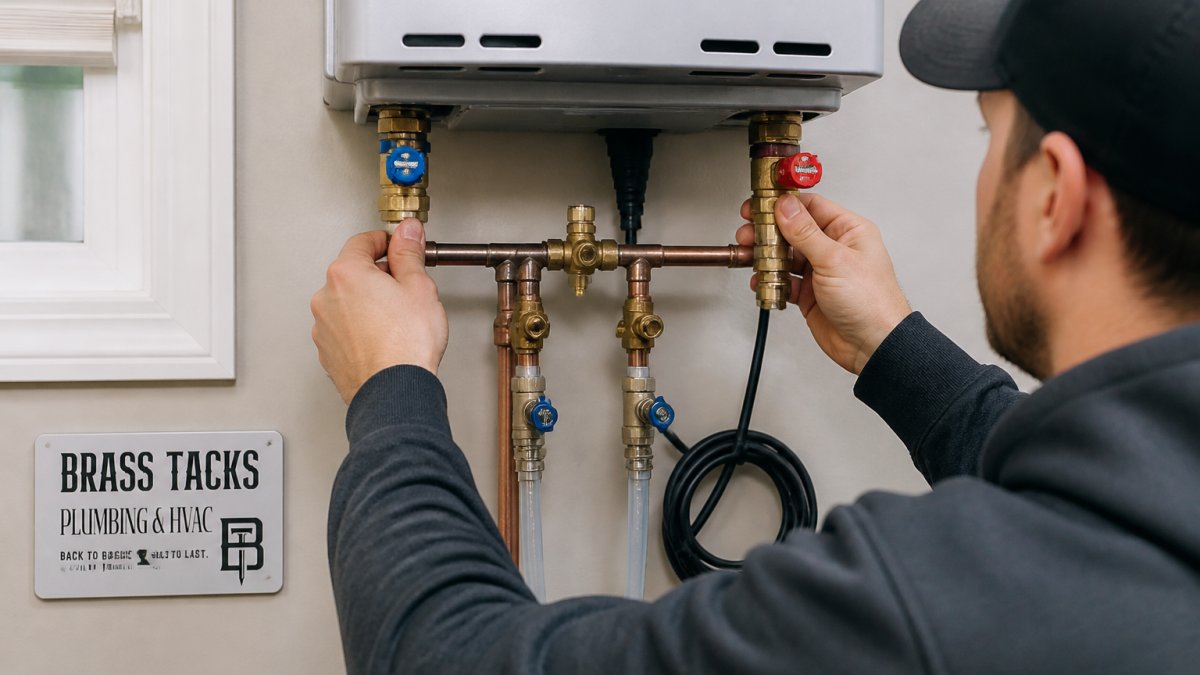
The layout is simple once you see it:
- Cold-water inlet: brings supply water into the unit, fitted with a shutoff valve
- Hot-water outlet: sends heated water to the home’s hot side
- Isolation valves: let you shut off both sides for service
Why Service Valves and Flush Ports Matter
Service valves and flush ports turn a tankless water heater from a sealed box into a serviceable appliance. Without them, every flush or repair means shutting off water to the house and cutting into the piping.
Minnesota water tends to run hard, and hard water scales the heat exchanger over time. Flush ports let a technician pump descaling solution through the unit in under an hour.
Ask your installer to fit a ball valve and a purge port on both the cold and hot sides. It adds little to the install and saves hours on every future flush.
Tankless Water Heater Gas Line Requirements for Minnesota Homes
Tankless water heater gas line requirements are stricter than most homeowners expect. A tankless unit fires a large burner to heat water instantly, so it draws far more gas at peak than a tank-style heater of similar capacity. A typical whole-home tankless unit pulls roughly 150,000 to 199,000 BTU per hour at full fire, while a storage tank heater of similar output often sits closer to 40,000 BTU per hour.
How a Gas Line Is Actually Sized
Sizing is not a guess based on pipe diameter alone. A licensed technician works through four inputs:
- Appliance input rating. The manufacturer’s nameplate lists the maximum BTU per hour the unit draws. That number, not the size of the old heater, drives everything.
- Developed length of the run. This is the total distance from the meter to the unit, plus extra allowance for every elbow, tee, and valve. Fittings add effective length, so a short-looking run can behave like a long one.
- Available pressure and allowable drop. Natural gas is delivered at low pressure, and code limits how much pressure can be lost between the meter and the appliance.
Once those inputs are known, the pipe size is read from a gas pipe capacity table. A run that fed a tank heater on 1/2-inch pipe often needs 3/4-inch or larger for a tankless unit, and long runs may need a bigger meter or a regulator adjustment. This is a job for a licensed technician.
Why Undersized Gas Supply Shows Up as Weird Symptoms
A starved gas line rarely fails cleanly. Common patterns include:
- The burner lights, then drops out mid-shower
- Error codes that clear on reset and come back under load
- Short cycling when two hot fixtures run at once
Homeowners often blame the heater. Most of the time the unit is fine and the supply is the problem.
What Minnesota Winters Do to Gas Demand
Cold Minnesota winters add another wrinkle. Incoming ground water drops into the 40s or lower, so the unit has to raise water temperature further to hit the same output. That longer, harder burn means the unit sits at high fire more often, which is exactly when an undersized line shows its weakness.
Before buying, check the unit’s rated temperature rise against your incoming water temperature. A unit sized for a mild climate may not keep up here.
Never tap a tankless unit into an existing gas line without confirming the line can carry the new load. A line that was fine for a tank heater can be dangerously undersized for a tankless unit, and the failure mode is not always obvious.
Venting, Combustion Air, and Condensate Drainage
Venting and combustion air are safety requirements, not optional extras. Gas tankless units need an approved vent routed outdoors and a supply of combustion air.
Vent material matters. Most condensing tankless units require PVC, CPVC, or polypropylene vent pipe rated for the flue temperature, and the manufacturer’s instructions specify the approved material and maximum equivalent length.
Condensing units also produce acidic condensate, which must drain through a properly sloped line to an approved location. Freezing is a real risk.
Never vent a gas tankless unit into a chimney flue that served an old tank heater without confirming it is approved for the new appliance. The wrong vent material can allow exhaust gases back into the home.
PEX Connections for Tankless Water Heaters: What Works
PEX connections for tankless water heaters work well when the manufacturer approves them and the fittings are rated for the temperature and pressure the unit produces. Many modern units accept PEX at the inlet and outlet, and PEX is common in newer West Metro homes because it is fast to run, resists scale buildup better than copper in hard water, and does not sweat in humid basements.
That said, PEX is not a universal answer. The right choice depends on the unit, the water chemistry, and how the piping is routed.
PEX vs. Copper at the Unit
| Factor | PEX | Copper |
|---|---|---|
| Manufacturer approval | Varies by model, check the manual | Widely approved |
| Heat tolerance near flue | Needs distance from vent and flue | Handles heat well |
| Freeze behavior | Flexes, may survive a light freeze | Can split and burst |
| Scale in hard water | Smoother interior, less buildup | Buildup over time |
| Vibration at unit | Absorbs vibration | Transmits vibration |
| Repair | Cut and couple | Solder or press |
Most installers run copper for the last foot or two at the unit and transition to PEX further back. That gives you copper’s heat and vibration tolerance where it matters and PEX’s cost and freeze advantages on the long runs.
Temperature and Pressure Limits to Respect
PEX is rated for a maximum temperature and pressure combination that varies by manufacturer. Tankless units can deliver water hot enough to approach those limits, especially if the output temperature is set high. Check the tubing’s rating printed on the pipe and confirm it exceeds the unit’s maximum output. If the numbers are close, use copper at the unit and transition to PEX downstream.
Minnesota Freeze Considerations
PEX has a real advantage in Minnesota because it can flex when water freezes inside it, which often means it survives a cold snap that would split copper. That does not make it freeze-proof. A PEX line that freezes repeatedly can still crack at a fitting, and a burst PEX line in a finished ceiling causes the same damage as a burst copper one.
Practical steps for cold climates:
- Keep PEX runs inside the conditioned envelope wherever possible
- Insulate any run through a garage, crawlspace, or rim joist area
- Do not run PEX through exterior walls if it can be avoided
Fittings and Transitions
PEX fittings come in several styles, and the connection method matters as much as the pipe. Crimp rings, clamp rings, and expansion fittings each have their own tooling and failure modes.
At the unit, use brass or another approved transition fitting. Plastic fittings can become brittle over time near a heat source. Support the pipe run so the tubing’s weight does not hang on the unit’s connections, and leave a little slack so vibration does not fatigue the joint.
When Copper Still Makes Sense
Copper still has its place, especially near the unit where heat and vibration are factors, in homes with existing copper piping that would be expensive to transition, and where the manufacturer specifically requires it.
If hard water is scaling your fixtures and appliances, a water softener or other water quality treatment can reduce scale in the heat exchanger and extend the life of the unit regardless of which pipe material you choose.
Ask your installer which pipe material the manufacturer approves for your specific model before the work starts. Approval varies by unit, and using the wrong material can void the warranty.
Tankless Water Heater Maintenance and Flushing
Tankless water heater maintenance and flushing keep the heat exchanger clear so the unit holds its flow rate and efficiency. In hard-water areas, annual descaling is the single most useful thing you can do.
The flush process looks like this:
- Shut off the unit and let it cool
- Close the isolation valves on both sides
- Connect a pump to the flush ports
- Circulate descaling solution through the unit
- Flush with clean water
- Reopen the valves and check for leaks
Beyond flushing, check the inlet filter screen, confirm the vent is clear, and look for weeping at the connections. A small leak caught early is a cheap fix.
Annual flushing is the difference between a tankless unit that lasts and one that fails early. Hard water is the main reason these heaters lose performance.
Commissioning, Leak Testing, and Troubleshooting
Commissioning is the step that separates a good install from a callback.
A simple commissioning checklist:
- Pressure-test all water connections
- Check every joint for weeping
- Confirm gas supply and test for leaks
When a problem points to the unit rather than the plumbing, our water heater repair team can diagnose it. If the system is at the end of its life, we handle water heater replacement as well.
Plumbing for a tankless water heater is not complicated, but it is unforgiving of shortcuts.
If you’re planning a tankless install or your current unit isn’t keeping up, Brass Tacks Plumbing, Heating & Cooling can help.
Schedule your plumbing service now and get hot water you can count on.
Frequently Asked Questions
Do you need special plumbing for a tankless water heater?
Yes. A tankless water heater installation usually needs larger gas piping, dedicated venting, and water connections with isolation and flush valves. Most homes can reuse the existing water line locations, but undersized gas lines and missing service valves are the two most common reasons a swap from a tank unit turns into a bigger project. A licensed plumber can check gas capacity and pipe sizing before you buy the unit.
Does a tankless water heater need a dedicated gas line?
In many homes, yes. Tankless units fire at a much higher BTU input than tank heaters, so the existing half-inch gas branch often cannot supply enough volume. Tankless water heater gas line requirements typically call for a larger dedicated run sized to the unit’s input and the length of pipe from the meter. A manual J-style gas load calculation confirms whether your current line is enough.
Can you hook PEX directly to a tankless water heater?
PEX connections for tankless water heaters are allowed when you follow the manufacturer’s instructions and local code. Many units require a minimum length of metallic pipe, often 18 to 36 inches, between the heater and any PEX to protect the plastic from heat. Use the correct fittings and support the pipe so stress does not transfer to the connections. Check your unit’s manual before cutting anything.
What maintenance does a tankless water heater need?
Tankless water heater maintenance and flushing once a year removes mineral scale from the heat exchanger. Minnesota water can be moderately hard, so annual descaling with a pump kit and white vinegar or a commercial descaler keeps flow and temperature rise steady. While flushing, inspect the inlet filter, check for leaking connections, and confirm the vent and condensate line are clear. Skipping this shortens the unit’s life.
