

Whole House Water Purification Systems: 2026 Guide
Table of Contents
- Signs Your Home Needs Whole House Water Purification
- Types of Whole House Water Purification Systems Compared
- Whole-House Water Filter vs. Point-of-Use System
- Water Softener vs. Water Filter: What’s the Difference?
- Choosing a Whole-House Water Filter for Hard Water
- Whole-House Water Filter Maintenance and Ongoing Costs
- Well Water vs. Municipal Water: Which System Fits Your Home?
- Conclusion
- Frequently Asked Questions
Last Updated: October 5, 2026
Signs Your Home Needs Whole House Water Purification
If your fixtures crust over with white scale, your water smells like a swimming pool, or your ice cubes taste off, your home is telling you something.
Watch for these signs:
- White, chalky buildup on faucets, showerheads, and glassware
- A chlorine or chemical smell in tap water
- Frequent water heater or appliance repairs
Cold Minnesota groundwater and long winters put extra stress on plumbing. Hard water plus freezing cycles shortens the life of water heaters, dishwashers, and washing machines. If you notice any of these signs, test your water first instead of buying a system.
Types of Whole House Water Purification Systems Compared
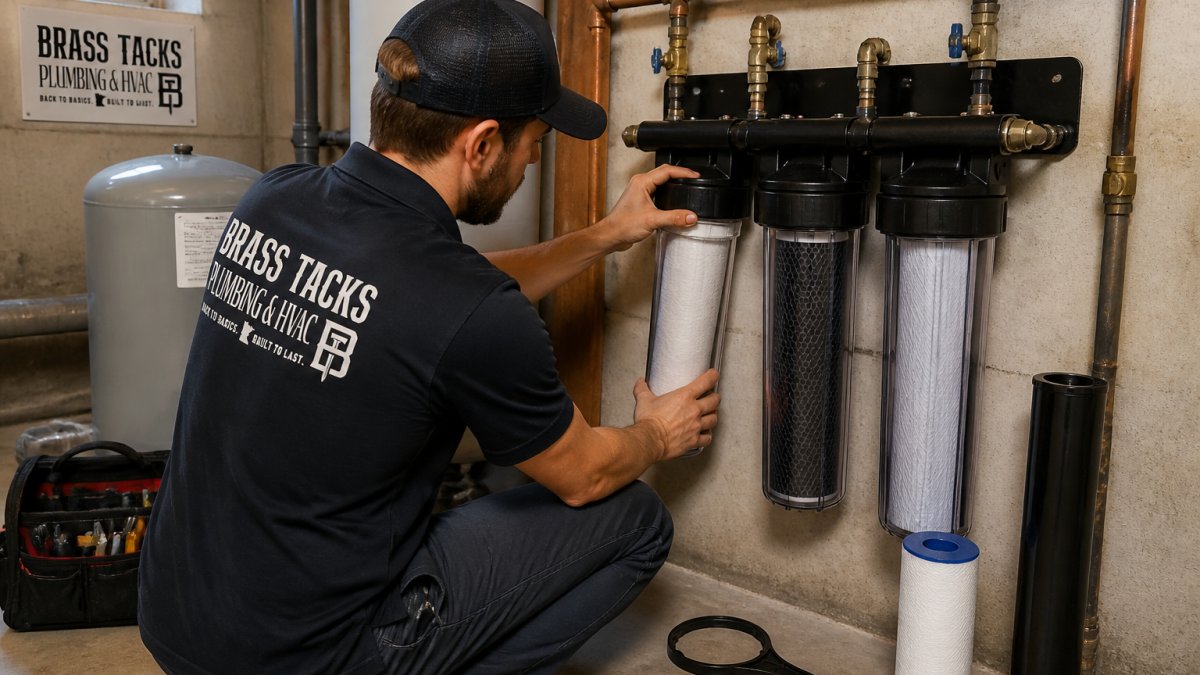
Whole house water purification systems fall into a few main categories, and most homes combine two or more. Each stage handles a different problem: sediment, chemicals, hardness, or microbes.
| System Type | What It Removes | Best For | Ongoing Upkeep |
|---|---|---|---|
| Sediment filter | Sand, rust, grit | Well water, older pipes | Replace cartridge regularly |
| Activated carbon | Chlorine, taste, odor | Municipal water | Replace every few months |
| Water softener | Hardness minerals | Hard water homes | Add salt, service yearly |
| Salt-free conditioner | Scale-forming minerals | Low-maintenance homes | Minimal |
| UV disinfection | Bacteria, viruses | Well water | Replace lamp yearly |
| Multi-stage | Combination | Most whole-home setups | Varies by stage |
Sediment and Carbon Filtration
Sediment filtration is the first line of defense, trapping sand, rust, and grit before they reach the rest of your plumbing. Activated carbon filtration comes next and handles taste, odor, and chlorine. Together they form the backbone of most whole-house setups.
Water Softeners and Salt-Free Conditioners
A water softener removes the calcium and magnesium that cause hard water and scale buildup. Salt-free conditioners change how minerals behave so they are less likely to stick to pipes, but they do not remove them. If you want softer-feeling water and protection from scale, a softener is the more thorough option. If you want to avoid salt and maintenance, a conditioner is simpler but less complete.
UV Disinfection and Multi-Stage Systems
UV disinfection uses ultraviolet light to neutralize bacteria and viruses, and it is common in homes on well water. Multi-stage filtration combines sediment, carbon, and sometimes UV or softening into one connected system. For most West Metro homes, a multi-stage setup covers the widest range of problems with one installation.
Whole-House Water Filter vs. Point-of-Use System
A whole-house water filter treats all the water entering your home, while a point-of-use system treats water at a single tap. The right choice depends on what you are trying to fix.
Choose a whole-house system when you want:
- Protection for your water heater, dishwasher, and washing machine
- Better water for showering and laundry, not just drinking
- Consistent quality at every faucet
Choose a point-of-use system when:
- You only care about drinking water at the kitchen sink
- You want a lower upfront investment
- Your water is fine for everything except taste
Many homeowners start with a point-of-use filter and later add whole-home treatment once they see how much scale and chlorine affect their appliances. If you are unsure which fits your home, a water test answers the question quickly.
Water Softener vs. Water Filter: What’s the Difference?
A water filter removes contaminants like sediment, chlorine, and some chemicals. A water softener removes the minerals that cause hardness. They solve different problems, and confusing them leads to the wrong purchase.
- Water filter: targets particles, taste, odor, and certain contaminants
- Water softener: targets calcium and magnesium that create scale
- Both together: the most complete protection for a hard-water home
If your water is both hard and heavily chlorinated, which is common in this region, you likely need both. A softener protects your plumbing and appliances from scale, while filtration improves taste and reduces chemicals.
Choosing a Whole-House Water Filter for Hard Water
The best whole-house water filter for hard water pairs softening with filtration, because hardness and contaminants are separate issues. Start by testing your water to confirm hardness levels and identify any contaminants. Then match the system to your home’s size and water use.
A few practical steps:
- Test your water for hardness, chlorine, and any local contaminants
- Measure your home’s peak water demand so the system keeps up
- Decide whether you need softening, filtration, or both
- Check the flow rate so pressure does not drop
- Plan for maintenance before you buy
Flow rate matters more than most homeowners expect. A system that is too small will choke your water pressure when several fixtures run at once.
Check the flow rate in gallons per minute against your home’s peak demand, not its average use. A system sized for average use will struggle when the shower, dishwasher, and laundry all run together.
If you are on a private well, well water versus municipal water changes the recommendation entirely. Well water often needs sediment and UV treatment, while city water usually needs carbon and softening.
Whole-House Water Filter Maintenance and Ongoing Costs
Maintenance keeps any system working, and it is the part most homeowners underestimate. Filters need replacing, softeners need salt, and UV lamps need annual swaps. Ongoing cost and verified performance are also tied together: a system that claims to reduce lead or PFAS but is not certified for that claim may not deliver it, no matter how faithfully you change the media.
How to Read NSF/ANSI Certifications Before You Buy
NSF/ANSI standards are the clearest way to separate marketing from verified performance. The certification mark on a system or its replacement cartridge tells you which standard it was tested against and what it was tested to reduce.
- NSF/ANSI 42 covers aesthetic claims: chlorine taste and odor, and particulate reduction.
- NSF/ANSI 53 covers health-related claims for many contaminants, including lead, volatile organic compounds, and some PFAS.
- NSF/ANSI 44 applies to water softeners and their hardness-reduction claims.
A system can carry a 42 mark and still not be certified for lead or PFAS. Look up the specific model on the NSF listing to confirm which contaminants and reduction percentages the certification actually covers.
What Ongoing Costs Actually Include
Rather than quote a single number, think in terms of what you will replace and how often:
- Sediment cartridges: replaced on a set schedule, more often on well water with heavy grit.
- Carbon cartridges or tanks: replaced on a schedule set by the manufacturer and your water chemistry.
- Annual inspection: catches small issues before they become pressure problems or water quality problems.
Add up the media, salt, lamps, and service over a five-year window and compare that to the purchase and installation. The lowest sticker price is often not the lowest five-year cost, especially for systems with proprietary cartridges.
Before you buy, ask two questions: which NSF/ANSI standard is this system certified to, and what does the replacement media cost over five years? If either answer is vague, keep shopping.
Why Maintenance Matters More in a Cold Climate
Freezing temperatures add a maintenance dimension that warmer markets do not have. A system installed in an unheated garage, crawlspace, or vacation cabin can freeze and crack housings, cartridges, or UV sleeves. Insulate exposed lines, keep the system in a conditioned space where possible, and drain or protect it before extended cold snaps. If your water heater is also aging, it is worth reviewing water heater repair alongside your filtration plan, since hard water and sediment affect both.
Well Water vs. Municipal Water: Which System Fits Your Home?
Well water and municipal water need different treatment, and matching the system to your source prevents wasted money. Municipal water is already treated and disinfected, so the focus is usually chlorine or chloramine, taste, and hardness. Well water is untreated, so sediment, bacteria, iron, manganese, and minerals become the priority. Build your decision around your water test results, not a generic recommendation.
If You Are on Municipal Water
Start with your utility’s annual water quality report, then confirm with your own test at the tap.
- Chlorine or chloramine taste and odor: activated carbon filtration, sized to your household demand.
- Hardness above roughly 7 grains per gallon: a water softener is usually the more thorough fix.
- Lead or PFAS concerns: look for a system certified to NSF/ANSI 53 or 401 for those specific contaminants, not just a taste-and-odor claim.
If You Are on a Private Well
Well water is your responsibility to test and treat. A standard well panel covers bacteria, nitrates, arsenic, iron, manganese, hardness, and pH.
- Sediment, grit, or rust: sediment filtration ahead of everything else.
- Coliform bacteria: UV disinfection, often paired with sediment filtration so the UV sleeve stays clear.
- Iron and manganese: these stain fixtures and can foul a softener, so they are usually treated before softening.
Sizing, Flow Rate, and Pressure Drop
This is where most systems fail in practice. A system sized for average use will choke when the shower, dishwasher, and laundry run together.
- Count fixtures and occupants. More bathrooms and more people mean higher peak demand.
- Match the system’s rated flow rate in gallons per minute to your peak demand, not your average.
- Account for pressure drop. Every filter, softener, and UV unit adds resistance. A long run of undersized pipe makes it worse.
A common pattern is a homeowner who buys a high-capacity system and still sees pressure loss because the plumbing between the meter or pressure tank and the system is undersized. Sizing the system and the supply line together avoids that.
Do not skip a water test before buying. A system chosen without testing often misses the actual problem, leaving you with treated water that still tastes wrong or still leaves scale. If your well has not been tested in the last year, start there.
A Note on Salt-Free Conditioners
Salt-free conditioners change how scale-forming minerals behave so they are less likely to stick to pipes and fixtures, but they do not remove calcium and magnesium.
Minnesota’s cold climate adds another layer. And if your existing softener is limping along or has stopped regenerating, we also handle water softener repair and replacement so your treatment setup keeps working the way it should.
Conclusion
Choosing the right whole house water purification systems comes down to testing your water first, then matching the treatment to your source and your home’s demand. Whether you are on a private well or municipal supply, the right setup protects your plumbing, your appliances, and your water quality for years. If you want help figuring out what your home actually needs, our team can test your water and walk you through the options without pressure.
Frequently Asked Questions
How much does a whole house purification system cost?
Costs vary widely based on system type, home size, and installation complexity. Basic sediment and carbon filters cost less upfront, while multi-stage systems with UV disinfection or water softening cost more. Ongoing expenses include replacement cartridges and filter media, which vary by system. For current pricing on installation and service, check the Brass Tacks Plumbing, Heating & Cooling pricing page or request a quote.
Is a whole-house water filtration system worth it?
It depends on your water quality and goals. If you deal with hard water, chlorine taste, sediment, or well water contaminants, a whole-house system can protect plumbing, extend appliance life, and improve water at every tap. Homes on municipal water with few issues may find a point-of-use filter sufficient. Testing your water first tells you which contaminants are actually present and whether treatment is warranted.
Does a whole-house water filter soften hard water?
Standard carbon and sediment filters do not remove the minerals that cause hardness. Only a true ion-exchange water softener removes calcium and magnesium. Salt-free conditioners change how minerals behave but do not remove them. If hard water is your main concern, you likely need a softener, possibly combined with a filter for other contaminants. A water test confirms hardness levels before you choose.
How do I know which contaminants a whole-house water filter removes?
Check the system’s NSF/ANSI certifications. These standards verify what a filter actually reduces, such as lead, chlorine, or volatile organic compounds. Look for certification numbers on the product label and match them to your water test results. No single system removes everything, so choose based on the specific contaminants found in your water.
How often do whole-house water filters need maintenance?
Maintenance intervals depend on the system and your water quality. Sediment pre-filters often need replacement every few months, while carbon cartridges may last six to twelve months. UV lamps typically need annual replacement. Hard water and high sediment loads shorten intervals. Setting a calendar reminder and checking pressure drop between the pre-filter and post-filter helps you stay ahead of replacements.
