

How to Know When to Replace Your Hot Water Heater

Last Updated: November 6, 2026
Quick Summary
You should replace hot water heater equipment when the tank leaks, shows heavy rust or corrosion, or is past its expected service life, since corrosion cannot be reversed. Two or more repairs in a single year, or a repair bill approaching the cost of a new unit on an aging tank, also signal it is time to replace.
- Water pooling at the tank base usually means the steel corroded through and no repair can reverse it.
- Two or more repairs in one year is a pattern that signals the end of service life.
- A leaking tank or heavy rust is a replacement call regardless of the unit’s age.
- Flushing sediment annually and checking the anode rod help extend service life.
- If you smell gas, leave the area and call your gas utility from a safe location.
Table of Contents
- How to Tell When to Replace Your Hot Water Heater
- Understanding Water Heater Lifespan by Type
- 7 Signs of Water Heater Failure to Watch For
- How Hard Water Impact on Water Heaters Shortens Service Life
- Water Heater Repair vs Replacement Cost: Making the Call
- How to Find Your Water Heater’s Age and Read the Warranty
- Maintenance That Can Extend Your Water Heater’s Service Life
- Safety First: When a Failing Water Heater Needs Urgent Attention
- Frequently Asked Questions
How to Tell When to Replace Your Hot Water Heater
Most homeowners wait until the tank fails, and that is the expensive way to learn this lesson. The smarter approach is to know the signs of a failing unit months ahead of time, so you can replace hot water heater equipment on your schedule instead of in a panic on a Sunday night.
Here is what matters most. A conventional tank water heater has a finite service life, and once it passes that window, every month you keep it running is a gamble against water damage in your basement or utility closet.
Understanding Water Heater Lifespan by Type
A tank water heater has a finite service life, and a tankless unit can run longer with proper care. In Minnesota, cold incoming water and hard water in many West Metro homes push most tanks toward the shorter end of that range.
Type matters as much as age. If you want the full breakdown on how long these units actually last here, read our guide on how long water heaters last in Minnesota.
7 Signs of Water Heater Failure to Watch For
Watch for these seven signals: leaks at the tank or base, rust and corrosion, discolored water, lukewarm or inconsistent hot water, rumbling or banging noises, rising energy bills, and a unit that is simply past its expected lifespan. Any one of these deserves attention. Two or more together usually means replacement is the better call.
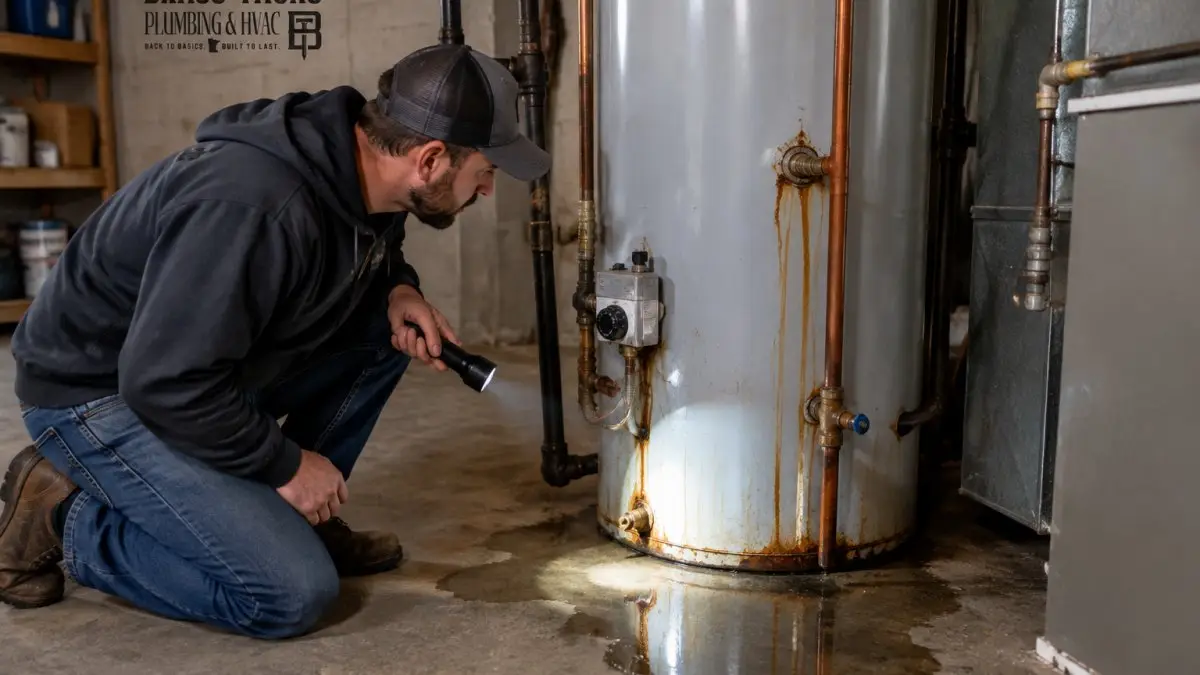
Leaks, Rust, and Discolored Water
Water pooling around the base of the tank is the clearest sign of internal failure, and it rarely gets better. A leaking tank usually means the steel has corroded through from the inside, which no repair can reverse. Rust streaks on the tank body or rusty hot water at the tap point to the same problem. If the water coming out is discolored, that is a strong signal the tank lining has given out.
Lukewarm Water and Strange Noises
Lukewarm or inconsistent hot water often traces back to a failing heating element, a worn dip tube, or a tank that can no longer keep up. Rumbling, banging, or knocking usually means sediment buildup on the bottom of the tank, which forces the burner to work harder and shortens the unit’s life. If your heater is making a racket, our breakdown of why water heaters make banging noises covers the common causes and when it means a repair versus a replacement.
How Hard Water Impact on Water Heaters Shortens Service Life
Hard water is the quiet killer of water heaters, and it is a real factor across much of the West Metro. Minerals in the water settle out as sediment on the tank bottom and heating elements, which reduces efficiency and accelerates wear.
A water softener is the most direct defense. Our team handles water softener installation alongside heater replacement so the new unit is not fighting the same problem the old one lost to.
Water Heater Repair vs Replacement Cost: Making the Call
Most homeowners do not struggle with the obvious cases. A twelve-year-old tank with water on the floor is a replacement. A four-year-old unit with a tripped breaker is a repair. The hard part is the middle: a seven- or eight-year-old heater that needs a repair you can afford but do not want to repeat. That is where a little structure helps.
Start with age, then layer in the repair itself, then weigh the risk of another failure. Each filter narrows the decision.
Step 1: Where is the unit in its service life?
A conventional tank has a finite window, and the closer you are to the end of it, the less a repair buys you. A unit that is relatively young has most of its life ahead of it, so a single failed part is often worth fixing. As a tank ages, the repair math gets harder, and an older unit near the end of its service life is usually better served by a replacement.
Step 2: How does the repair cost compare to replacement?
A useful rule of thumb is to compare the repair bill against the cost of a new unit, not against zero. If a repair approaches a meaningful fraction of what a full replacement would run, the repair is a poor bet on an old tank. A cheap fix on a young unit is an easy yes. An expensive fix on an old unit is an easy no. The middle is where you ask how many more repairs you expect before the tank goes.
Step 3: What is the failure risk?
Some failures are inconvenient. Others are destructive. A bad heating element or a worn dip tube means lukewarm water, and you can schedule the fix. A leaking tank, heavy rust, or corrosion at the fittings means the steel has given out from the inside, and no repair reverses that. Those are replacement calls regardless of age, because the downside is water damage in your basement or utility closet, not just a cold shower.
Step 4: How often are you calling for repairs?
Two or more repairs in a single year is a pattern, not bad luck. It usually signals a unit at the end of its service life, and each repair is money you will not get back when the tank finally goes.
Use this framework to decide:
| Situation | Recommendation | Why |
|---|---|---|
| Under 6 years, one failed part | Repair | Unit has most of its life left |
| 6-10 years, minor issue, modest cost | Repair | Weigh the bill against remaining years |
| 6-10 years, repair approaching replacement cost | Replace | You are buying a short extension on an aging tank |
| 10+ years, any major failure | Replace | Past expected service life |
| Leaking tank or heavy rust | Replace | Corrosion cannot be reversed |
| Repeated repairs in one year | Replace | Signals end of service life |
Watch out: a repair that fixes the symptom but not the cause, like replacing a heating element in a tank full of sediment, often leads to the next failure within months. Ask why the part failed before you approve the fix.
For a deeper look at how we weigh age, condition, and safety, read our explanation of repair versus replacement. If you are leaning toward a new unit, our water heater replacement service walks through sizing and installation so the replacement fits your household instead of just matching the old tank.
How to Find Your Water Heater’s Age and Read the Warranty
The age is stamped in the serial number on the manufacturer’s label, usually as a date code or the first few characters. Write it down and keep it. Check the warranty paperwork that came with your unit before you assume a failure is on your dime. If the unit is out of warranty and past its service life, that tips the decision toward replacement.
Maintenance That Can Extend Your Water Heater’s Service Life
Flushing sediment annually, checking the anode rod, and testing the temperature and pressure relief valve are the maintenance steps that actually move the needle.
Professional maintenance catches these items before they become failures. Our water heater maintenance in Plymouth service covers flushing, anode inspection, and a full safety check, which is the cheapest way to get more years out of a tank that still has life in it.
Safety First: When a Failing Water Heater Needs Urgent Attention
An active leak, a gas smell, or water near electrical components is not a wait-and-see situation. The difference between a minor cleanup and a flooded basement often comes down to what you do in the first few minutes. Here is how to think about urgency and what to do while help is on the way.
Which failures are true emergencies?
A gas smell is the clearest emergency. If you smell gas, leave the area, do not flip switches or use your phone near the unit, and call your gas utility from a safe location before calling anyone else. Water contacting electrical connections is the next most urgent, because it creates a shock and fire risk.
A failed heating element, a noisy tank, or lukewarm water is a same-day or next-day call, not an emergency. Those are inconvenient but not destructive.
What to do first when the tank is leaking
Shut off the water supply to the heater first. There is a valve on the cold-water line feeding the unit, and turning it clockwise stops new water from entering the tank. Then shut off the power or gas.
Watch out: on an electric heater, shut off the breaker before you touch anything near the unit. Water and live electrical connections are a serious hazard, and the breaker is the only reliable way to make the unit safe.
Limiting water damage while you wait
Once the supply and power are off, move anything stored near the unit, put down towels or a bucket to catch the flow, and keep the area clear. Do not try to drain or move the tank yourself. A full tank is heavy, and a gas or electrical unit is not a DIY project. If water is spreading toward finished space, a wet/dry vacuum and a fan can help, but the priority is stopping the source, which you have already done by shutting the valve.
Why Minnesota winters raise the stakes
A failed heater in January is more than a cold shower. If the unit is in an unheated garage or a utility room that depends on the heater for warmth, a shutdown can put nearby pipes at risk of freezing.
If you are facing a failure now, our water heater replacement service can help you decide on the next step. Do not attempt a DIY swap on a gas unit.
Frequently Asked Questions
How do you know when a hot water heater needs to be replaced?
The clearest signals are age past its expected lifespan, water pooling around the base, rust or discolored hot water, and hot water that runs lukewarm or runs out fast. Rumbling or banging noises from sediment buildup also point to a tank near the end. If you see two or more of these at once, or the tank itself is leaking, plan to replace rather than repair.
My water heater is 15 years old. Is it worth repairing?
It depends on the problem and the repair cost. A single failed part like a heating element or thermostat on a 15-year-old tank may still be worth fixing if the tank is sound. But if the repair bill approaches a large share of a new unit’s cost, or the tank shows rust or leaks, replacement is the better use of money. A licensed technician can tell you whether the tank itself is failing.
Does hard water affect the lifespan of a water heater?
Yes. Hard water leaves mineral sediment that settles on the tank bottom and heating elements. That buildup insulates the water from the heat source, forcing the unit to work harder, and it speeds up corrosion. Flushing the tank annually and addressing hard water with a softener can slow the damage and help the unit reach its expected service life.
Should I replace my water heater before it starts leaking?
Often, yes. A tank that fails can release water fast enough to damage flooring, drywall, and stored belongings, and in Minnesota a basement leak in winter adds freezing risk. If your unit is near the end of its expected lifespan and showing warning signs, scheduling a proactive replacement on your terms beats an emergency call after a leak starts.

