

How to Vet a Plumber Before Water Heater Repair
Last Updated: November 7, 2026
Quick Summary
Before you hire a plumber for water heater repair, ask whether they are licensed and insured, how much experience they have with your specific water heater type, and what part failed and what test confirmed it. Ask for a written, itemized quote before approving any work.
- Ask for proof of both the plumber’s license and liability insurance, including a copy of the insurance certificate.
- Ask how often the plumber works on your specific water heater type, brand, fuel type, and age.
- Ask the plumber to show you the failed part or the test that confirmed the diagnosis.
- Get a written, itemized quote covering the service fee, labor, parts, and permit fees before work begins.
- Ask for both the parts and labor warranty terms in writing before the job closes.
Table of Contents
- Which Water Heater Repair Questions to Ask a Plumber First
- How to Confirm the Diagnosis Before Any Work Starts
- Water Heater Repair Appointment Checklist for the Service Visit
- Getting a Written Estimate and Itemized Pricing
- Water Heater Repair or Replacement: Deciding With Your Plumber
- How Long Does Water Heater Repair Take and What to Expect
- Warranty and Post-Repair Checks to Schedule Your Water Heater Service
- Frequently Asked Questions
Before you hand a water heater repair to a plumber, you should know what to ask. A few direct questions about licensing, experience, the diagnosis, and the price can tell you whether a company is worth your money. Brass Tacks Plumbing, Heating & Cooling serves homeowners across the West Metro, and we think every homeowner deserves straight answers before any work starts.
Which Water Heater Repair Questions to Ask a Plumber First
Start with the basics. A good plumber will answer these questions plainly and without pressure.
Are You Licensed and Insured for This Work?
Ask for proof of both. A licensed plumber has met state or local requirements for the trade. Liability insurance covers damage to your home if something goes wrong during the repair.
Requirements for plumbers and water heater work vary by state and city. Check your state’s licensing board to confirm the plumber’s license is current. The U.S. Department of Labor’s guide to plumbers and pipefitters describes the training and licensing typically required for the trade.
How Much Experience Do You Have With My Water Heater Type?
Water heaters are not all the same. A standard tank unit, a tankless model, and a heat pump water heater each work differently and fail in different ways. Ask how often the plumber works on your specific type.
Ask about the brand, the fuel type (gas or electric), and how old the unit is. An experienced plumber will ask you these questions too.
How to Confirm the Diagnosis Before Any Work Starts
A water heater can fail for a dozen reasons that look identical from the outside. No hot water could be a failed heating element, a tripped high-limit switch, a bad thermocouple, a gas supply problem, or a control board. A leak could be a failed tank, a loose fitting, a bad temperature and pressure relief valve, or condensation. The diagnosis determines whether the repair actually fixes the problem, so ask the plumber to walk you through it before you approve anything.
What Should the Plumber Actually Inspect?
A thorough diagnostic visit on a tank water heater usually includes:
- Power or fuel source: Confirm the breaker, disconnect, or gas supply is working and that the pilot or igniter is functioning.
- Thermostat and high-limit switch: Test settings and confirm the high-limit switch has not tripped.
- Heating elements (electric) or burner assembly (gas): Check for continuity, scorching, sediment buildup, or a dirty flame sensor.
For a tankless unit, the inspection shifts to the heat exchanger, inlet water filter, flow sensor, gas pressure, and descaling needs. Hard water can make scale a common culprit, so ask whether the unit has been descaled and how often it should be.
What Evidence Should Support the Diagnosis?
Ask the plumber to show you, not just tell you. Reasonable evidence includes a meter reading on an element, a photo of a corroded fitting, a pressure gauge reading, a flame observation, or a visible crack in the tank.
Watch out: if a plumber recommends replacement without opening a panel, testing a component, or showing you the failed part, ask what specifically failed and how they confirmed it. A diagnosis that cannot be demonstrated is a guess.
Questions That Force a Clear Explanation
- What part failed, and what test confirmed it?
- Is the problem the heater itself, or something connected to it, like the gas line, the venting, the electrical circuit, or the water supply?
- Could a different cause produce the same symptoms?
A common pattern is a repair approved on a symptom rather than a cause. If the same part fails again in a few months, the original diagnosis was likely incomplete. A plumber who shows you the failed component and explains the test behind the conclusion is usually a safer bet than one who pushes for a quick sign-off. For more on how we approach diagnostics and repair, see our water heater repair service.
Water Heater Repair Appointment Checklist for the Service Visit
Use this checklist to prepare for the visit and to keep the job on track:
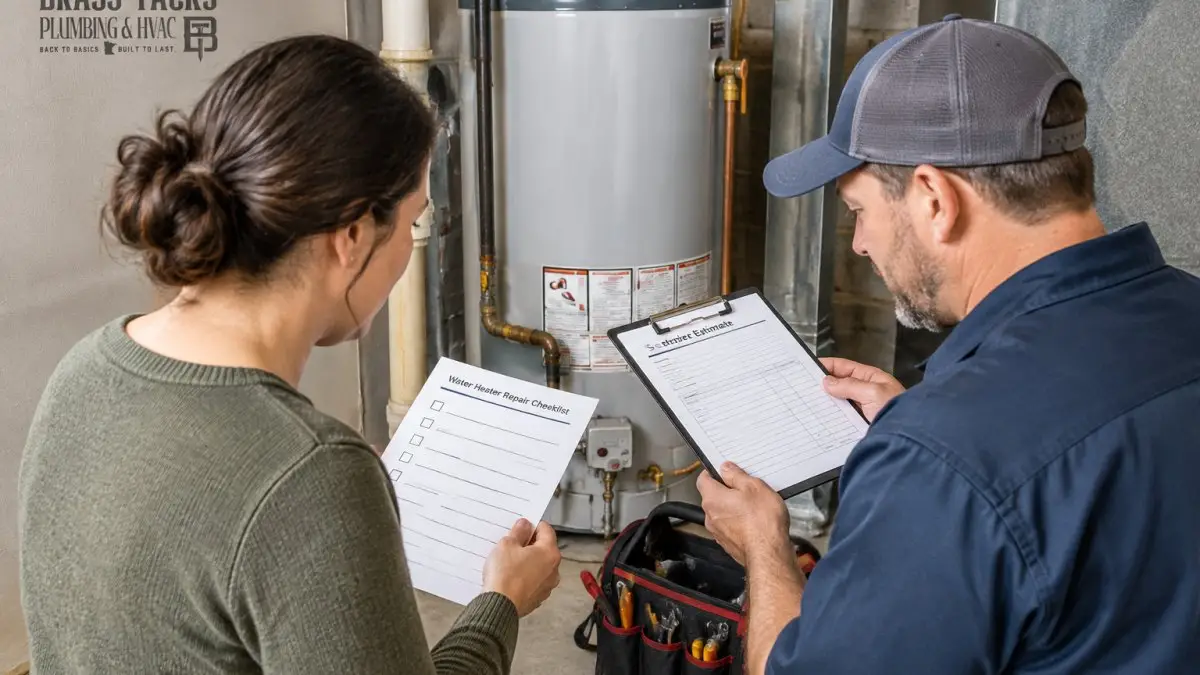
- Clear access to the water heater and the surrounding area
- A list of symptoms you’ve noticed (no hot water, rust-colored water, popping noises, leaks, or a pilot light that won’t stay lit)
- The age of the unit and any previous repair records
Keep notes during the visit, including the technician’s name and the diagnosis. These details matter if you need to file a warranty claim later.
Getting a Written Estimate and Itemized Pricing
Never approve a repair based on a verbal estimate alone. Ask for a written quote that lists each item separately, including:
- The diagnostic or service fee
- Labor costs, with the estimated hours
- Each part and its price
An itemized quote lets you see exactly what you are paying for and protects you from surprise charges. If the plumber finds additional problems during the repair, ask them to stop and call you before doing extra work.
Compare quotes if you can, but do not choose only on price. A low quote that leaves out parts or labor can cost more in the end.
Water Heater Repair or Replacement: Deciding With Your Plumber
Sometimes a repair makes sense. Other times, replacing the unit saves money over time. The honest answer depends on the unit, the failure, and what you plan to do with the home. Ask your plumber to walk you through both options in writing so you can compare them side by side.
A Practical Framework for the Decision
Use these factors together rather than any single one:
- Age versus expected service life: Service life depends on the unit type, water quality, and maintenance history, so check the manufacturer’s rating for your model. If your unit is near or past that range and the repair is significant, replacement deserves serious weight. Check the manufacturer label for the build date, not just the install date.
- What failed: A heating element, thermostat, thermocouple, or relief valve is usually a repair. A leaking tank shell, a cracked heat exchanger, or widespread corrosion is usually a replacement.
- Repair cost versus replacement cost: Get both repair and replacement costs in writing before you decide.
Minnesota Considerations That Affect the Call
Cold weather raises the stakes on a failing water heater. A unit limping along in October may fail entirely during a January cold snap, when a no-hot-water emergency is far more disruptive and harder to schedule. If your unit is already showing age-related problems heading into winter, ask your plumber whether repairing now or replacing before the heating season makes more sense.
How to Compare the Two Options Fairly
Ask for both a repair quote and a replacement quote in writing, itemized the same way, so you can compare labor, parts, permits, and disposal.
Watch out: if a plumber will only quote replacement and will not price the repair, ask why.
If you are weighing these options, our guide on when to replace your water heater explains the warning signs. For repair work, see our water heater repair service.
Use these factors together when weighing a repair against a replacement.
| Factor | What to check | Why it matters |
|---|---|---|
| Age versus expected service life | Manufacturer rating and build date on the label | Old units near end of life favor replacement |
| What failed | Element, thermostat, or relief valve versus tank shell | Minor parts usually repair; tank leaks usually mean replacement |
| Repair frequency | Number of repairs in recent years | Three repairs in two years signals end of life |
| Efficiency and operating cost | Efficiency rating on current and replacement units | Compares operating cost, not just purchase price |
| Water quality and maintenance | Hard water, flush and anode rod history | Neglect and hard water shorten tank life |
| Safety and code | Venting, relief valve, gas or electrical concerns | Unsafe installations may require replacement |
How Long Does Water Heater Repair Take and What to Expect
Most repairs take a few hours, but the timeline depends on the problem. A simple part swap may be finished the same day.
Ask the plumber for an estimated timeline before work starts. Also ask what happens if the part is not in stock.
Expect the technician to test the unit after the repair. You should see hot water return within a reasonable time, and the technician should explain what they checked.
Warranty and Post-Repair Checks to Schedule Your Water Heater Service
Before the job closes, ask about warranties. There are usually two kinds:
- Parts warranty: Covers the replacement part, usually set by the manufacturer.
- Labor warranty: Covers the plumber’s work, set by the company. This varies widely, so ask how long it lasts and what it includes.
Get both in writing. Keep the receipt, the warranty paperwork, and the diagnosis notes in one place.
Ask the plumber what to watch for after the repair. Common signs of a problem include:
- Water that stays lukewarm or runs out quickly
- Leaks around the tank or connections
- Strange noises from the tank
- Discolored or smelly hot water
If you notice any of these, call the company right away. A good plumber wants to know if a repair did not hold.
Vetting a plumber takes a few minutes of questions, but those minutes can save you money and stress. If you have questions about your water heater, call Brass Tacks Plumbing, Heating & Cooling.
Frequently Asked Questions
What is usually the most common water heater problem?
Sediment buildup at the bottom of the tank is one of the most frequent issues, especially in areas with hard water. Sediment insulates the water from the burner or heating element, which makes the unit work harder, run longer, and wear out sooner. Popping or rumbling sounds during heating are a common sign. Other frequent problems include a failed thermostat or heating element on electric units, a faulty pilot or thermocouple on gas units, and slow leaks around fittings or the tank itself. Ask your plumber to check for sediment during any diagnostic visit, since flushing the tank can sometimes restore performance. A proper diagnosis should explain the cause, not just the symptom.
Should I ask a plumber about licensing before water heater repair?
Yes. Ask whether the company and the technician working on your unit hold the appropriate state and local licenses for plumbing or HVAC work in your area, and ask whether they carry liability insurance and workers’ compensation coverage. A licensed plumber is accountable to licensing rules and typically follows local permit and code requirements. You can verify credentials with your state’s licensing board before the appointment. Ask for proof of insurance in writing so you are not relying on a verbal assurance. These questions take little time and protect you if something goes wrong during the repair.
How long does a water heater repair usually take?
Many common repairs, such as replacing a thermostat, heating element, or a faulty gas valve, can often be completed in one visit once the parts are on hand. More involved work, like tank repairs that require ordering parts or repairs that uncover additional damage, may take longer or require a second visit. Ask your plumber to estimate the timeline before work begins and to explain what would cause a delay. Clarify whether parts need to be ordered and how long that typically takes, so you know what hot-water gap to plan for at home.
Should I ask for a written estimate before approving water heater repair?
Yes. A written estimate should itemize labor, parts, any service fees, and any potential additional costs, and it should state the warranty on both parts and labor. Ask the plumber to explain each line item and to call you for approval before performing any work beyond what was quoted. Asking for itemized pricing makes it easier to compare options and reduces the chance of surprise charges on the final invoice.

