

5 Best Ways to Shut Off Your Main Water Valve
Last Updated: October 22, 2026
Quick Summary
Shut off your main water valve by turning a lever-handle ball valve a quarter turn, or by turning a round-wheel gate valve clockwise until it stops. If the indoor valve is missing or stuck, use a water meter key on the curb stop at the meter box.
- The main shutoff usually sits in the basement, utility room, or crawl space near the foundation wall.
- A lever handle sits parallel to the pipe when open and perpendicular when closed.
- Count the turns when closing a gate valve so you can reopen it fully later.
- Never force a stuck valve, since cranking it can snap the stem inside the wall.
- Fixture valves at toilets, sinks, and the washing machine buy time when the main valve fails.
Table of Contents
- Why Knowing How to Shut Off Your Main Water Valve Matters
- How to Find the Main Water Shut Off Valve in Your Home
- Main Water Shut Off Valve Types You Will Run Into
- Method 1: Turn Off a Lever-Handle Ball Valve
- Method 2: Close a Round-Wheel Gate Valve
- Method 3: Use a Water Meter Key at the Curb
- Method 4: Shut Off a Stuck Main Water Shut Off Valve Safely
- Method 5: Use Local Fixture Valves When the Main Valve Fails
- How to Turn the Water Back On in Your House
- When to Call a Plumber
- Frequently Asked Questions
Why Knowing How to Shut Off Your Main Water Valve Matters
A burst supply line can push out several gallons a minute. Knowing how to shut off your main water valve is the fastest way to stop that damage, and it takes about a minute once you know where the valve is.
Minnesota winters raise the stakes. Pipes in exterior walls and unheated crawl spaces freeze, then split, then flood the moment they thaw.
Never force a valve handle that will not budge. Cranking a stuck gate valve can snap the stem inside the wall, which turns a simple shutoff into a repair that requires opening drywall.
How to Find the Main Water Shut Off Valve in Your Home
The main water shutoff valve sits where the water line enters your house, usually in the basement, utility room, or crawl space within a few feet of the foundation wall. Look for a pipe coming through the floor or wall with a valve handle on it, often near the water meter.
- Follow the pipe from where it enters the home toward the meter
- Look for a lever or round wheel on the line
- Check for a tag or paint mark left by a plumber
If you cannot find it, call your water utility and ask where the meter sits. Then look on the interior wall closest to that spot.
Indoor Valve Locations to Check First
Most West Metro homes hide the main valve in one of these spots:
- Basement utility corner near the front foundation wall
- Mechanical room beside the furnace or water heater
- Crawl space just inside the access hatch
Outdoor and Meter Box Locations
Some homes have the shutoff outside in a meter box near the curb or sidewalk. Lift the lid with a screwdriver and look for a valve on the pipe inside. In cold climates, this box may sit below the frost line, so the valve is deeper than you expect. You will need a water key to reach it.
Main Water Shut Off Valve Types You Will Run Into
Two valve types cover nearly every home: the lever-handle ball valve and the round-wheel gate valve. A third type, the curb stop at the meter, needs a special key.
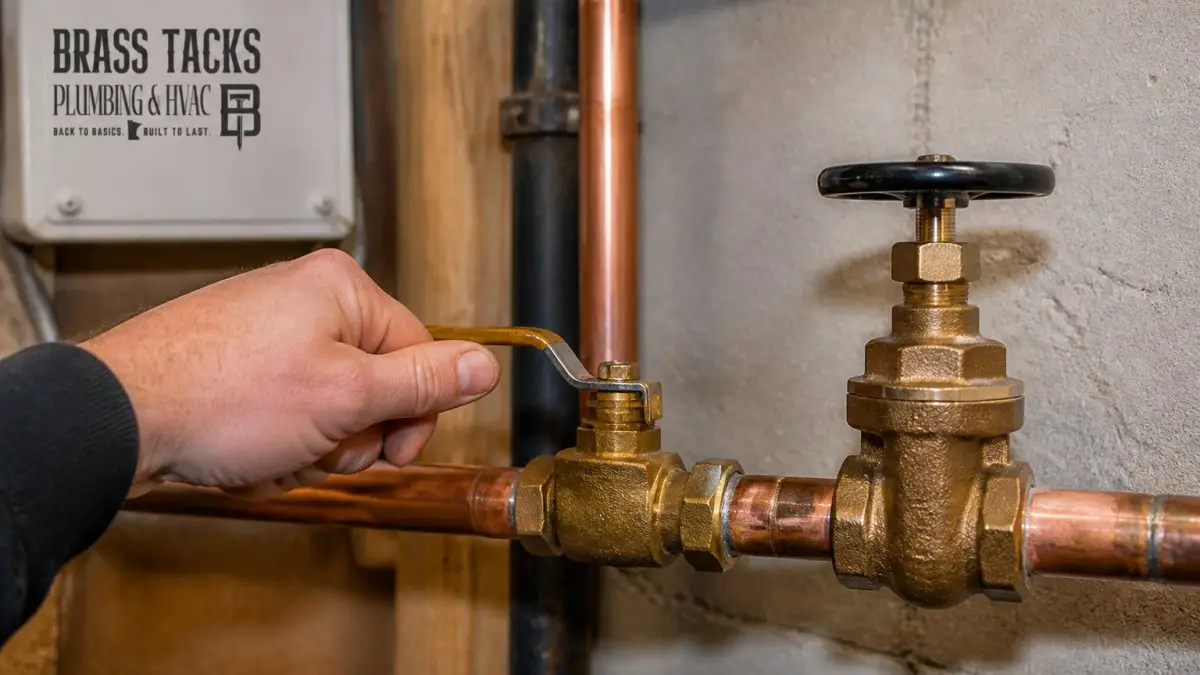
| Valve Type | How It Looks | How It Closes | Typical Location |
|---|---|---|---|
| Ball valve | Flat lever handle | Quarter turn | Indoor main, newer homes |
| Gate valve | Round wheel | Several turns clockwise | Indoor main, older homes |
| Curb stop | No handle, needs key | Several turns with key | Outdoor meter box |
Method 1: Turn Off a Lever-Handle Ball Valve
A lever-handle ball valve is the easiest main water valve to shut off. Push or pull the handle a quarter turn, or 90 degrees, until it stops. The water stops almost instantly.
Here is the sequence:
- Locate the lever on the main water supply line
- Grip the handle firmly with one hand
- Turn it a quarter turn so the handle sits perpendicular to the pipe
- Open a nearby faucet to confirm the flow has stopped
The handle position tells you the valve state. Parallel to the pipe means open. Perpendicular means closed. If the lever will not move, do not force it. Move to Method 4.
Method 2: Close a Round-Wheel Gate Valve
A round-wheel gate valve closes by turning the wheel clockwise until it stops. It takes several turns, and the water slows gradually rather than stopping at once. Older homes in Plymouth and Minnetonka often have this style.
Turn the wheel clockwise, the same direction as tightening a jar lid, until you feel it seat. Then open a faucet to check that the water flow has stopped.
Count the turns as you close a gate valve. If it takes twelve turns to shut off, opening it twelve turns brings you back to fully open. That prevents leaving the valve half-closed, which wears the gate and restricts your water pressure.
Method 3: Use a Water Meter Key at the Curb
When the indoor valve is missing, seized, or buried behind finished drywall, the curb stop at the meter box is your backup. A water meter key is a long metal rod with a forked or U-shaped end that reaches into the box and grips the valve.
Here is the sequence:
- Clear the lid before you lift it. Snow, ice, and lawn debris hide meter boxes, and prying a frozen lid can crack it.
- Lift the lid with a screwdriver or pry bar and set it well off to the side.
- Find the valve on the supply pipe. In cold climates the box sits below the frost line, so the valve is deeper than you expect.
- Fit the forked end of the key squarely over the valve so it seats on the ears, not the stem.
- Turn clockwise until the water stops. Curb stops are multi-turn valves, so expect several rotations.
- Replace the lid and test a faucet inside to confirm flow has stopped.
Do not stand over an open meter box while turning the key. If the key slips or the valve stem snaps, water can spray upward. Keep your face and body to the side, and wear gloves. If the box is full of water or ice, stop and call the utility rather than reaching in.
A few realities about curb stops:
- The valve may belong to the utility. In many systems the curb stop is the water utility’s property, and homeowners are not supposed to operate it except in an emergency. If it is stiff or damaged, call the utility first.
- Frozen boxes are a winter problem here. After a hard freeze, the lid may be sealed by ice and the valve may be stiff. Use warm (not boiling) water around the lid only, or wait for a thaw and call for help.
- The key must match the valve. Curb stops come in different sizes and shapes. A key that is too small will spin without gripping. Test the fit before you crank.
If the curb stop will not close, do not force it. A broken curb stop can send a continuous stream of water into the box and undermine the surrounding soil.
Method 4: Shut Off a Stuck Main Water Shut Off Valve Safely
A stuck main water shut off valve needs patience, not muscle. Apply steady pressure in the closing direction, and if it will not move, stop and call a licensed plumber. Forcing it risks a broken stem or a burst pipe behind the wall.
Try these steps first:
- Spray a penetrating lubricant on the stem and wait
- Grip the handle with a proper wrench, not pliers
- Apply slow, steady pressure rather than a sharp jerk
If the valve still will not close, do not keep cranking. A stuck valve on the main line is a plumbing repair, not a homeowner project.
A valve that will not turn is a warning sign, not a challenge. The safest move is to stop, shut off what you can at the fixture level, and call a plumber before the situation gets worse.
Method 5: Use Local Fixture Valves When the Main Valve Fails
When the main valve will not close, local shutoff valves buy you time. Every toilet, sink, and washing machine has its own supply valve. Closing the right one stops a leak without touching the main and keeps the rest of the house running while you wait for a plumber.
Where the fixture valves are and how they close:
- Toilet: oval or quarter-turn valve behind the bowl near the floor. Turn clockwise until it stops.
- Sink: two valves under the cabinet, one hot and one cold. Turn both clockwise.
- Washing machine: two valves in the wall box behind the unit. Turn both clockwise.
These valves stop water to one fixture, not the whole house. They are a stopgap, and they are worth testing twice a year so they actually turn when you need them.
Setups Where Fixture Valves Are Your Only Option
The main valve is not always reachable. Here is how to handle trickier setups:
- Wells and private supply. If your home runs on a well, the main shutoff is usually the pressure tank or the pump breaker, not a curb stop. Shut off the pump at the breaker panel first, then close the valve on the line leaving the pressure tank. If you are unsure which breaker controls the pump, label it now.
- Condos and shared supplies. In a condo or townhome, the main valve may be in a shared mechanical room or behind a locked access panel. Fixture valves and the building’s water shutoff (call the HOA or building manager) are your tools. Do not open shared walls to reach a valve.
- Shared or party-line supplies. Some older properties share a supply line. Shutting off the main can affect a neighbor. Use fixture valves and coordinate with the neighbor or utility before touching the main.
Label every fixture valve with a small tag or a piece of tape marked “water.” In an emergency, you do not want to guess which valve under the sink controls the hot line. Test each one twice a year by closing and reopening it while a faucet runs.
If a fixture valve is stuck or dripping, it is a small repair that is best handled before it fails. Our plumbing repair team replaces fixture valves, water heater shutoffs, and main valves across Plymouth, Wayzata, Minnetonka, Maple Grove, and the surrounding West Metro. If you are not sure which valve controls what, an onsite inspection is the fastest way to map your system before the next emergency.
How to Turn the Water Back On in Your House
Turning the water back on is the reverse of shutting it off, but do it slowly. Open the main valve partway, let the pipes fill, then open it fully.
After the water is back on:
- Open each faucet one at a time to push out trapped air
- Check under sinks and near the water heater for leaks
- Run the water heater through a normal cycle
If you shut the water off before a winter trip, ask a neighbor to check the house or leave the heat set above freezing. Frozen pipes cause more damage in this region than any other single plumbing failure.
When to Call a Plumber
Call a licensed plumber when the main valve will not close, when it leaks at the stem, or when you cannot find it at all.
Brass Tacks Plumbing, Heating & Cooling is family owned and serves homeowners across Plymouth, Wayzata, Minnetonka, Maple Grove, and the surrounding West Metro. Whether you need a valve replaced, a water heater repaired, or a frozen line thawed, we handle the diagnosis and the fix.
Frequently Asked Questions
How do I find the main water shutoff valve in my home?
Start where the water line enters the house, usually the basement, crawlspace, or utility room on the side facing the street. Look for a valve on the pipe just past the water meter. In warmer setups, check an outdoor wall near the foundation or a covered meter box at the curb. If you cannot find it, trace the pipe back from your water heater or follow the sound of running water.
What should I do if my main water shut off valve is stuck?
Do not force it. A stuck main water shut off valve can snap or strip if you lean on the handle. Apply steady pressure rather than jerking, and try a lever handle first since it needs only a quarter turn. If a round wheel will not budge after firm effort, stop and call a licensed plumber. Forcing an old valve can turn a small repair into a flooded basement.
Should I shut off the main water supply if a pipe is leaking?
Yes. If water is actively spraying or pooling, close the main water valve first, then open a low faucet to drain pressure from the lines. That stops the flow and limits damage before a plumber arrives. For a slow drip under a sink, the local fixture valve may be enough. For anything behind a wall or in the ceiling, shut the main and call for emergency plumbing help.
How do I turn the water back on in my house after shutting it off?
Open the main valve slowly, about a quarter turn at a time, and listen for rushing or knocking. Run cold water at the lowest faucet in the house to push air out, then check each fixture for leaks. Open the valve fully once the lines settle. In cold months, watch for any signs of a frozen or split pipe before restoring full pressure.
A stuck or leaking main valve is a problem that gets worse with time, and Minnesota cold makes it urgent. If your shutoff will not close or you are not sure which valve controls your water, call Brass Tacks Plumbing, Heating & Cooling. We offer honest recommendations, clear communication, and quality workmanship from licensed technicians who respect your home. Schedule service today and get your water supply back under control.
