
Water Softener Installation Near Me: What to Expect

Table of Contents
- Water Softener Installation Near You: How to Get Started
- Start With a Water Hardness Test
- Water Softener Sizing: Matching the System to Your Home
- The Water Softener Installation Process, Step by Step
- Can You Install a Water Softener in Winter?
- Water Softener Maintenance After Installation
- Repair, Replacement, or a New Water Softener Installation Near You
- Frequently Asked Questions
Last Updated: October 15, 2026
Water Softener Installation Near You: How to Get Started
If you are searching for water softener installation near me, start with this: a softener is not a one-size-fits-all appliance. Water softener installation fits a system that removes dissolved calcium and magnesium before water reaches your fixtures, appliances, and pipes. In the West Metro, where homes draw from wells or municipal supplies with varying mineral content, the process starts with testing, not shopping.
At Brass Tacks Plumbing, Heating & Cooling, we handle water softener work across Plymouth, Wayzata, Minnetonka, Maple Grove, and the surrounding communities, and one question comes up on almost every call: how do I know what I actually need?
The short answer: you need a water hardness test, a correctly sized system, and a licensed plumber who explains the plan before work begins. This guide walks through each step, including installation day and long-term care.
Skip the guesswork. Test your water first, then size the system to your household. Buying a softener before you know your hardness level is the most common and most expensive mistake we see.
Start With a Water Hardness Test
A water hardness test measures dissolved minerals in your water, usually reported in grains per gallon. That number decides whether you need a softener and how much capacity it requires.
You have two practical options for testing:
- At-home test strips give you a rough range in about a minute. Fine for a first look, but not precise enough to size a system.
- A professional water test measures hardness along with iron, manganese, and pH. Iron matters because it shortens the life of softener resin and changes which system we recommend.
Minnesota water varies widely. Municipal supplies often test at moderate hardness, while private wells in outlying parts of the West Metro can run considerably harder, sometimes with iron alongside it.
If you are not sure which you have, check a recent utility report or call us. We test as part of the installation assessment so the recommendation is based on your water, not a sales script.
Water Softener Sizing: Matching the System to Your Home
Water softener sizing comes down to two numbers: your water hardness and your household’s daily water use. Get them right and the system regenerates efficiently.
Here is the math in plain terms.
But the math is only the starting point. Three other factors change the recommendation more than most homeowners expect.
Hardness level. Water under about 3 grains per gallon is often soft enough that a softener is optional.
Iron and manganese. Dissolved iron shortens resin life and can foul a standard softener.
Peak flow. A system has to keep up with your busiest hour, not the average day.
| Household Size | Typical Daily Use | Sizing Consideration |
|---|---|---|
| 1-2 people | Lower volume | Smaller cabinet unit often works |
| 3-4 people | Moderate volume | Mid-size, single-tank system |
| 5+ people | Higher volume | Larger capacity or dual-tank setup |
| High iron in water | Varies | Iron-rated resin or pretreatment |
| High peak demand | Varies | Dual-tank for continuous soft water |
A dual-tank system runs two resin tanks in alternating cycles, so you get continuous soft water even while one tank regenerates. That matters in busy households and in homes where the water heater or boiler draws a steady flow.
Resin capacity is the other number worth understanding. Resin is measured in cubic feet, and each cubic foot holds a certain amount of hardness before regenerating.
Ask about your regeneration cycle settings before the installer leaves. A correctly sized unit should regenerate every few days, not nightly. If it runs every night, the system is either undersized or the hardness setting is wrong, and you will burn through salt for no reason.
If you are not sure which system fits your home, our water quality team can test your water and walk through the sizing math with you. The goal is a system that matches your actual water, not the biggest unit on the shelf.
The Water Softener Installation Process, Step by Step
The water softener installation process typically takes a few hours for a standard residential job, though older homes or well systems can take longer. Here is what to expect.
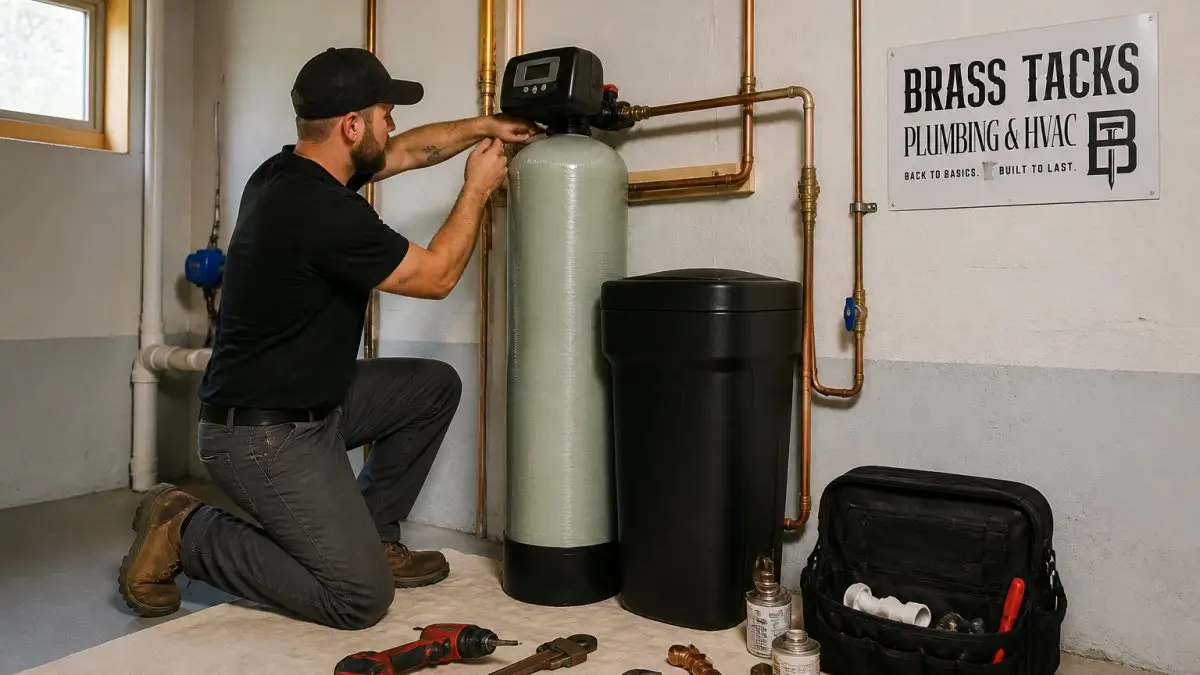
Where the Softener Goes
Most homes get a softener installed near the main water shutoff, usually in the basement, garage, or a utility closet. The unit needs a drain connection for regeneration discharge, a nearby power outlet, and clearance to load salt.
Placement matters more than people expect. Putting the softener before the water heater protects the heater and every fixture downstream. Installing it after an outdoor spigot means your garden hose still gets hard water, which is usually what you want. We map the plumbing layout during the assessment.
What Happens on Installation Day
Installation day follows a predictable sequence:
- Shut off the main water supply and drain the lines
- Cut into the main line and fit the bypass valve
- Set the softener in place and connect supply, drain, and overflow lines
- Program hardness, capacity, and regeneration settings
- Restore water and check every connection for leaks
- Run a manual regeneration and confirm the drain flows correctly
- Walk you through salt loading and basic settings
Expect some water shutoff during the job. We lay drop cloths, keep the work area contained, and clean up before we leave. If you have an older home with original plumbing, we flag anything that needs attention before cutting.
Can You Install a Water Softener in Winter?
Yes, a water softener can be installed in winter, and Minnesota homeowners do it every year. The work happens indoors, so cold weather itself is not a barrier.
The real winter concern is freezing. Any exposed line, drain, or discharge hose through an unheated space can freeze and crack. We insulate and route lines to avoid that, and we check that the drain discharge does not create ice where it exits. If your softener lives in a cold garage or crawl space, tell us during the assessment.
One more cold-weather note: if your pipes have already frozen this season, deal with that first. A softener installed on a compromised plumbing system just adds a new failure point. Our plumbing services team can look at both in one visit.
Water Softener Maintenance After Installation
Water softener maintenance is simple, but skipping it is the fastest way to shorten the life of a good system. Most of the work is on you, and it takes minutes per month.
- Check salt monthly and refill before the tank runs empty. Never let it go dry, since the resin needs brine to regenerate.
- Break up salt bridges if the level looks fine but the water tastes hard. A bridge forms a crust that blocks brine from reaching the water.
- Clean the brine tank once a year to remove sediment and buildup.
- Test your water annually to confirm the system is still keeping up.
- Watch for changes in water feel, pressure, or salt use. Any of those can signal a problem early.
Hard water leaves scale buildup inside your water heater, dishwasher, and washing machine. Keeping the softener working protects those appliances and your plumbing system at the same time. If your water heater is already struggling, our water heater repair team can check whether scale is the cause.
Never pour a full bag of salt into a brine tank that is already full. Overfilling causes bridging and can compact the salt into a solid block that has to be chipped out by hand.
Repair, Replacement, or a New Water Softener Installation Near You
Not every hard water problem needs a new system. Sometimes a repair keeps a good unit running for years. Here is how to tell the difference.
Repair makes sense when the unit is relatively young, the issue is mechanical, and parts are still available. Common repairs include a failed control valve, a bad motor, a clogged injector, or a loose brine line. Our water softener repair service covers them.
Replacement makes sense when the resin has worn out, the tank is cracked, or the unit is old enough that repair costs approach replacement. Resin does not last forever, and once it degrades, no amount of salt brings the softness back.
A new installation makes sense when you have never had a softener, your household has grown, or you are moving from a small unit to one sized for your actual water use. If you are weighing a replacement, our water softener installation page walks through the options.
A Simple Troubleshooting Checklist
Before you call for service, a few quick checks can tell you whether the problem is the system or something simpler.
- No soft water, salt level is fine. Check for a salt bridge. A crust can form on top of the salt and block brine from reaching the water, even though the tank looks full. Break it up with a broom handle or similar tool.
- Water feels hard between regenerations. The hardness setting may be too low, or the system may be undersized. Recheck your test result against the programmed number.
- Salt use has spiked. A stuck control valve, a wrong regeneration schedule, or a failing seal can all cause the unit to run more often than it should.
- Water pressure dropped after installation. A partially closed bypass valve or a clogged inlet screen is a common cause.
- Resin in your plumbing or fixtures. This usually means a broken distributor or a failing tank and needs professional attention.
Maintenance That Prevents Most Repairs
Water softener maintenance is simple, but skipping it is the fastest way to shorten the life of a good system. Most of the work is on you, and it takes minutes per month.
- Check salt monthly and refill before the tank runs empty. Never let it go dry, since the resin needs brine to regenerate.
- Break up salt bridges if the level looks fine but the water tastes hard.
- Clean the brine tank once a year to remove sediment and buildup.
- Test your water annually to confirm the system is still keeping up.
- Watch for changes in water feel, pressure, or salt use. Any of those can signal a problem early.
Hard water leaves scale buildup inside your water heater, dishwasher, and washing machine. Keeping the softener working protects those appliances and your plumbing system at the same time. If your water heater is already struggling, our water heater repair team can check whether scale is the cause.
We also carry filtration and conditioning systems for homes that need more than softening alone. For homes dealing with both hard water and other water quality issues, our water quality team can recommend a combination that addresses the source.
Frequently Asked Questions
How long does water softener installation take?
Most residential installations are finished in a few hours, depending on how accessible your water main and drain are and whether any plumbing needs to be adjusted. A straightforward swap of an existing softener usually moves faster than a first-time install in an older home. Your installer can give you a realistic time window after the installation assessment, so you can plan your day around it.
How do I know what size water softener my home needs?
Sizing starts with a water hardness test and a look at your household water use. Your installer checks how many people live in the home, how many bathrooms you have, and your daily water habits, then matches that to a system with the right grain capacity. A softener that is too small will struggle to keep up, while one that is oversized costs more than you need to spend.
How often should a water softener be serviced?
Plan on a professional check once a year and keep an eye on salt levels in between. During a service visit, a technician inspects the regeneration cycle, checks the flow rate, and looks for leaks or worn parts. If you notice hard water returning, salty-tasting water, or the unit running constantly, call for water softener repair before the problem affects your plumbing and appliances.
Can a water softener be installed during a Minnesota winter?
Yes. Installation happens indoors, so cold weather is not a barrier. The bigger winter concern is protecting the softener and its drain line from freezing, especially if the unit sits near a cold exterior wall or in an unheated space. Your installer can point out freeze risks during the installation assessment and recommend ways to keep the system and your water supply protected through the season.
