Is Hydro Jetting Safe for Old Pipes? A Homeowner’s Guide

Table of Contents
- Is Hydro Jetting Safe for Old Pipes? The Short Answer
- How Hydro Jetting Works and What High-Pressure Water Does Inside a Drain Line
- The Sewer Camera Inspection Before Hydro Jetting: Why It Comes First
- Pipe Material and Condition: Where Hydro Jetting Is Safe and Where It Is Not
- Signs of Damaged Sewer Pipes That Rule Out Hydro Jetting
- Hydro Jetting vs. Drain Snaking: Which One Fits Your Clog and Your Pipes?
- What to Expect During and After Hydro Jetting Service
- Conclusion: Matching the Method to the Pipe, Not the Clog
- Frequently Asked Questions
Last Updated: October 14, 2026
Is Hydro Jetting Safe for Old Pipes? The Short Answer
Hydro jetting is safe for old pipes when a camera inspection confirms the pipe walls, joints, and material can handle the pressure.
A clogged drain in a 1950s Minnetonka rambler and one in a newer Maple Grove build are two different jobs.
Below, we cover how hydro jetting works, what a camera inspection reveals, which pipe materials are risky, and when to choose something else.
How Hydro Jetting Works and What High-Pressure Water Does Inside a Drain Line
Hydro jetting uses high-pressure water pushed through a special hose and nozzle to scour the inside of a drain line.
Think of the difference between poking a hole in a clog and washing the pipe wall clean. A snake does the first.
The pressure is adjustable. A skilled plumber matches it to the pipe, not to the clog.
Ask what pressure setting will be used and why. A plumber who can explain the reasoning is reading your pipe, not just running a machine.
The Sewer Camera Inspection Before Hydro Jetting: Why It Comes First
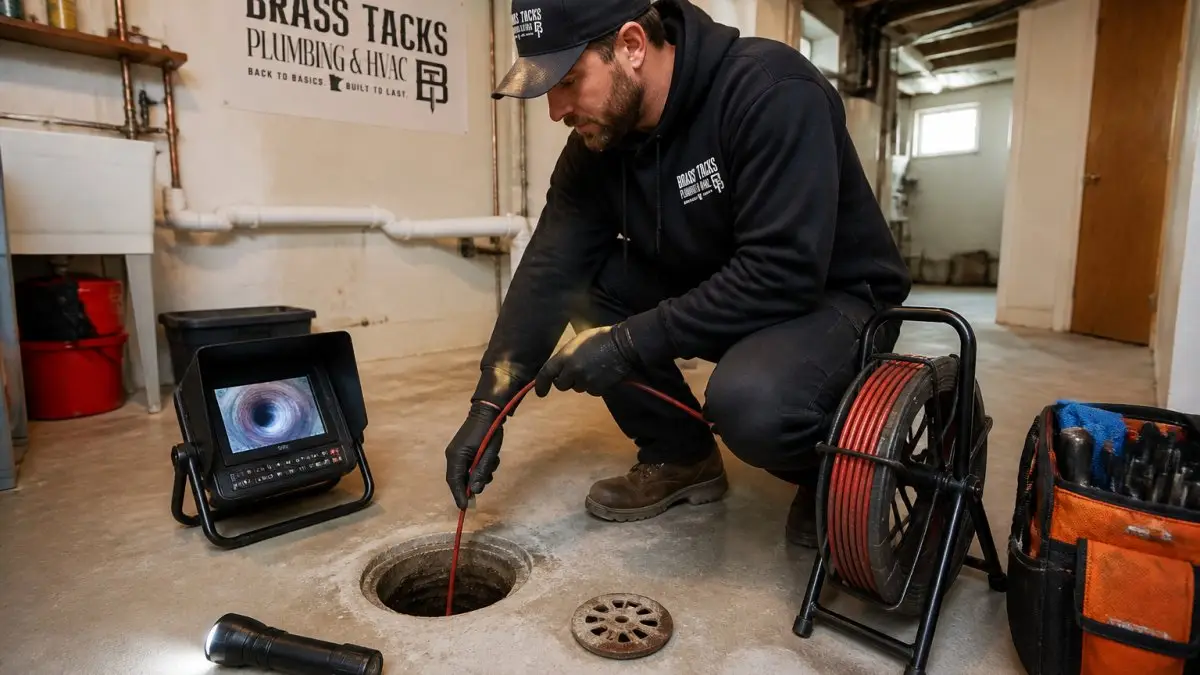
A sewer camera inspection before hydro jetting separates a safe job from a gamble. The camera shows the pipe’s true condition from the inside, so we know whether the line can take the pressure before any water flows.
What a Camera Reveals That a Snake Cannot
A drain snake only tells you whether it got through. A camera tells you why the line clogged and what shape it is in.
Here is what the camera shows:
- Pipe material all the way through the run
- Cracks and fractures in the pipe wall
- Corrosion and scale buildup narrowing the line
Pipe Material and Condition: Where Hydro Jetting Is Safe and Where It Is Not
Pipe material and condition decide whether hydro jetting is safe. Two pipes of the same age and material can still get opposite answers, because what matters is wall thickness, joint integrity, and whether the line has shifted or sagged. Age alone tells you almost nothing.
| Pipe Condition | Hydro Jetting Fit | Why |
|---|---|---|
| Newer PVC or ABS in good shape | Usually safe | Strong walls, solvent-welded joints, smooth interior |
| Cast iron with light scale | Often safe with care | Pressure must be adjusted; walls still have thickness |
| Cast iron with heavy corrosion | Risky | Walls are thin, pitted, and can fail under pressure |
| Clay tile with intact joints | Sometimes safe | Joints are the weak point; reduced pressure only |
| Clay tile with cracks or roots | Usually not safe | Pressure can shatter tiles or push joints apart |
| Orangeburg or bituminous fiber | Not safe | These lines crush and deform under almost any load |
| Any pipe with known cracks or offsets | Not safe | Risk of full failure and a much larger repair |
How to Read the Table for Your Own Home
The table is a starting point, not a verdict. A few rules of thumb help:
- Material sets the ceiling. PVC and ABS tolerate higher pressure than cast iron, clay, or Orangeburg. A plumber should never run the same setting on all four.
- Condition sets the floor. A sound cast iron line can often be jetted. A corroded one cannot, even at low pressure.
- Joints fail first. Clay tile, in particular, gives way at the joints long before the tile itself cracks. Root intrusion almost always starts there.
Cast Iron Pipe Considerations
Cast iron pipe considerations matter because so many West Metro homes still have it. Older cast iron drains corrode from the inside out over decades, so the pipe can look fine outside while the walls have thinned to almost nothing.
A few patterns are worth knowing:
- Light surface scale is normal and usually jetting-safe at moderate pressure.
- Heavy tuberculation (the lumpy rust nodules inside the pipe) narrows the line and signals wall loss. Jetting may clear it, but the pressure has to come down.
- Pitting and pinholes mean the wall is already compromised. Jetting can turn a pinhole into a full breach.
Jetting a sound cast iron line with light scale is usually fine. Jetting one that is corroded through can blow a hole in the wall. The camera tells us which one you have.
Hydro Jetting Clay Pipes: What Changes
Hydro jetting clay pipes calls for extra caution because clay tile is brittle and the joints are the weak spots.
Clay lines in good condition can often be jetted at reduced pressure. Cracked or shifted clay usually needs a different approach. In many older West Metro neighborhoods, clay laterals have also settled over the decades, creating low spots that hold water and debris.
What About Orangeburg and Other Legacy Materials?
Some homes built in the mid-twentieth century still have Orangeburg sewer pipe, a tar-paper and pitch fiber material that was never meant to last this long. It deforms, flattens, and collapses under its own weight, so hydro jetting is not safe for Orangeburg at any pressure setting. If a camera shows Orangeburg, the conversation shifts to repair or replacement, not cleaning.
When Condition, Not Material, Is the Deciding Factor
A pipe can be the right material and still be the wrong candidate. These conditions rule out jetting even on PVC or sound cast iron:
- Active leaks at a joint or fitting
- Visible cracks or holes on camera
- Major offsets where two sections no longer line up
If any of these show up, the right next step is usually a targeted repair or a section replacement, then a cleaning once the line is sound again.
Running high pressure through a cracked clay or thin cast iron line can turn a clog into a collapsed pipe. That is a repair bill instead of a cleaning bill.
Signs of Damaged Sewer Pipes That Rule Out Hydro Jetting
Signs of damaged sewer pipes should stop the job before it starts. If any of these show up, we do not jet the line.
Watch for:
- Repeated clogs in the same spot
- Slow drains throughout the house
- Sewage smells in the basement
Any of these can point to cracked, offset, or root-filled pipe. Jetting a line in that shape can make things worse. A camera confirms what is going on before we choose a method.
Hydro Jetting vs. Drain Snaking: Which One Fits Your Clog and Your Pipes?
Hydro jetting vs. drain snaking comes down to what is in the pipe and what the pipe can handle. Snaking is the safer choice for fragile lines. Jetting is the better choice for sound lines with heavy buildup.
Here is the difference:
- Snaking cuts a path through the clog. It clears the blockage but leaves buildup on the walls.
- Jetting scours the full inside of the pipe. It removes the clog and the gunk feeding it.
For a weak or damaged pipe, snaking is the lower-risk option. For a solid pipe with grease or roots, jetting cleans more thoroughly and lasts longer.
Match the method to the pipe, not just the clog. A safe cleaning on a fragile line beats a thorough one that causes damage.
What to Expect During and After Hydro Jetting Service
Knowing what a normal hydro jetting visit looks like helps you tell a job done right from one that skipped steps. Here is the sequence, start to finish.
Before the Water Flows
- Access point confirmed. Most homes are jetted through a basement floor cleanout, an exterior cleanout, or a roof vent. The plumber should tell you which one and why.
- Camera inspection first. No jetting without a look inside. If a plumber wants to skip this, that is your cue to ask why.
- Pressure setting chosen and explained. The setting should match the pipe material and condition, not the size of the clog.
During the Cleaning
The actual jetting is often the shortest part of the visit. The hose feeds into the line, the nozzle pulls itself forward, and water scours the walls on the way back.
What is not normal: water backing up at the cleanout, sudden loss of pressure, or the plumber stopping abruptly. Any of those can mean the line gave way, and the job should pause for another camera look.
Debris and Cleanup
Hydro jetting flushes the clog and buildup down the line to the city main, so there is usually no debris to haul out, just water, sometimes a fair amount at the cleanout. A careful crew lays down protection, wipes up, and leaves the area as they found it. If your basement floor drain or laundry sink backs up during the job, the line downstream is still restricted and needs another pass.
After the Job: What to Check
Once the equipment is packed up, a few things should happen before the plumber leaves:
- A camera recheck to confirm the line is clean and no new damage appeared.
- A flow test at the fixtures tied to that line, so you can see water moving freely.
- A straight answer about anything the camera found, including anything that will need attention later.
Warning Signs in the Days After Service
Most hydro jetting jobs are uneventful. If something is wrong, it usually shows up quickly. Call your plumber back if you notice:
- New moisture or damp spots near the cleanout or along the basement floor
- Sewage odor that was not there before
- A slow drain that returns within a few days
Any of these can point to a joint that let go or a section weaker than the camera suggested. The sooner it is looked at, the smaller the fix tends to be.
If the Camera Finds Something Jetting Cannot Fix
Sometimes the inspection turns up a problem cleaning will not solve: a collapsed section, a major offset, or a root mass that has deformed the pipe.
If your home also has water quality issues, like hard water scaling up fixtures and appliances, that is a separate conversation we are glad to have, and it is one our water softener repair and water softener replacement services cover.
Ask for the camera recheck before the plumber leaves. A clean line on camera is the best proof the job was done right.
Conclusion: Matching the Method to the Pipe, Not the Clog
The real question is not whether hydro jetting is safe in general, but whether it is safe for your pipe right now, in its current condition. That answer comes from a camera, not a guess.
At Brass Tacks Plumbing, Heating & Cooling, we inspect first, explain what we find, and recommend the method that fits your line.
Frequently Asked Questions
Can hydro jetting damage old pipes?
It can, but the damage almost always traces back to skipping the inspection. Hydro jetting uses high-pressure water to scour the inside of a drain line, and a pipe that is already cracked, corroded, or held together by scale can fail under that force. A pipe in reasonable condition usually handles it fine. That is why a camera inspection and a pressure setting matched to the pipe material come before any jetting, not after.
Should old pipes be inspected before hydro jetting?
Yes. A sewer camera inspection before hydro jetting shows the pipe material, the location and size of the blockage, and any cracks, joint separation, or root intrusion along the run. Without that footage, a plumber is guessing at what the line can handle. The inspection also confirms the cleanout is usable and that the jetting hose can reach the clog without forcing its way through a damaged section.
Is hydro jetting safe for clay sewer pipes?
Clay pipe is the material that demands the most caution. Clay is brittle, and older clay runs often have offset joints, hairline cracks, or roots that have widened gaps over decades. Hydro jetting clay pipes is sometimes workable at reduced pressure when the camera shows the pipe is otherwise sound. If the footage shows crumbling sections or heavy root intrusion, mechanical snaking, spot repair, or replacement is the safer path. The camera decides, not the age of the house.
What are the alternatives to hydro jetting for an aging drain line?
Mechanical snaking is the most common alternative. It breaks up or pulls out a clog with a cable and auger, and it puts less stress on fragile pipe walls. For recurring root problems, a plumber may recommend cutting the roots, spot repairs at the damaged section, or pipe replacement if the line is failing along most of its length. In some cases, preventive maintenance on a schedule keeps a marginal line flowing without ever exposing it to high pressure.
