

Emergency Furnace Repair in Plymouth, MN: What to Do

Table of Contents
- When Is a Furnace Problem an Emergency?
- What to Do First: A DIY Troubleshooting Checklist
- Signs of a Failing Furnace You Should Not Ignore
- What Emergency Furnace Repair in Plymouth, MN Involves
- Furnace Repair vs Replacement: How to Decide
- Why Minnesota Winters Make Fast Response Critical
- How to Prevent Future Furnace Emergencies
- Frequently Asked Questions
Last Updated: September 9, 2026
When Is a Furnace Problem an Emergency?
A furnace emergency is any failure that leaves your home without heat when outdoor temperatures put your family or your plumbing at risk. When the temperature drops below freezing, an inoperable furnace threatens your pipes and your family’s safety. Emergency furnace repair in Plymouth, MN becomes necessary when you have no heat, smell gas, or see signs of a carbon monoxide issue.
At Brass Tacks Plumbing, Heating & Cooling, we understand the urgency of a heating failure in a Minnesota winter. The distinction between a routine repair and an emergency often comes down to the outdoor temperature, the age and condition of your system, and whether vulnerable family members are in the home. If temperatures are forecast to drop below freezing and your heat is out, do not wait until morning to call for help.
What to Do First: A DIY Troubleshooting Checklist
Before you call for emergency furnace repair, work through a few simple checks that might restore heat or help you describe the problem to a technician.
- Check the thermostat: Confirm it is set to “Heat” and the temperature is set higher than the current room temperature. Replace batteries if the display is blank.
- Inspect the circuit breaker: Look for a tripped breaker labeled for the furnace or air handler. Reset it once. If it trips again, call a professional.
- Check the furnace switch: Ensure the power switch on or near the unit is in the “On” position. It looks like a regular light switch.
- Verify the gas valve is open: The shut-off valve near the furnace should be parallel with the gas line. If it is perpendicular, the gas is off.
- Replace or clean the air filter: A severely clogged filter can cause the system to overheat and shut down on its safety limit switch.
If these checks do not restore heat, the issue likely requires professional diagnostics. Write down what you observed, including any error codes on the thermostat display, so you can share that information with your technician.
Signs of a Failing Furnace You Should Not Ignore
A failing furnace rarely stops working without warning. Most systems display subtle signs for weeks or months before a complete breakdown.
Common warning signs include unusual noises like banging, rattling, or squealing from the furnace cabinet, which often point to issues with the blower motor, igniter, or other internal components. Uneven heating, rooms that never reach the set temperature, and a furnace that runs constantly without cycling off are all red flags. A yellow pilot light or burner flame, rather than a crisp blue flame, can indicate incomplete combustion.
Strange odors, particularly a metallic or burning smell when the heat kicks on, warrant immediate attention. While a brief burning odor is normal at the start of the season as dust burns off the heat exchanger, a persistent or acrid smell is not.
What Emergency Furnace Repair in Plymouth, MN Involves
When you call for emergency furnace repair in Plymouth, MN, a licensed technician will arrive at your home in a fully equipped service vehicle. The process begins with a thorough inspection to identify the root cause of the failure, not just the symptom.
The technician will explain what is wrong in plain language before any work begins. You should receive a clear diagnosis, an explanation of your options, and an upfront price for the repair. A reputable company will not pressure you into a decision while your family is cold, but will present honest recommendations that include both the immediate repair and the long-term outlook for your system.
A professional HVAC technician in a dark navy uniform kneeling beside an open furnace panel in a well-lit basement, holding a multimeter and a small flashlight, inspecting the burner assembly
Most emergency repairs fall into a few categories: ignition failures, blower motor failures, thermostat malfunctions, and safety switch trips. Repair time varies based on the complexity of the issue and the availability of parts. Some repairs are completed in under an hour, while others may require ordering a component that takes a day or two to arrive.
What drives the cost of an emergency call?
Homeowners are often anxious about the cost of an emergency repair, and for good reason. Unlike a scheduled appointment, an emergency call involves a technician being dispatched immediately, often outside of normal business hours.
- The service call fee. This is a flat fee that covers the technician’s time to travel to your home and perform the initial diagnostic. This fee is standard across the industry and is charged regardless of whether you approve the repair.
- Overtime or after-hours rates. Many companies charge a premium for calls that come in during evenings, weekends, or holidays. This premium reflects the higher cost of keeping a technician on call. Always ask about this rate when you call so there are no surprises.
- The cost of parts. The price of the replacement component itself varies widely. A simple flame sensor is an inexpensive part, while a new blower motor or control board is significantly more costly. The technician should provide you with the price of the part before installing it.
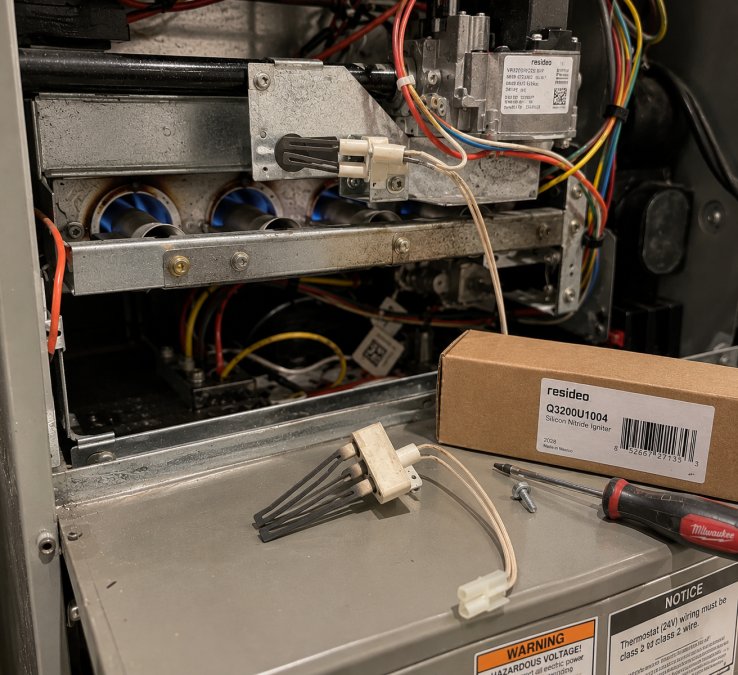
- The complexity of the labor. Some repairs, like replacing an igniter, are straightforward. Others, like accessing a heat exchanger or replacing a blower motor, require more time and skill, which is reflected in the labor charge.
Furnace Repair vs Replacement: How to Decide
The furnace repair vs replacement decision is one of the most stressful calls a homeowner faces, especially at 10 p.m. on a Sunday in January.
A good rule of thumb is the age of your system. Most furnaces have a service life of 15 to 20 years with regular maintenance. If your furnace is under 10 years old, a repair is almost always the right financial call. If your system is older than 15 years and the repair estimate is significant, replacement deserves serious consideration. Repeated breakdowns, rising energy bills, and a repair cost approaching half the price of a new system all point toward replacement.
|
Factor |
Repair Makes Sense |
Replacement Makes Sense |
|---|---|---|
|
Furnace age |
Under 10 years |
Over 15 years |
|
Repair frequency |
First or second call |
Third or more in two years |
|
Repair cost |
Small fraction of new unit |
Approaching half of new unit |
|
Energy bills |
Stable or normal |
Noticeably rising |
|
Home plans |
Staying 1-3 years |
Staying 5+ years |
Why Minnesota Winters Make Fast Response Critical
Minnesota winters are not forgiving to a home without heat. When outdoor temperatures hover near zero or drop below, the interior of an unheated home can fall below freezing within hours, especially in rooms with exterior walls and little insulation. As water in your pipes freezes, it expands, and the resulting pressure can crack pipes, leading to flooding when the ice thaws.
While you wait for a technician, your priority is to keep the indoor temperature above freezing, ideally above 55 degrees, to protect your plumbing.
Immediate steps to protect your home:
- Turn off the water supply. If your home will be without heat for an extended period, locate the main water shut-off valve, typically in the basement or utility room, and turn it off. This stops the flow of water to your pipes, so if a freeze does occur, the damage is contained to the water already in the lines.
- Drain the faucets. After shutting off the main valve, open all faucets, both hot and cold, to drain the water from the pipes. Flush toilets to empty the tanks and bowls. This removes the water that could freeze and expand.
- Open cabinet doors. In kitchens and bathrooms, open the cabinet doors under sinks to allow warmer indoor air to circulate around the pipes, which are often located on exterior walls.
- Use space heaters safely. Space heaters can supplement the heat from your furnace, but they must be used with extreme caution. Keep them at least three feet away from anything flammable, plug them directly into a wall outlet rather than an extension cord, and never leave them unattended or running while you sleep.
- Drip the faucets. If you cannot shut off the main water valve, let a thin stream of cold water drip from the faucet farthest from where the water enters your home. Moving water is much less likely to freeze.
Keeping your family comfortable:
- Dress in layers. Wearing thermal underwear, sweaters, and wool socks helps your body retain heat more effectively than turning up a space heater.
- Close off unused rooms. Shut the doors to rooms you are not using to contain the heat in the main living areas. Place a rolled-up towel at the base of the doors to block drafts.
- Use sunlight to your advantage. Open the curtains on south-facing windows during the day to let in solar heat, and close them at night to provide an extra layer of insulation.
- Keep the garage door closed. If your furnace is in the garage, or if you have water lines running through it, keep the garage door closed as much as possible to block the cold wind.
How to Prevent Future Furnace Emergencies
Preventative maintenance is the single most effective way to avoid an emergency furnace repair. An annual tune-up, ideally in the early fall before the heating season begins, allows a technician to catch small issues before they become system failures.
Between professional visits, replace or clean the air filter every one to three months, depending on filter type and household conditions. Keep the area around the furnace clear of clutter and flammable materials. Ensure snow does not block the exterior exhaust and intake vents during winter storms.
A furnace emergency in a Minnesota winter is stressful, but you do not have to face it alone. Brass Tacks Plumbing, Heating & Cooling provides emergency furnace repair to homeowners across Plymouth and the West Metro, backed by licensed technicians who respect your home and explain what is wrong before they start work. We offer upfront pricing and honest recommendations without sales pressure, so you can make the right decision for your family and your budget.
Frequently Asked Questions
What should I check before calling for emergency furnace repair?
Before you call, try these quick checks: make sure your thermostat is set to heat and the temperature is above the current room temperature. Check your circuit breaker and reset a tripped breaker if needed. Verify the furnace power switch looks like a light switch on or near the unit and is in the on position. If you have a gas furnace, check that the gas shutoff valve is open. If none of these solve the problem, call a licensed technician.
How quickly can a technician arrive for emergency heating service in Plymouth?
Many local companies in the West Metro, including Brass Tacks, prioritize emergency calls to restore heat quickly, especially during Minnesota winters. Response time depends on the time of day and current call volume. It is best to call for an estimated arrival window. When you call, ask about their current dispatch schedule so you know what to expect.
What are the signs that a furnace needs immediate professional attention?
Call for emergency furnace repair if you smell gas, hear banging or screeching noises, see flames that are yellow or flickering, or if your carbon monoxide detector goes off. A complete loss of heat when temperatures drop below freezing is also an emergency. These issues can indicate a safety hazard or a system that is about to fail completely.
How does upfront pricing work for emergency furnace repair?
Upfront pricing means the technician provides the cost of the repair before any work begins, so you are not surprised by the final bill. For example, a technician will diagnose the issue, explain the needed repair, and give you the price to fix it. You approve the work before it starts. This approach builds trust and is a standard practice for companies focused on honest service.
